
What Does a Software Developer Do?
A software developer writes and maintains the code that powers applications, websites, and systems. Depending on specialisation, the work can involve front-end development (what users see and interact with), back-end development (servers, databases, and business logic), or full-stack development (both). Developers also test their code, fix bugs, collaborate with designers and product managers, and continuously update software as requirements change
Software Developer Eligibility 2026
There is no single, mandatory qualification to become a software developer in India. Most professionals follow one of two broad routes.
Route 1: Formal Computer Science Education
| Course | Duration | Eligibility |
| BTech / BE in
Computer Science or IT |
4 years | Class 12 with Physics, Chemistry, and Mathematics;
admission via JEE Main or state engineering entrance exams |
| BCA (Bachelor of
|
3 years | Class 12 in any stream, usually with Mathematics;
admission through merit or university entrance test |
| BSc Computer Science | 3 years | Class 12 with Mathematics/Science; admission through merit or entrance exam, depending on the university |
| MCA (Master of
Computer Applications) |
2 years | Bachelor’s degree with Mathematics as a subject at Class 12 or graduation level |

Route 2: Non-CS Degree or Self-Taught Path
Candidates from commerce, arts, or any other academic background can also become software developers by building core programming skills independently. This typically involves:
1. Learning a programming language (Python, Java, or JavaScript) through a structured online course or coding bootcamps

3. Practising data structures and algorithms (DSA) on platforms used for technical interview preparation
4. Completing internships to gain real-world development experience
Companies, especially product-based firms and start-ups, increasingly evaluate candidates on coding tests and project portfolios rather than academic background alone, though a recognised degree still helps with initial shortlisting at larger IT services firms.
Also Read – Buddy4Study Career Assessment Test
Skills Required to Become a Software Developer
| Skill Category | Examples |
| Programming language | Python, Java, JavaScript, C++ |
| Web development | HTML, CSS, front-end frameworks (React, Angular), back-end frameworks |
| Data structures & algorithms | Arrays, trees, graphs, sorting, searching, time complexity |
| Databases | SQL, MySQL, PostgreSQL, MongoDB |
| Version control & collaboration | Git, GitHub |
| Cloud fundamentals | Basics ofAWS, Microsoft Azure, or Google Cloud |
| Soft skills | Problem-solving, communication, teamwork, adaptability to new tools |
Step-by-Step: How to Become a Software Developer?
Step 1 – Choose an education path: BTech/BCA/BSc CS, or a self-taught/bootcamp route if from a non-CS background.
Step 2 – Learn one programming language thoroughly (Python, Java, or JavaScript) before
spreading across multiple stacks.
Step 3 – Build a strong foundation in data structures and algorithms, since most technical interviews are DSA-heavy.
Step 4 – Learn web fundamentals (HTML, CSS, JavaScript) and pick a specialisation: front-end,
back-end, or full-stack.
Step 5 – Build 3-5 personal or open-source projects that showcase practical, end-to-end
development ability.
Step 6 – Learn Git and collaborate on shared codebases to build workplace-ready habits.
Step 7 – Apply for internships or entry-level roles; use coding platforms to prepare for technical
interviews.
Step 8 – Pick up a relevant certification (cloud, DevOps, or a specific language) to strengthen your profile.
Step 9 – Clear technical rounds (coding tests, system design basics) and a behavioural/HR round to secure a role.
Step 10 – Continue upskilling after landing your first job – cloud, AI integration, and system design .pay off over time.
Important Note: With focused, consistent effort, most career-switchers and fresh graduates take roughly 6-12 months to become interview-ready for entry-level developer roles, provided they combine structured learning with real projects rather than tutorials alone.
Also Read – How to Become a Chef in India
Top Courses and Certifications for Software Developers in India 2026
| Certification | Provider | Best For |
| AWS Certified Developer –
Associate |
Amazon Web Services | Developers building and deploying cloud-based applications |
| AWS Certified Cloud Practitioner | Amazon Web Services | Beginners looking for an entry point into cloud computing |
| Google IT Automation with Python | Google (via Coursera) | Beginners with no prior coding
background |
| Microsoft Certified: Azure Developer Associate | Microsoft | Developers working in Azure cloud environments |
| Oracle Certified Professional, Java SE Programmer | Oracle | Developers specialising in Java-based enterprise applications |
Certifications strengthen a resume but rarely substitute for hands-on project experience; recruiters generally weigh a working GitHub portfolio and problem-solving ability more heavily than certificates alone.
Software Developer Salary in India 2026
Software developer pay in India varies significantly by company type, city, and specialisation. The figures below reflect indicative industry ranges compiled from multiple 2026 salary reports and should be treated as broad estimates rather than fixed numbers.
Software Developer Salary by Experience Level
| Experience Level | Approximate Annual Salary
(CTC) |
Typical Roles |
| Fresher (0-1 year) | ₹3-8 LPA | Junior Developer, Trainee Software Engineer |
| Early career (1-3 years) | ₹6-12 LPA | Software Developer, Associate
Engineer |
| Mid-level (3-5 years) | ₹10-20 LPA | Senior Developer, Team Lead |
| Senior (5+ years) | ₹20-40 LPA and above | Tech Lead, Engineering Manager,
Architect |
Software Developer Salary by Company Type
| Company Type | Fresher Salary
Range |
Notes |
| IT services firms (TCS, Infosys,
Wipro, Cognizant) |
₹3-7 LPA | Larger hiring volume; stable but slower growth |
| Product-based companies and startups | ₹6-15 LPA | Pay a premium for strong DSA and project skills |
| Global Capability Centres (GCCs) of MNCs | ₹8-18 LPA | Growing hiring category in India; strong benefits |
| FAANG/top-tier product companies | ₹15 LPA and above | Highly competitive; multiple rigorous interview rounds |
Bengaluru, Hyderabad, and Pune generally offer the highest packages due to the concentration of product companies and start-ups, though remote roles have started narrowing the gap for developers based in smaller cities.
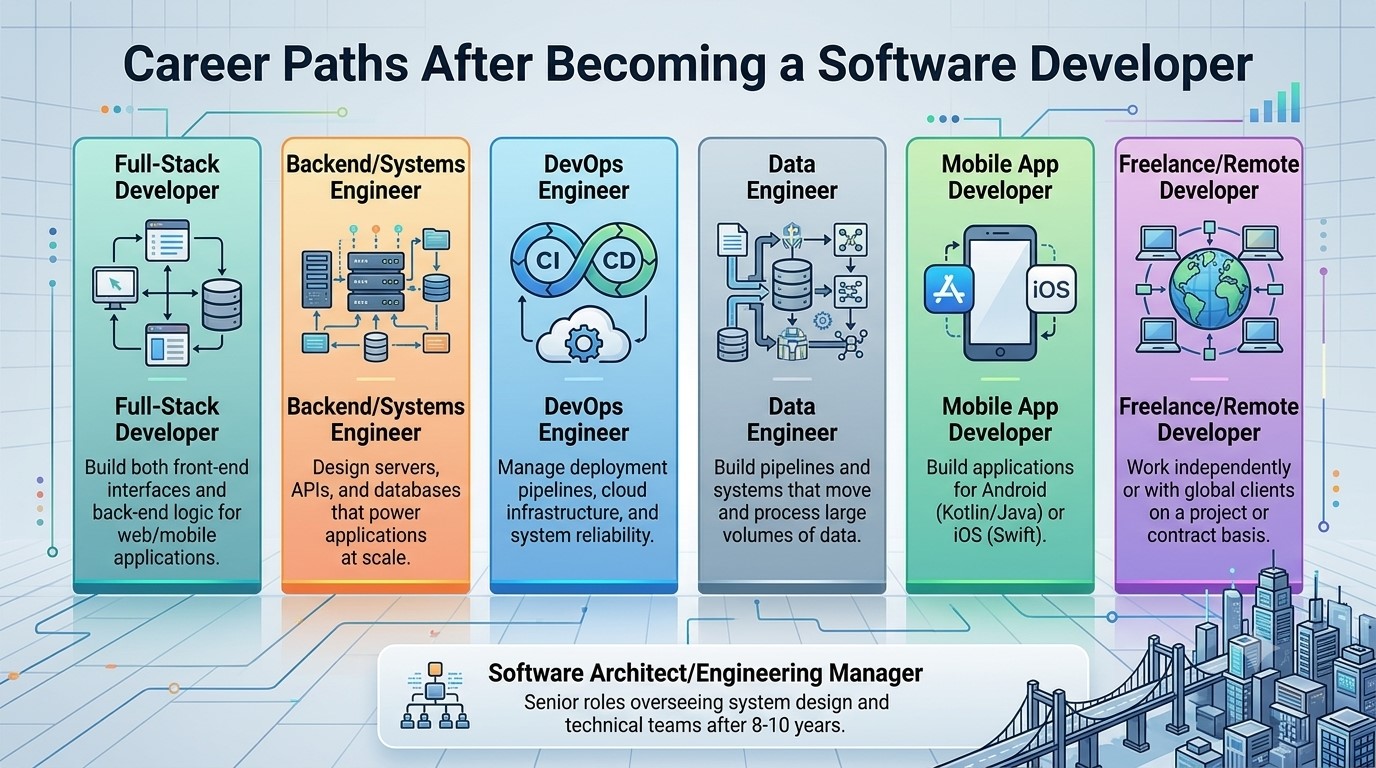
Career Paths After Becoming a Software Developer
| Career Path | What you do |
| Full-Stack Developer | Build both front-end interfaces and back-end logic for web/mobile applications |
| Backend/Systems Engineer | Design servers, APIs, and databases that power applications at scale |
| DevOps Engineer | Manage deployment pipelines, cloud infrastructure, and system reliability |
| Data Engineer | Build pipelines and systems that move and process large volumes of data |
| Mobile App Developer | |
| Build applications for Android (Kotlin/Java) or iOS (Swift) | Work independently or with global clients on a project or contract basis |
| Software Architect/Engineering Manager | Senior roles overseeing system design and technical teams after 8–10 years |
Why Pursue a Career in Software Development?
Software development remains one of India’s most in-demand career paths, with the country home to millions of software professionals across IT services, product companies, and start-ups. That said, the hiring environment in 2026 is more selective than it was a few years ago – company growth has moderated, and employers increasingly prioritise demonstrated skills such as data structures, system design basics, and applied AI literacy over degrees alone. This makes the path more merit-based than before: candidates who combine consistent programming practice, real projects, and targeted upskilling in cloud or AI tools tend to stand out, regardless of whether they came from an engineering college or a non-technical background.
Final Thoughts: Is Software Development the Right Career for You?
Software development offers a flexible entry path, strong long-term earning potential, and the option to work across industries, company sizes, and even geographies through remote roles. It particularly suits students who enjoy structured problem-solving and are comfortable with continuous, self-directed learning, since the tools and frameworks in this field change frequently.
The most reliable way to break in, whether through a computer science degree or a self-taught route, is to prioritise strong fundamentals in programming and data structures, build real projects instead of only completing tutorials, and prepare deliberately for the coding-heavy interview process most companies now use.
Also Read – How to Become an Aerospace Engineer
How to Become a Software Developer – FAQs
Q1. Do I need a computer science degree to become a software developer?
No. While a B.Tech, BCA, or B.Sc CS degree helps with initial shortlisting, many developers in India are self-taught or come from non-CS backgrounds. Companies, especially product-based firms, place significant weight on coding skills, projects, and interview performance.
Q2. How long does it take to become a software developer?
With focused effort, most beginners take 6–12 months to become job-ready for entry-level roles, covering programming fundamentals, data structures and algorithms, and at least a few solid personal projects, though timelines vary with prior background and study intensity.
Q3.What is the starting salary for a software developer in India?
Freshers typically earn between ₹3–8 LPA, depending on the company type. IT services firms such as TCS and Infosys generally offer ₹3–7 LPA, while product companies and startups pay ₹6–15 LPA for strong candidates with good DSA and project skills.
Q4.Which programming language should I learn first?
Python and Java are commonly recommended starting points due to their readability and wide industry use, while JavaScript is essential for anyone pursuing web development. The right choice often depends on your target specialisation, such as web, data, or mobile development.
Q5. Are certifications necessary to become a software developer?
Certifications such as AWS Certified Developer or Google’s IT Automation with Python can strengthen a resume, but they are not mandatory. Recruiters generally weigh hands-on project experience and problem-solving ability more heavily than certificates alone.