
What is Aerospace Engineering?
Aerospace engineering is the branch of engineering that deals with the design, development, testing, and production of aircraft, spacecraft, satellites, missiles, and UAVs (unmanned aerial vehicles). It is broadly divided into two overlapping disciplines: Aeronautical Engineering, which focuses on vehicles operating within Earth’s atmosphere (aircraft, helicopters, drones), and Astronautical Engineering, which focuses on vehicles operating in outer space (rockets, satellites, space stations). In most Indian universities and job descriptions, both are combined under the single umbrella of Aerospace Engineering.
Aerospace engineers work on problems that span aerodynamics, propulsion systems, avionics, structural analysis, flight mechanics, materials science, and control systems. Aerospace engineers work with industry-standard tools such as MATLAB for simulation and flight dynamics modelling, CATIA and SolidWorks for aircraft and component design, and ANSYS along with Computational Fluid Dynamics (CFD) software like ANSYS Fluent and OpenFOAM for structural and aerodynamic analysis.
The Indian aerospace sector is currently valued at over ₹6.2 lakh crore (approximately USD 75 billion) and is projected to reach USD 70 billion by 2030, driven by government defence spending, ISRO’s expanding mission portfolio, and a growing commercial aviation market that already serves over 150 million passengers annually.
Aerospace Engineer Eligibility 2026
The path to becoming an aerospace engineer in India follows a clear academic route. Understanding the eligibility requirements for Aerospace Engineer roles at each level will help you plan your journey effectively.
For B.Tech / B.E. in Aerospace Engineering (Undergraduate)
| Criterion | Requirement |
| Minimum Qualification | Class 12 (10+2) or equivalent from a recognised board |
| Compulsory Subjects (Class 12) | Physics, Chemistry, and Mathematics (PCM) – mandatory |
| Minimum Marks | 50–60% aggregate in PCM (varies by institution; IITs and premier colleges require higher) |
| Entrance Exam | JEE Main + JEE Advanced (IITs), MHT CET, BITSAT, SRMJEEE, VITEEE, or state-level engineering entrance exams |
| Age Limit | No fixed upper age limit for most institutions; typically 17 years minimum |
| Duration | 4 years (B.Tech / B.E.) |
For M.Tech in Aerospace Engineering (Postgraduate)
| Criterion | Requirement |
| Minimum Qualification | B.Tech / B.E. in Aerospace, Aeronautical, Mechanical, or related engineering |
| Minimum Marks | 55–60% aggregate in undergraduate degree (50% for SC/ST at many institutions) |
| Entrance Exam | GATE (Aerospace Engineering – AE paper) for IITs, NITs, and public institutions; some private universities accept direct admission |
| Duration | 2 years (M.Tech / M.E.) |
For PhD in Aerospace Engineering
A PhD in Aerospace Engineering requires an M.Tech degree (or sometimes a B.Tech with excellent academic record under direct PhD programmes at IITs and IISc). Admission is through GATE score, national fellowships (SRF, CSIR-JRF), or institution-specific written tests and interviews. ISRO and DRDO also sponsor PhD research through their collaborative programmes with Indian universities.

Top Colleges for Aerospace Engineering in India
| Institution | Programme |
| IIT Bombay | B.Tech / M.Tech / PhD – Aerospace Engineering |
| IIT Kanpur | B.Tech / M.Tech / PhD – Aerospace Engineering |
| IIT Madras | B.Tech / M.Tech / PhD – Aerospace Engineering |
| IIT Kharagpur | B.Tech / M.Tech – Aerospace Engineering |
| IISc Bengaluru | B.S. (Research) / M.Tech / PhD – Aerospace |
| IIST Thiruvananthapuram | B.Tech – Aerospace Engineering (ISRO-linked) |
| PEC Chandigarh | B.Tech – Aerospace Engineering |
| Amity University Noida | B.Tech / M.Tech – Aerospace Engineering |
| SRM Institute of Science & Technology | B.Tech – Aerospace Engineering |
| Hindustan Institute of Technology | B.Tech – Aeronautical / Aerospace |
Important Note – The Indian Institute of Space Science and Technology (IIST), Thiruvananthapuram, is directly under ISRO. B.Tech graduates from IIST who maintain the required CGPA are guaranteed absorption into ISRO/VSSC as scientists, making it the single most direct route into India’s space programme.
Entrance Exams for Becoming an Aerospace Engineer
| Entrance Exam | Entrance Exam |
| JEE Advanced | JEE Main |
| GATE | KVPY |
| ISAT (IIST Admission Test) | SRMJEEE |
Steps to Become an Aerospace Engineer
| Step | Action |
| 1 | Focus on PCM (Physics, Chemistry, Maths) in Class 11 and Class 12 |
| 2 | Prepare for JEE Main and JEE Advanced (or BITSAT, SRMJEEE, VITEEE) |
| 3 | Secure admission in B.Tech Aerospace Engineering at a recognised institution |
| 4 | Build skills in CFD software (MATLAB, CATIA, ANSYS) from 2nd year onwards |
| 5 | Apply for internships at ISRO, DRDO, HAL, Boeing India, or Airbus during vacations |
| 6 | Complete B.Tech with a strong CGPA (7.5+ for competitive recruiters) |
| 7 | Option A: Join the industry directly via campus placement or off-campus drives |
| 8 | Option B: Appear for GATE AE paper and pursue M.Tech for specialisation and higher salary |
| 9 | Option C: Appear for ISRO Centralised Recruitment Board (ICRB) exam for Scientist/Engineer SC post |
| 10 | Build niche expertise in one domain: propulsion, avionics, structures, or CFD |
Aerospace Engineer Salary in India 2026
The Aerospace Engineer salary in India has shown consistent upward momentum, driven by ISRO’s expanding mission pipeline, India’s growing defence modernisation budget, and the entry of global aerospace majors like Boeing, Airbus, and Lockheed Martin into Indian R&D centres.
Aerospace Engineer Salary based on Experience Level
| Experience Level | Annual Salary Range (India, 2026) |
| Fresher (0–2 years) | ₹4.5–8 LPA |
| Mid-Level (3–7 years) | ₹8–18 LPA |
| Senior (8–15 years) | ₹18–35 LPA |
| Lead / Principal Engineer (15+ years) | ₹35–60 LPA |
Aerospace Engineer Salary based on Employer
| Employer | Role | Salary Range (2026) |
| ISRO (Indian Space Research Organisation) | Scientist / Engineer SC (Entry) | ₹56,100–60,000/month (₹6.7–7.2 LPA) + allowances |
| DRDO (Defence R&D Organisation) | Scientist B (Entry) | ₹56,100/month (₹6.7 LPA) + DA, HRA, project bonuses |
| HAL (Hindustan Aeronautics Limited) | Graduate Engineer Trainee | ₹40,000–60,000/month (₹5–7 LPA) |
| Boeing India R&T | Aerospace / Systems Engineer | ₹10–18 LPA (fresher to mid-level) |
| Airbus India Engineering Centre | Design / Stress Engineer | ₹8–16 LPA (fresher to mid-level) |
| Lockheed Martin India | Systems / Avionics Engineer | ₹14–22 LPA (mid-level) |
| Private Startups (Agnikul, Skyroot) | Propulsion / Structures Engineer | ₹8–15 LPA + equity upside |
| TATA Advanced Systems / Mahindra Aerospace | Design / Manufacturing Engineer | ₹6–14 LPA |
| Research & Academia (IIT, IISc) | Project Associate / Research Fellow | ₹5–10 LPA (fellowship-based) |
Aerospace Engineer Salary based on City
| City | Average Aerospace Engineer Salary (2026) | Why |
| Bengaluru | ₹9–12 LPA (fresher to mid) | ISRO, HAL, Boeing India R&T, Airbus, Lockheed Martin all present |
| Hyderabad | ₹7–10.5 LPA | DRDO labs, Boeing, defence contractors |
| Chennai | ₹6–9 LPA | HAL (Koraput Division), aerospace manufacturing |
| Pune | ₹6–9 LPA | Kalyani Group, Tata Advanced Systems, defence supply chain |
| Mumbai | ₹6–8.5 LPA | NAL, aerospace maintenance, MRO companies |
| Thiruvananthapuram | ₹6.7–10 LPA | ISRO / VSSC campus – dominant employer |
Indian aerospace engineers are increasingly sought internationally. In the USA (NASA, Boeing, Lockheed Martin, SpaceX), entry-level engineers earn $75,000–100,000/year (₹62–83 LPA). In the UK and Germany, packages range from £40,000 to £70,000 (₹42–74 LPA). The GATE qualification and ISRO experience are particularly valued by international employers.
Also Read – How to Become a Chartered Accountant in India
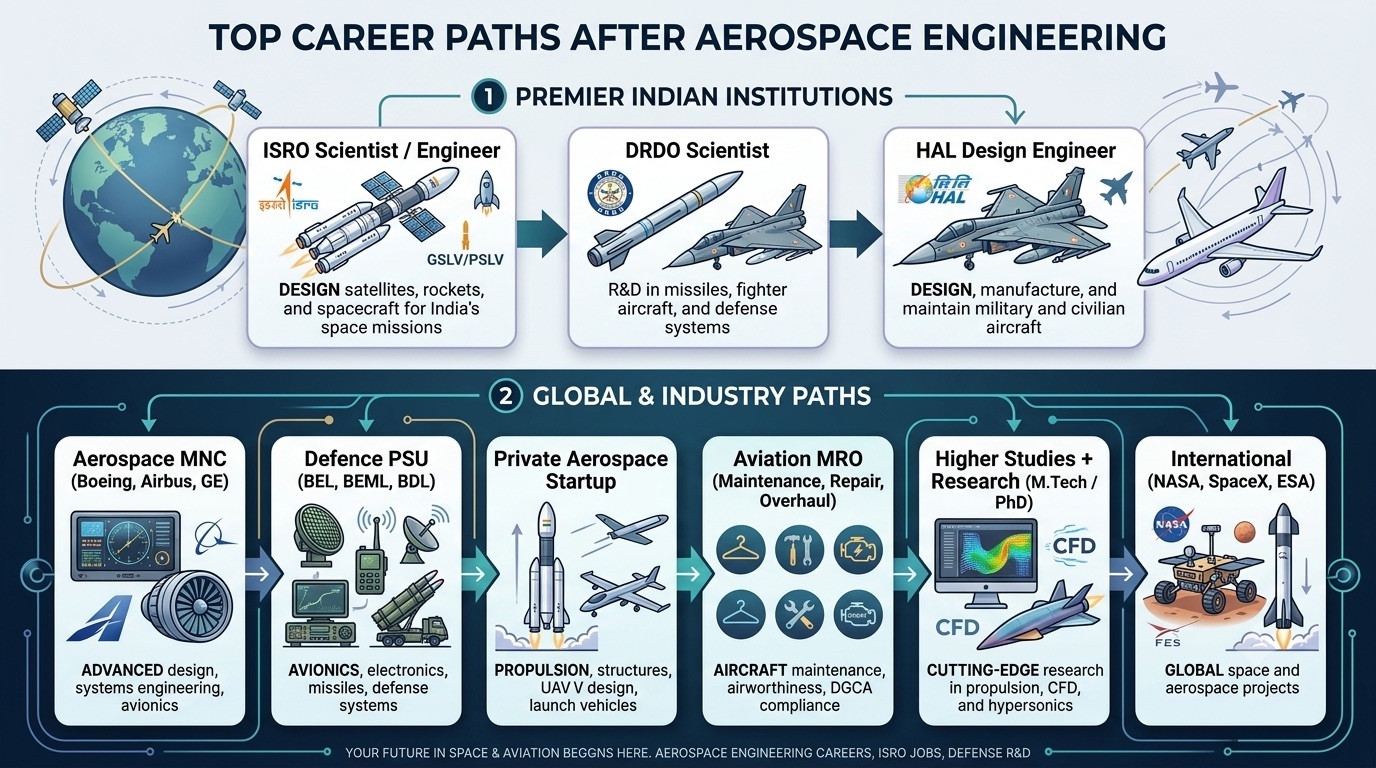
Career Paths After Aerospace Engineering
| Career Path | What You Do |
| ISRO Scientist / Engineer | Design satellites, rockets, and spacecraft for India’s space missions |
| DRDO Scientist | R&D in missiles, fighter aircraft, and defence systems |
| HAL Design Engineer | Design, manufacture, and maintain military and civil aircraft |
| Aerospace MNC (Boeing, Airbus, GE) | Advanced design, systems engineering, avionics |
| Defence PSU (BEL, BEML, BDL) | Avionics, electronics, missiles, defence systems |
| Private Aerospace Startup | Propulsion, structures, UAV design, launch vehicles |
| Aviation MRO (Maintenance, Repair, Overhaul) | Aircraft maintenance, airworthiness, DGCA compliance |
| Higher Studies + Research (M.Tech / PhD) | Cutting-edge research in propulsion, CFD, and hypersonics |
| International (NASA, SpaceX, ESA) | Global space and aerospace projects |

Key Skills Every Aerospace Engineer Needs
Getting the degree is only part of the picture. The aerospace engineers who command the highest salaries and fastest promotions are those who combine strong technical fundamentals with proficiency in modern software and cross-functional problem-solving skills. Here are the skills that matter most in 2026:
Key Skills to become an Aerospace Engineer
| Skill Category | Specific Skills |
| Core Technical | Aerodynamics, Flight Mechanics, Propulsion, Structural Analysis, Thermodynamics |
| Software & Simulation | MATLAB, ANSYS Fluent, CATIA V5/V6, SolidWorks, OpenFOAM, NASTRAN, Python |
| Emerging Technologies | AI/ML in flight systems, Autonomous UAV design, Additive Manufacturing (3D printing for aerospace) |
| Soft Skills | Systems thinking, precision documentation, and team collaboration in multi-disciplinary environments |
| Industry Knowledge | DGCA regulations, MIL-SPEC standards, and IS/ISO standards for aerospace materials and manufacturing |
Why Choose Aerospace Engineering in 2026?
India is entering a genuinely exciting era in aerospace. The Gaganyaan human spaceflight programme is progressing toward its crewed mission. The AMCA (Advanced Medium Combat Aircraft) project is in active development. The FDI cap in the defence sector has been raised to 74% under the automatic route, opening the door to major global investments. The UDAN regional connectivity scheme is expanding air travel to tier-2 and tier-3 cities, driving demand for MRO engineers.
And India’s private space sector with startups like Agnikul Cosmos, Skyroot Aerospace, Pixxel, and Dhruva Space attracting global funding is creating a parallel ecosystem of well-paying aerospace jobs outside the traditional government sector. Add to this India’s role as a preferred global Aerospace Engineering & MRO services hub, and the career outlook is unambiguously positive.
Also Read – How to Become a Chef in India
How to Become an Aerospace Engineer – FAQs
Q1. What is the minimum qualification to become an Aerospace Engineer?
You need a BE/BTech degree in aerospace, mechanical, or electrical engineering. This requires completing a 10+2 education in the science stream with Physics, Chemistry, and Mathematics (PCM).
Q2. What is the Aerospace Engineer salary for freshers in India?
Freshers earn ₹4.5–8 LPA on average. IIT and IIST graduates start at ₹6–8 LPA. ISRO / DRDO scientists begin at approximately ₹6.7 LPA plus allowances. Private MNCs like Boeing and Airbus India offer ₹8–16 LPA.
Q3. Which entrance exam is required for Aerospace Engineering in India?
JEE Main and JEE Advanced are the primary exams for IITs. Other options include BITSAT, SRMJEEE, VITEEE, MHT CET, and the ISAT (IIST Admission Test) for ISRO-linked IIST. For M.Tech, the GATE AE paper is the key exam.
Q4. How many years does it take to become an Aerospace Engineer?
A B.Tech in Aerospace Engineering takes 4 years after Class 12. Adding an M.Tech requires 2 more years. A PhD takes a further 3–5 years. Most students enter the industry within 4–6 years of finishing school.
Q5. Is Aerospace Engineering a good career in India?
Yes, especially now. India’s aerospace sector is projected to reach USD 70 billion by 2030. ISRO’s Gaganyaan, expanding private startups, and global MNC R&D centres are creating strong, well-paying demand for qualified aerospace engineers with the right technical skills.