Who is a Chef?

How to Become a Chef in India 2026 – Standard Eligibility
One of the most encouraging things about the culinary profession is how accessible and stream-agnostic it is. You don’t need to be a Commerce or Science student. Here is the standard Chef eligibility breakdown for 2026:
Minimum Academic Qualification
| Course Level | Minimum Eligibility |
| Certificate Courses (6 months – 1 year) | Class 10 pass (some accept Class 12) |
| Diploma in Culinary Arts (1–2 years) | Class 12 pass – any stream – min. 45–50% |
| B.Sc. Hospitality & Hotel Administration (3 years) | Class 12 – any stream – min. 50%; NCHM JEE required |
| BHM / B.A. in Culinary Arts (3–4 years) | Class 12 – any stream – min. 45–50% |
| PG Diploma / M.Sc. Culinary Arts | Graduation in Culinary Arts / Hotel Management |
Age, Stream & Other Conditions
1. Stream: No restriction. Science, Arts, and Commerce students are equally eligible for all culinary courses.
2. Age: Most professional courses require applicants to be at least 17 years of age. Private institutes are generally flexible; government IHMs have specific age limits as per NCHM norms.
3. Entrance Exams: Government IHMs require the National Council for Hotel Management and Catering Technology Joint Entrance Exam (NCHMCT JEE) conducted by NTA. Private culinary schools such as the Culinary Academy of India, WGSHA Manipal, and Le Cordon Bleu India conduct their own tests or admit students based on merit and interviews.
4. Prior Cooking Experience: Not required for any course. Most culinary programmes start from absolute basics.
How to Become a Chef in India 2026 – Course Options

1. Certificate Courses
Duration: 3 to 12 months | Fees: ₹25,000 – ₹1,50,000
Certificate programmes are ideal for students who want to enter the kitchen quickly, test their aptitude, or add a specific culinary skill to an existing profile. Popular options include the Certificate in Food Production, the Certificate in Bakery & Confectionery, and the Certificate in Patisserie. Government IHMs, such as IHM Pusa (New Delhi), offer affordable certificate programmes with strong industry recognition.
2. Diploma in Culinary Arts
Duration: 1 to 2 years | Fees: ₹1 Lakh – ₹7 Lakh (varies significantly by institute)
The Diploma in Culinary Arts is the most popular chef course in India and the preferred route for most serious culinary aspirants. It combines hands-on kitchen training (at least 60% of the curriculum in good institutes) with theory on cuisine science, menu planning, food costing, hygiene, and nutrition. Diploma holders enter the kitchen at the Commis Grade 1 level, skipping the two lowest entry grades that non-diploma holders begin at. Key institutes offering Diplomas include the Culinary Academy of India (Hyderabad), WGSHA Manipal, IHM colleges, Tedco, Florence Academy of World Cuisines, and Le Cordon Bleu India.
3. B.Sc. in Hospitality & Hotel Administration (BSc HHA)

Offered through NCHM-affiliated IHMs across India (IHM Pusa, IHM Mumbai, IHM Bengaluru, IHM Chennai, and 21 others), the B.Sc. HHA is a comprehensive degree covering Food Production, F&B Service, Accommodation Operations, and Front Office Management. Admission is through the NCHMCT JEE (held annually in April–May). While it covers the full spectrum of hotel management, students can specialise in culinary arts in the later semesters. This is the most affordable route to a recognised degree for aspiring chefs.
4. BHM / B.A. / B.Sc. in Culinary Arts
Duration: 3 to 4 years | Fees: ₹5 Lakh – ₹12 Lakh+ per year
Private universities like Symbiosis School of Culinary Arts (Pune), Lovely Professional University, Chandigarh University, WGSHA Manipal, and Le Cordon Bleu India offer dedicated culinary arts degree programmes with modern infrastructure, international cuisine exposure, and strong placement networks. These are premium options that command higher fees but offer deeper culinary specialisation, international accreditation (e.g., City & Guilds, WACS), and often better industry connections.
5. Specialisation Courses
Beyond the core culinary programmes, several specialised chef courses are available for students who know exactly which direction they want to pursue:
Specialised Courses to Become Chef in India
| Specialisation | Duration | Best For |
| Diploma in Bakery & Patisserie | 6 months – 2 years | Aspiring pastry chefs, bakery owners |
| Advanced Diploma in Bakery & Confectionery | 1–1.5 years | Luxury patisserie, hotel dessert kitchens |
| Italian / French Cuisine Diploma | 6–12 months | Fine-dining, international cuisine specialists |
| Japanese / Asian Cuisine Certificate | 3–6 months | Hotel cuisine specialists, sushi chefs |
| Molecular Gastronomy & Modern Techniques | 3–6 months | Avant-garde fine-dining chefs |
| Vegetarian / Vegan Culinary Arts | 6 months – 1 year | Growing vegan hospitality segment |
How to Become a Chef in India 2026? Step-by-Step Process
Interested students can follow the roadmap below to become a successful chef in India –
Steps to become a chef in India 2026
1. Pass Class10/Class 12 in any stream with a minimum of 45–50% marks.
2. Choose your Chef course — Certificate, Diploma, or Degree — based on your budget and goal.
3. Appear for NCHMCT JEE (for the IHM degree route) or apply directly to private institutes.
4. Enrol in your chosen culinary programme and immerse yourself in both practical kitchen training and theory.
5. Complete the mandatory industrial internship/training of 6 months to 1 year in hotels or restaurants.
6. Apply for entry-level kitchen roles such as Commis Chef or Kitchen Trainee at a hotel, restaurant, or catering firm.
7. Gain 2–3 years of experience across different kitchen sections — hot range, cold, bakery, and garde manger.
8. Build a specialisation such as Pastry, Italian, Japanese, or Molecular Gastronomy, and seek international exposure if possible.
9. Progress through the kitchen hierarchy: CDP → Sous Chef → Executive Sous Chef → Executive Chef over years 5–15+.
10. Optionally, launch your own restaurant, cloud kitchen, food brand, or culinary consultancy when ready.
Also Read – Buddy4Study’s Career Assesment Test
Chef Salary in India 2026
The salary for a Chef in India ranges widely, from ₹10,000 per month for an entry-level commis chef to ₹4 lakh+ per month for a top Executive Chef in a luxury five-star property. The gap is real and explained entirely by experience, specialisation, and the type of employer. Here is what the numbers look like in 2026, based on data from Indeed India, Jobted, Florence Academy, and Truffle Nation research.
Designation-wise Chef Salary in India 2026
| Designation | Experience | Monthly Salary (India) | Annual CTC (Approx.) |
| Commis Chef / Kitchen Trainee | 0–2 years | ₹10,000 – ₹25,000 | ₹1.2 – 3 LPA |
| Demi Chef de Partie (DCDP) | 2–3 years | ₹20,000 – ₹35,000 | ₹2.4 – 4.2 LPA |
| Chef de Partie (CDP) | 3–5 years | ₹30,000 – ₹60,000 | ₹3.6 – 7.2 LPA |
| Sous Chef | 5–8 years | ₹50,000 – ₹1,00,000 | ₹6 – 12 LPA |
| Executive Sous Chef | 8–12 years | ₹80,000 – ₹1,50,000 | ₹9.6 – 18 LPA |
| Executive Chef / Head Chef | 10+ years | ₹1,00,000 – ₹4,00,000+ | ₹12 – 48 LPA |
| Celebrity Chef / Culinary Consultant | 15+ years / Brand | ₹5,00,000+ / project-based | ₹60 LPA – ₹1 Crore+ |
Chef Salary based on Employer Type in India 2026
| Employer | Freshers (0–2 yrs) | Mid-Level (5–8 yrs) | Senior (10+ yrs) |
| Luxury 5-Star Hotel (Taj, Oberoi, Marriott) | ₹18,000–25,000/month | ₹60,000–1,20,000/month | ₹2–4 Lakh/month |
| Mid-range Hotels / Business Hotels | ₹14,000–20,000/month | ₹35,000–60,000/month | ₹80,000–1.5 Lakh/month |
| Standalone Fine-Dining Restaurant | ₹15,000–22,000/month | ₹40,000–80,000/month | ₹1–2 Lakh/month |
| Cloud Kitchen / Food Startup | ₹15,000–25,000/month | ₹35,000–70,000/month | Equity + ₹75K–1.5 Lakh/month |
| Cruise Lines (International) | ₹20,000–40,000/month (INR eq.) | ₹60,000–1,20,000/month (INR eq.) | ₹1.5–3 Lakh/month (INR eq.) |
| International (UAE / Maldives / UK) | ₹30,000–60,000/month (INR eq.) | ₹80,000–1,50,000/month (INR eq.) | ₹2–5 Lakh/month (INR eq.) |
Important Note – Certified pastry chefs earn 20–40% more than general cooks at the same experience level (Truffle Nation, 2026). A diploma-trained pastry chef with 3–5 years of experience at a five-star hotel can earn ₹60,000–1,20,000 per month.
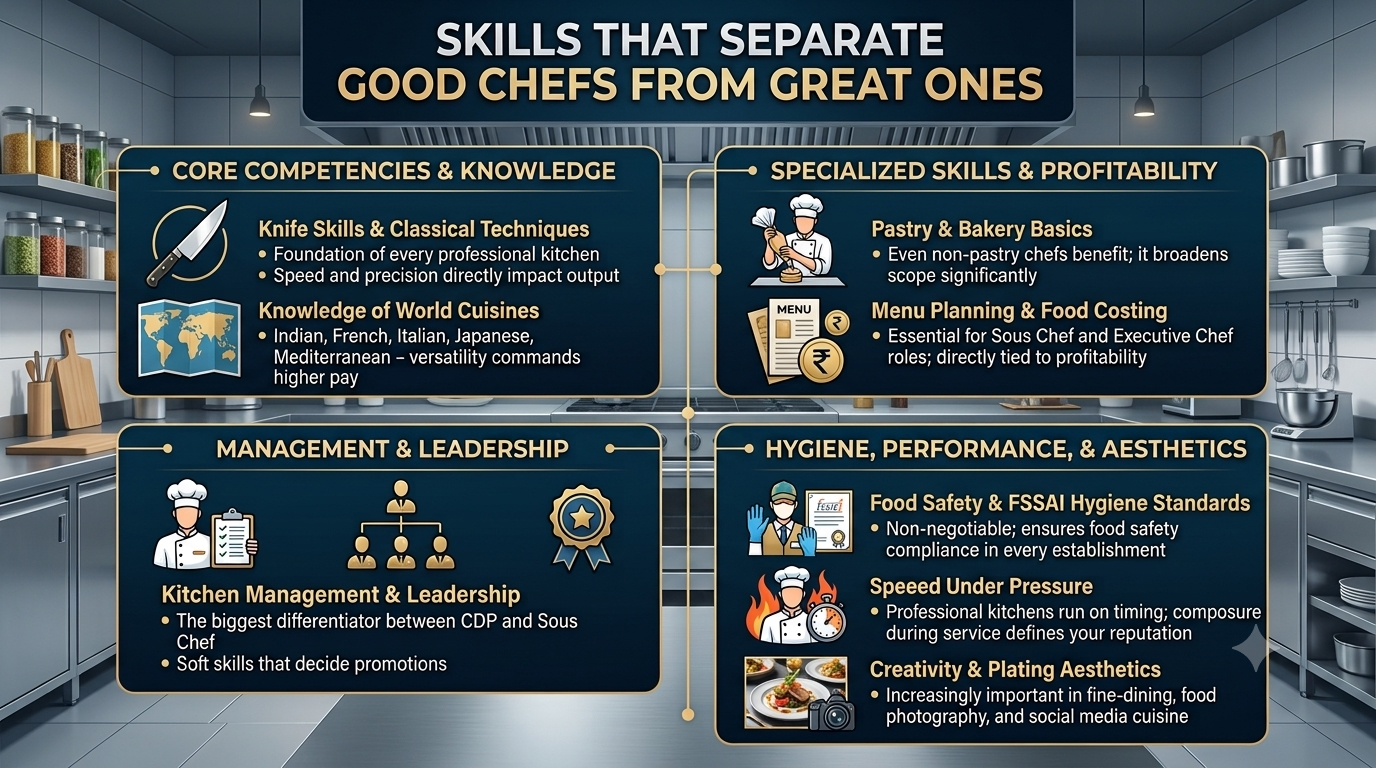
Skills That Separate Good Chefs from Great Ones
| Skill | Why It Matters |
| Knife Skills & Classical Techniques | Foundation of every professional kitchen; speed and precision directly impact output |
| Knowledge of World Cuisines | Indian, French, Italian, Japanese, Mediterranean – versatility commands higher pay |
| Pastry & Bakery Basics | Even non-pastry chefs benefit; it broadens scope significantly |
| Menu Planning & Food Costing | Essential for Sous Chef and Executive Chef roles; directly tied to profitability |
| Kitchen Management & Leadership | The biggest differentiator between CDP and Sous Chef; soft skills that decide promotions |
| Food Safety & FSSAI Hygiene Standards | Non-negotiable; ensures food safety compliance in every establishment |
| Speed Under Pressure | Professional kitchens run on timing; composure during service defines your reputation |
| Creativity & Plating Aesthetics | Increasingly important in fine-dining, food photography, and social media cuisine |
List of Career Paths After Becoming a Chef in India 2026
The beauty of culinary training is that it opens far more doors than the kitchen brigade alone. Here are the most exciting career directions for trained chefs in 2026:
Careers After Becoming a Chef in India 2026
| Career Path | Description | Earning Potential |
| Executive Chef (Hotel / Resort) | Run the kitchen, lead teams, and create menus for a luxury property | ₹1 – 4 Lakh/month |
| Restaurant Owner / Entrepreneur | Launch your own restaurant, cloud kitchen, or food brand | Uncapped; dependent on concept |
| Pastry Chef / Patissier | Specialise in desserts, cakes, chocolates, and premium niche | ₹60K – 1.5 Lakh/month (senior) |
| Food Stylist | Style food for photo shoots, advertisements, cookbooks, and OTT content | ₹30,000–1 Lakh per project |
| Culinary Instructor / Trainer | Teach at culinary institutes or corporate kitchens | ₹35,000–80,000/month |
| Private Chef / Personal Chef | Cook exclusively for wealthy individuals, celebrities, or families | ₹60K – 2 Lakh/month |
| Food & Travel Content Creator | Build a personal brand on YouTube, Instagram, or OTT platforms | Ad revenue + sponsorships |
| Culinary Consultant | Advise restaurants, hotels, or food brands on menus and operations | Project-based: ₹1–5 Lakh per engagement |
| Chef on Cruise Lines | Cook for passengers on international cruise ships; live & travel globally | ₹45,000 – 1.5 Lakh/month (INR eq.) |
Why is 2026 an Excellent Time to Become a Chef?
According to a report by Fortune Business Insights, India’s foodservice market was valued at USD 114.40 billion in 2025 and is projected to reach USD 282.04 billion by 2034, growing at a CAGR of 10.55%. This decade-long expansion, driven by rising disposable incomes, urbanisation, and a thriving dining-out culture in Tier-2 cities like Pune, Jaipur, and Kochi, makes 2026 a particularly strong entry point for culinary careers.
Cloud kitchens and food delivery platforms like Swiggy, Zomato, and ONDC have created entirely new employment opportunities for trained culinary professionals. Meanwhile, MasterChef India and social media have elevated the chef profession’s appeal, and international mobility to destinations like the UAE, UK, and Australia has expanded significantly for skilled Indian chefs.
Also Read – Buddy4Study’s Aptitude Test for Students
How to Become a Chef in India 2026 – FAQs
Q1. What is the minimum qualification to become a Chef?
You need to pass Class 12 in any stream with at least 45–50% marks for most diploma and degree culinary courses. Some certificate programmes accept Class 10 scores as well. No prior cooking experience is required to enrol.
Q2. What is the Chef salary in India for freshers in 2026?
A fresh commis chef earns ₹10,000–25,000 per month. Diploma holders typically start higher, at ₹15,000–25,000 per month, entering at Commis Grade 1 in 5-star hotels and skipping the lowest two entry grades.
Q3. Which is the best Chef course after Class 12?
A 1–2 year Diploma in Culinary Arts offers the best balance of cost, duration, and practical training. For a degree, the B.Sc. HHA from NCHM-affiliated IHMs via NCHMCT JEE is the most affordable and widely recognised route.
Q4. Can a Chef earn ₹1 Lakh per month in India?
Yes. Sous Chefs at top 5-star hotels earn ₹50,000–₹1 Lakh per month. Executive Chefs in luxury hotels earn ₹1–4 Lakh per month. Pastry specialists and private chefs also regularly cross the ₹1 Lakh monthly mark with experience.
Q5. Is a hotel management degree necessary to become a Chef?
No. Many successful chefs hold only a 1-year Diploma in Culinary Arts. A degree helps with management roles and the speed of career progression. Practical skill, specialisation, and experience ultimately matter more than the degree level.