
What Does an Event Manager Actually Do?

1. Client consultation and understanding event objectives and budget
2. Vendor sourcing and negotiation (venues, catering, décor, logistics)
3. Timeline and showflow planning
4. On-ground execution and crisis management during the live event
5. Post-event evaluation and client reporting
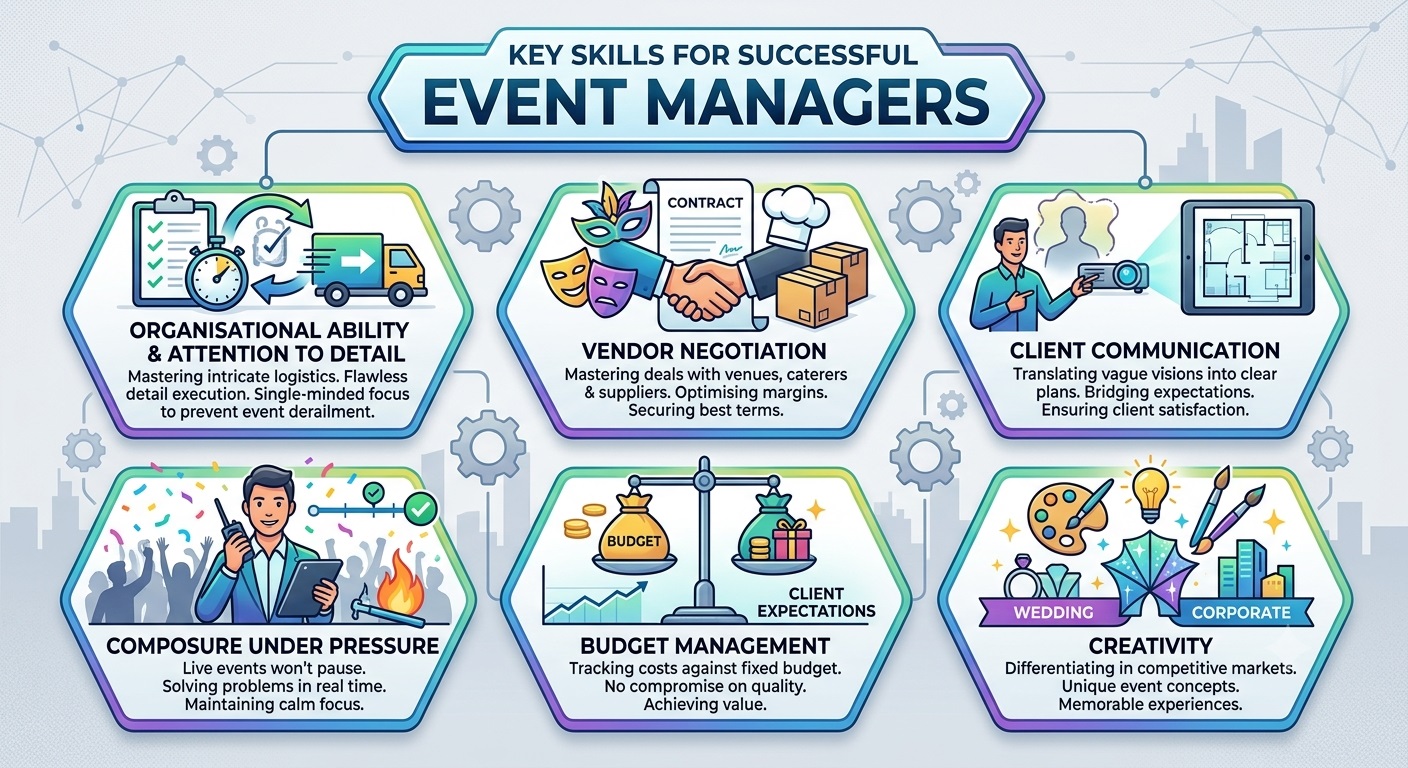
Skills to Become an Event Manager

1. Organisational ability and attention to detail – a single missed logistics detail can derail an entire event
2. Vendor negotiation – margins in this field are heavily influenced by how well you negotiate with venues, caterers, and suppliers
3. Client communication – translating a client’s vague vision into an executable plan
4. Composure under pressure – live events don’t pause for problems; you solve them in real time

6. Creativity – particularly for differentiating in a competitive wedding and corporate events market
Eligibility to Become an Event Manager
Unlike more rigid professions, event management genuinely offers multiple valid paths in:
1. Business & Management Route: Complete Class 12 in any stream, earn a Bachelor’s degree in any discipline, and pursue an MBA or PGDM in Event Management for high-level managerial and strategic roles.
2. Media & PR Route: Finish Class 12 in any stream, enroll in a Bachelor’s in Mass Communication, and follow up with a Master’s in Mass Communication – ideal for careers focused on public relations, media integration, and large-scale public events.
3. Fast-Track Specialized Route: Complete Class 12 in any stream, earn a Bachelor’s degree in any field, and complete a targeted Postgraduate Diploma (PG Diploma) in Event Management to quickly gain industry-specific practical skills.
4. Hospitality & Operations Route: Finish Class 12 in any stream, obtain a Bachelor in Hotel Management and Catering Technology (BHMCT), and top it off with a PG Diploma in Event Management to specialize in venue operations, catering, and large-scale guest experience management.
Notably, Class 12 in any stream is accepted across nearly all routes – this is one of the few professional fields in India with no science/commerce/arts restriction at the entry point. Most bachelor’s-level programmes require a minimum 50% aggregate in Class 12.
Also Read – How to Become an Actor
Course Levels and Fees to Become an Event Manager
Event management courses range from short, affordable certificate programmes to full MBAs, and the right level depends on how quickly you want to enter the field versus how much you’re investing in long-term career access.
| Course Type | Duration | Fee Range |
| Certificate Course | A few weeks to months | ₹1,100 – ₹50,000 |
| UG Degree (BBA/BEM in Event Management) | 3 years | ₹1 lakh – ₹6 lakh (full programme) |
| PG Diploma in Event Management | 1 year | ₹50,000 – ₹3 lakh |
| MBA/PGDM in Event Management | 2 years | ₹2 lakh – ₹10.6 lakh |
Note: These are indicative ranges compiled from institute and aggregator listings; confirm the exact fee for your chosen programme and college directly with the institute.
Certificate courses work well for quick entry or for working professionals testing the field, while a full degree or MBA meaningfully strengthens access to corporate and leadership-track roles later. If cost is a factor in choosing a level, it’s worth checking scholarships available for management and BBA/MBA students before ruling out a longer programme.
Entrance Exams to Become an Event Manager
Admission routes differ by course level and by the stream you enter through, so it’s worth checking which applies to your specific programme before you apply.
| Programme | Admission Criteria & Entrance Exams |
| Undergraduate (UG) Programmes | Merit-based: Admission is largely based on Class 12 marks. Entrance exams: Some institutes conduct their own entrance tests. |
| Postgraduate (PG) / MBA Programmes | Generally requires valid scores in national or institutional tests such as CAT, MAT, CUCET, or DSAT (varies by institute). |
| BHMCT Entry Route | Requires NCHMCT JEE specifically for entering event management via the Hotel Management and Catering Technology stream. |
Top Institutes to Consider for Event Management
Recognised names in Indian event management education include the National Institute of Event Management (NIEM), IMED Pune, MIT-WPU, AIMC New Delhi, INLEAD, ISBM Bangalore, and Chandigarh University. Beyond brand name, look specifically for programmes with strong live-event exposure and industry tie-ups, since hands-on execution experience carries more weight in this field than classroom learning alone.
Specialisations Within Event Management
Once you’re in the field, career paths tend to split by the type of event you work on rather than by a fixed job ladder – each specialisation has its own pace, clientele, and pay structure.
1. Corporate Events – conferences, product launches, team-building, client engagement events
2. Wedding Management – one of India’s fastest-growing and highest-earning segments, typically structured around project fees rather than salary
3. Sports Events – working with franchises (IPL, Pro Kabaddi) or national sporting federations
4. Entertainment and Music Production – live concerts and entertainment shows
5. Digital/Hybrid Events – a growing category managing online and hybrid event formats using virtual event platforms
6. MICE (Meetings, Incentives, Conferences, Exhibitions) – national and international-scale business event coordination
Global Certification to Become an Event Manager
For those specialising in corporate or MICE events in particular, the Certified Meeting Professional (CMP), awarded by the Events Industry Council, is the most globally recognised credential in the field – and it works differently from most certifications you’d expect.
1. You cannot simply study and sit an exam. Eligibility requires either 36 months of full-time meeting/event experience, or 24 months if you hold a relevant degree – meaning a degree literally saves you a full year of required experience.
2. On top of that, you need 25 hours of meeting-related education, accumulated within a rolling five-year window before applying.
3. Because of this structure, CMP has to be planned for years in advance, not crammed for – start logging your education hours and relevant work experience from the day you enter the field if you’re serious about eventually pursuing it.
In India’s corporate event sector specifically, this certification carries real weight with larger clients and employers, alongside India-specific certifications that add local market credibility.
Also Read – How to Become an Interior Designer
Career Progression in the Field of Event Management
Progression in event management is driven less by years served and more by the scale of what you’ve handled – here’s the broad shape it typically takes.
| Stage | Experience | Typical Responsibility |
| Coordinator/Assistant | 0–2 years | Execution-focused support roles |
| Project Lead/Event Manager | 3–5 years | Client briefs, vendor contracts, independent event ownership |
| Senior Manager/Director | 6+ years | Full P&L ownership, senior client relationships |
One genuinely useful piece of career advice from industry sources: build your portfolio by the scale and budget of events managed, not just by years of experience or event count – hiring managers and clients pay for demonstrated ability to handle complexity and budget size, not tenure alone.
Event Manager Salary in India by Specialisation
This is where a single “average salary” genuinely breaks down – pay structures differ meaningfully by specialisation.
| Specialisation | Earning Structure |
| Corporate Events (mid-level) | ₹40,000–₹80,000/month salaried; more at MNCs and top agencies |
| Wedding Management (mid-level) | ₹6–15 lakh/year, largely project-fee based (handling 20-30 weddings/year) |
| Sports Events | ₹40,000–₹1,00,000/month, depending on organisation and seniority |
| Entertainment/Music Production | ₹30,000–₹80,000/month at mid-level |
For a broader, experience-based view rather than a specialisation-based one, here’s how pay typically scales with seniority across the field:
| Experience | Annual Salary (₹) |
| Fresher/Coordinator (0-2 years) | ₹2.5 – 4.5 LPA |
| Mid-level (3-5 years) | ₹5 – 8 LPA |
| Senior (6+ years, large-scale events) | ₹12 – 25 LPA+ |
Note: Figures above are indicative, compiled from industry sources, and vary by employer, city and specific project scale – treat them as a starting reference rather than a guarantee.
A few things skew this further: wedding and freelance-based roles often pay per project rather than as a fixed salary, meaning experienced independent planners can significantly exceed these ranges during peak wedding season. City also matters – Mumbai and Delhi, with denser corporate and entertainment event activity, generally offer higher pay than smaller markets.
Also Read – How to Become a Film Director
FAQs: How to Become an Event Manager in India
Q1. Do I need a specific stream in Class 12 to pursue event management?
No, this is one of the more accessible professional fields in that regard. Science, Commerce, Arts, or Humanities students are all eligible for essentially every entry route into event management education.
Q2. Is an MBA necessary to succeed in event management, or can I start with just a certificate course?
A certificate course can get you into entry-level coordination roles, but an MBA/PGDM or full degree meaningfully improves access to corporate leadership-track roles and higher starting responsibility. Many successful event managers also built careers primarily through hands-on portfolio experience rather than advanced degrees, particularly in wedding and freelance-heavy specialisations.
Q3. What exactly is the CMP certification, and is it worth pursuing to become an event manager?
It’s the most globally recognised event management credential, but it requires 2-3 years of qualifying experience (reduced with a relevant degree) plus 25 hours of education within a 5-year window, it cannot be earned quickly. It’s worth planning for if you’re serious about corporate/MICE event management specifically, where it carries genuine weight with larger clients.
Q4. Why do salary figures for event managers vary so dramatically across different sources?
Because the field itself has genuinely different economics by specialisation – a salaried corporate event coordinator, a project-fee-based wedding planner, and a sports event manager working with a franchise all operate on different compensation structures entirely. A single blended “average” obscures more than it reveals in this specific field.
Q5. How important is a strong portfolio compared to formal education in event management?
Very important, and arguably more important than formal credentials alone in wedding and freelance-heavy specialisations. Employers and clients specifically look at the scale and budget of events you’ve managed, not just your degree or years in the industry.