
Who Is a Film Director and What Do They Do?

General responsibilities of a Film Director include:
1. Interpreting and often reworking the script alongside writers
2. Casting actors and directing their performances
3. Planning shots and visual style with the Director of Photography (DoP)
4. Coordinating with production designers, editors, and sound teams

6. Supervising post-production, including the final edit and colour grading
Directing sits at the intersection of storytelling, technical craft, and people management — which is why the eligibility and training paths for it look somewhat different from a conventional degree-to-job pipeline.
Eligibility Criteria to Become a Film Director in India 2026
Unlike engineering or medicine, there’s no single, government-mandated eligibility bar for becoming a film director in India. What exists instead is a layered set of entry points, depending on whether you’re going the formal-education route or building a career through hands-on set experience.
Educational Eligibility to Become a Film Director
| Level | Requirement |
|---|---|
| Diploma / Certificate courses | Pass Class 10 or 10+2 from a recognised board (varies by institute) |
| Undergraduate courses (BA/BSc in Filmmaking or Direction) | Pass 10+2 in any stream, typically with 50% aggregate marks |
| Postgraduate courses (PG Diploma in Direction, MA in Film Studies) | A bachelor’s degree in any discipline; premier institutes like FTII and SRFTI conduct their own entrance tests and interviews |
A distinctive feature of film director eligibility in India is that formal education isn’t mandatory. Many working directors have no film-school background at all – they entered the industry as assistant directors and learned the craft on set over several years. That said, a degree or diploma from a recognised film school does two concrete things: it gives you structured training in areas like screenplay structure and cinematography language that are hard to pick up informally, and it builds the peer network and portfolio you’ll need to get your first opportunities.
Skills Required to Become a Film Director in India 2026

2. Visual and technical literacy – working knowledge of cinematography, editing, and increasingly VFX, since directors need to communicate precisely with every technical department
3. Leadership and people management – a film set can involve anywhere from a dozen to several hundred crew members, and directors need to hold that group together under pressure and tight schedules
4. Resilience — rejection, budget cuts, and reshoots are routine; the ability to keep working through setbacks matters as much as raw talent
5. Networking ability — the film industry runs heavily on relationships and referrals, particularly for a director’s first few projects
Film Director Course Options in India 2026
If you’re choosing the formal-education route, there’s a wide range of film director course formats available, from three-year degrees to weekend certificate programmes.
Degree and Diploma Programmes
1. BA/BSc in Filmmaking or Direction – three-year undergraduate programmes covering direction, cinematography, editing, and screenwriting fundamentals
2. PG Diploma in Film Direction – one-to-three-year postgraduate diplomas at institutes like FTII Pune and SRFTI Kolkata, widely regarded as the most rigorous and prestigious route into Indian cinema
3. MA in Film Studies – a more theory-heavy postgraduate option, useful for those also interested in criticism, curation, or academia alongside direction
Diploma and Certificate Courses to Become a Film Director
Shorter, more accessible options exist for those who want to test the field before committing to a full degree, or who are entering later in their career:
1. Certificate courses in film direction (ranging from a few weeks to a year), offered by institutes such as AAFT, Whistling Woods International, and Pearl Academy
2. Part-time and weekend courses aimed at working professionals, offered by schools like Matrikas Film School and CRAFT (Centre for Research in Art of Film and Television)
3. Online filmmaking and direction courses, useful for building foundational knowledge before pursuing on-set experience
While short courses effectively teach foundational terminology, basic techniques, and help build portfolio pieces, they cannot substitute for the extensive apprenticeship years that working directors complete as assistants.
Top Institutes for a Film Director Course in India 2026
1. Film and Television Institute of India (FTII), Pune, is India’s most prestigious film school, government-run, with a highly competitive entrance process
2. Satyajit Ray Film and Television Institute (SRFTI), Kolkata is comparable in prestige and rigour to FTII
3. Whistling Woods International, Mumbai is a well-regarded private film school with strong industry connections
4. AAFT (Asian Academy of Film & Television), Noida offers a wide range of certificate, diploma, and degree options in direction and allied crafts
5. Pearl Academy offers filmmaking and media programmes across multiple Indian cities
Always verify an institution’s track record and alumni work before committing to a program. Because this industry relies heavily on referrals and demonstrated skill, the contacts you make and the quality of your portfolio will always matter more than the name on your diploma.
How to Become a Film Director 2026: Step-by-Step Process
Step 1: Build a Foundation in Storytelling and Visual Language – Watch widely and critically, read scripts, and start understanding why scenes are shot and cut the way they are, not just what happens on screen. This foundation matters whether or not you pursue formal education.
Step 2: Choose Your Training Path – Decide between a structured film director course (degree or diploma) and the on-set apprenticeship route. Neither is objectively “better” – the right choice depends on your finances, timeline, and how you learn best.
Step 3: Make Short Films – Whether you’re in film school or not, directing short films is non-negotiable. They form your portfolio, teach you to work within real constraints (budget, time, crew), and are usually your ticket into festivals, competitions, and your first industry contacts.
Step 4: Work as an Assistant Director – Almost every successful Indian director, film-school-trained or not, spends several years as an assistant director (AD) before getting their own project. ADs handle scheduling, continuity, and coordination on set, and this apprenticeship is where most people actually learn how a professional production runs.
Step 5: Network and Build Industry Relationships – Attend film festivals, script-reading sessions, and industry meetups. A significant share of directing opportunities in India comes through referrals and existing relationships rather than open applications.
Step 6: Pitch and Direct Your First Independent or Commissioned Project – This might be a short film, a web series episode, an ad film, or a low-budget independent feature. Each project, regardless of scale, adds to the portfolio that eventually gets you a bigger one.
Career Path & Job Roles for Film Director in India 2026
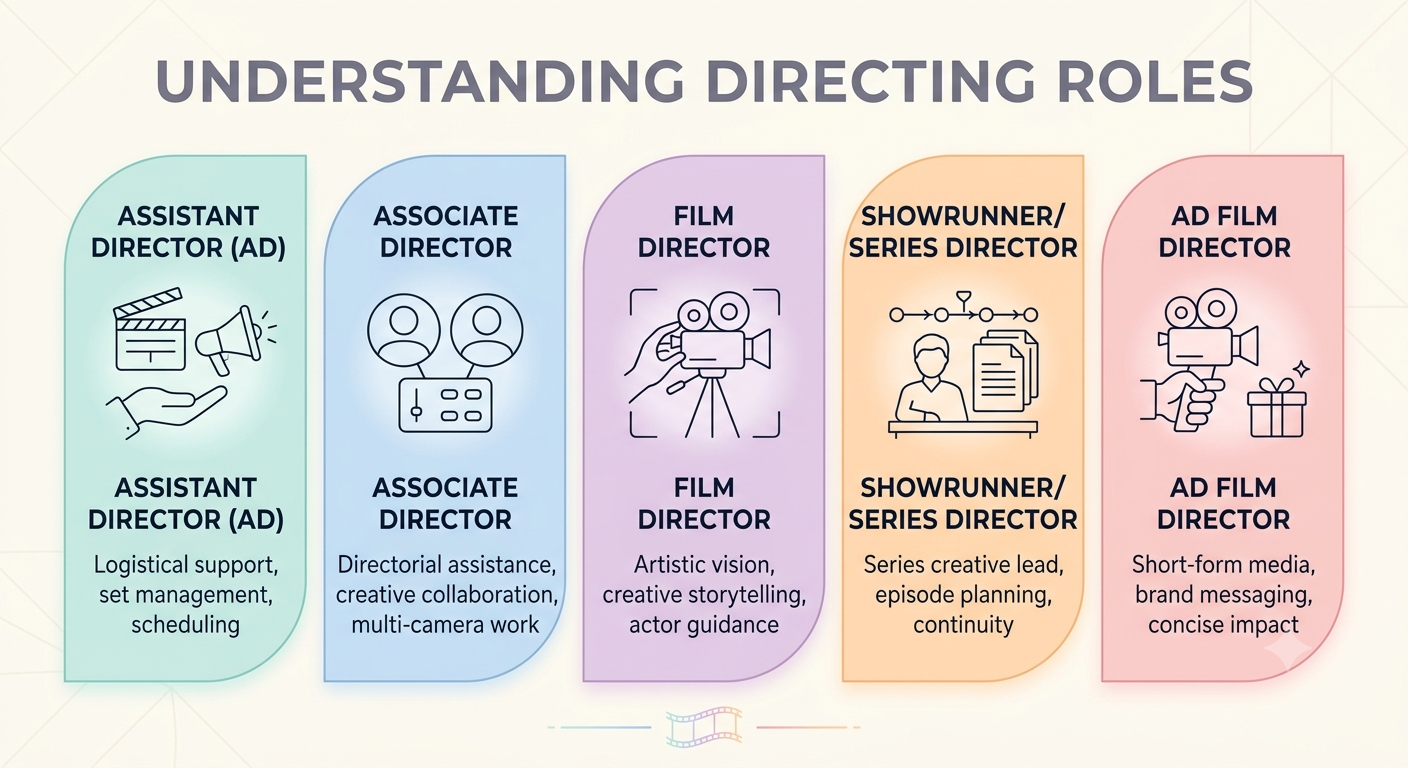
Directing is rarely a linear, single-title career. Most people move through several related roles on the way up, and many continue working across formats even after establishing themselves:
1. Assistant Director (AD) – the standard entry point, handling scheduling, continuity, and set coordination
2. Associate Director – a senior AD role, often directing second-unit scenes or specific sequences
3. Film Director – the standalone role, whether for feature films, short films, or web series
4. Showrunner/Series Director – increasingly common with the growth of OTT platforms, overseeing direction across multiple episodes of a series
5. Ad Film Director – a distinct, often more commercially stable career track directing advertisements and branded content
Also Read – How to Become a Psychologists
Film Director Salary in India 2026
This is the area where film directing differs most sharply from a conventional career: pay is overwhelmingly project-based rather than a fixed annual salary, and it varies enormously with experience, reputation, and the scale of the production. The figures below should be read as indicative ranges rather than guarantees – a director’s income in India can shift dramatically from one project to the next.
| Career Stage | Typical Earnings |
|---|---|
| Assistant Director (entry-level) | ₹1.5 – 3 LPA (often paid monthly/per-project rather than as a fixed salary) |
| Independent/emerging director (short films, ad films, web content) | ₹3 – 8 LPA equivalent, usually per-project |
| Mid-career director (a few credited feature films or a successful web series) | ₹6 – 15 LPA equivalent, though per-film fees vary widely |
| Established feature film director | Typically paid per film rather than annually; fees can range from several lakhs to several crores depending on the production’s budget and the director’s track record |
A few things worth understanding about how film director salary in India actually works in practice:
1. Entry-level pay is genuinely low – Assistant directors on many productions are paid modestly, and it’s common for early-career ADs to treat the role as an apprenticeship rather than a primary income source.
2. Location matters – Mumbai remains the centre of gravity for Hindi cinema and advertising work, and generally offers the highest concentration of paid opportunities, followed by regional hubs like Chennai, Hyderabad, and Kolkata for their respective film industries.
3. OTT has added a new, more stable income stream – Directing for streaming platforms often comes with more structured, contract-based pay than traditional theatrical features, which has made series direction an increasingly attractive entry point for newer directors.
4. Success is highly variable and back-loaded – Unlike salaried professions where pay rises predictably with experience, a director’s earning potential depends heavily on how their previous projects performed – a hit can transform earning potential overnight, while a string of unreleased or poorly received projects can stall it for years.
What Makes a Successful Film Director
Beyond formal qualifications, certain traits consistently separate directors who sustain long careers from those who don’t:
1. A distinct creative voice – something that makes their work recognisable beyond just technical competence
2. Collaborative leadership – the best directors get the best out of writers, actors, and technicians rather than working in isolation
3. Business awareness – understanding budgets, timelines, and what a producer or platform needs commercially, alongside the creative vision
4. Persistence through a long gestation period – it’s common for a director’s first feature to take several years to materialise after film school or the assistant-director phase
Also Read – How to Become an Interior Designer
FAQs: How to Become a Film Director in India
Q1. What is the eligibility to become a film director in India?
There’s no single mandatory qualification. For formal film director courses, eligibility typically starts at Class 10 or 10+2 pass for diplomas and certificates, and 10+2 with around 50% marks for undergraduate degree programmes. However, many working directors enter the industry through on-set experience without any formal film education.
Q2. Is a film director course necessary, or can I learn on the job?
Both paths are common and viable in India. A structured course gives you formal training and a peer network; on-set experience as an assistant director gives you practical, real-production learning. Many successful directors combine elements of both.
Q3. What is the average film director salary in India?
It varies enormously by career stage and project scale. Assistant directors typically start in the ₹1.5–3 LPA range (often paid per project), while established directors are usually paid per film, with fees ranging from several lakhs to several crores depending on the production’s budget and the director’s track record.
Q4. Which are the best institutes for a film director course in India?
FTII Pune and SRFTI Kolkata are the most prestigious government-run options, both with competitive entrance processes. Whistling Woods International, AAFT, and Pearl Academy are well-regarded private alternatives offering degree, diploma, and certificate programmes.
Q5. How long does it typically take to become a film director?
There’s no fixed timeline. Film-school graduates commonly spend several years as assistant directors before helming their own project, and even directors without formal training usually go through a multi-year apprenticeship on set. Building a strong portfolio and industry network matters more than any specific duration.