

JNU Admission 2026 – Important Date
| Event | Programme | Date |
| JNU PG / ADOP Online Application | PG | May 25, 2026 to June 15, 2026 |
| CUET UG 2026 Extended Exam Slots | UG | June 6, 2026 and June 7, 2026 |
| JNU PG Application Last Date | PG | June 15, 2026 (11:50 PM) |
| JNU PG Application Correction Window | PG | June 15, 2026 |
| Publication of First PG Merit List | PG | June 23, 2026 |
| Pre-enrolment Seat Blocking and Fee Payment (First List) | PG | June 23, 2026 to June 25, 2026 |
| Publication of Second PG Merit List | PG | July 1, 2026 |
| CUET UG 2026 Result Declaration | UG | July 2026 |
| JNU UG / COP Counselling Portal Opens | UG | July 2026 / August 2026 |
| Final Admission Window Against Vacant Seats | PG | July 20, 2026 to July 22, 2026 |
| Closing Date for All PG Admissions | PG | August 7, 2026 |
JNU Admission 2026 – Entrance Exam Accepted
| Courses | Entrance Exams Accepted |
| UG Programmes | CUET UG/JEE Main |
| PG Programmes | JNUEE/CUET PG/CAT |
| PhD Programmes | JRF/GATE/Entrance test conducted by the university |
JNU Admission 2026 – Courses & Eligibility Criteria
Below mentioned are the courses and eligibility criteria for JNU admission 2026.
JNU Eligibility Criteria: Certificate and UG Courses
| Course | Eligibility Criteria |
| B.A. (Hons.) in Persian | Class 12 or equivalent from a recognised board with min 45% marks |
| B.A. (Hons.) in Pashto | Class 12 or equivalent from a recognised board with min 45% marks |
| B.A. (Hons.) in Arabic | Class 12 or equivalent with min 45% marks; Certificate of Alimiah with min 45% from recognised Madrasas also accepted |
| B.A. (Hons.) in Japanese | Class 12 or equivalent from a recognised board with min 45% marks |
| B.A. (Hons.) in Korean | Class 12 or equivalent from a recognised board with min 45% marks |
| B.A. (Hons.) in Chinese | Class 12 or equivalent from a recognised board with min 45% marks |
| B.A. (Hons.) in French | Class 12 or equivalent from a recognised board with min 45% marks |
| B.A. (Hons.) in German | Class 12 or equivalent from a recognised board with min 45% marks |
| B.A. (Hons.) in Russian | Class 12 or equivalent from a recognised board with min 45% marks |
| B.A. (Hons.) in Spanish | Class 12 or equivalent from a recognised board with min 45% marks |
| COP in Pashto | Class 12 or equivalent with min 45% marks |
| COP in Uzbek | Class 12 or equivalent with min 45% marks |
| COP in Hebrew | Class 12 or equivalent with min 45% marks |
| COP in Mongolian | Class 12 or equivalent with min 45% marks |
| COP in Bahasa Indonesia | Class 12 or equivalent with min 45% marks |
| COP in Urdu | Class 12 or equivalent with min 45% marks |
| B.Sc. in Ayurveda Biology | Class 12 or equivalent with min 45% marks; Physics and Chemistry compulsory; Biology or Mathematics as third subject |
| COP in Pali | Class 12 or equivalent with min 45% marks |
| COP in Sanskrit Computational Linguistics | Class 12 or equivalent with min 45% marks |
| COP in Yoga Philosophy | Class 12 or equivalent with min 45% marks |
| COP in Vedic Culture | Class 12 or equivalent with min 45% marks |
| COP in Sanskrit | Class 12 or equivalent with min 45% marks |
| COP in Natya Shastra | Class 12 or equivalent with min 45% marks |
| COP in Health Awareness and Wellness | Class 12 or equivalent with min 45% marks |
| COP in Indian Philosophy | Class 12 or equivalent with min 45% marks |
| B.Tech. in Computer Science and Engineering | As per JEE Main 2026 eligibility criteria |
| B.Tech. in Electronics and Communication Engineering | As per JEE Main 2026 eligibility criteria |
JNU Admission 2026: PG Courses & Eligibility Criteria
| Course | Eligibility Criteria |
| M.A. in Politics (with specialisation in International Relations) | Bachelor’s degree in any discipline (10+2+3 pattern) with min 50% marks |
| M.A. in International Relations and Area Studies | Bachelor’s degree in any discipline (10+2+3 pattern) with min 50% marks |
| M.A. in Economics (with specialisation in World Economy) | Bachelor’s in Economics (Hons) with min 50%; OR any Bachelor’s with min 60% and Economics as a subject; Mathematics at Class 12 level is compulsory |
| M.A. in International Relations (West Asian Studies) | Bachelor’s degree in any discipline (10+2+3 pattern) with min 50% marks |
| M.A. in Persian, Pashto, Arabic, Japanese, Korean, Chinese, French, German, Hindi, Urdu, Hindi Translation, Linguistics, English, Russian, Spanish | Bachelor’s degree in relevant or any discipline (10+2+3 pattern) with min 45% to 55% marks (varies by language programme) |
| Advanced Diploma in Mass Media in Urdu (Part-Time) | Bachelor’s degree from a recognised university |
| M.Sc. in Life Sciences | Bachelor’s in Biological, Physical, or Agricultural Sciences with min 55% marks |
| M.A. in History, Sociology, Political Science, Economics, Psychology, and others | Bachelor’s degree in relevant discipline (10+2+3 pattern) with min 45% to 55% marks |
| M.Sc. in Environmental Sciences | Bachelor’s in Science or related discipline with min 45% marks |
| M.C.A. (Master of Computer Applications) | Bachelor’s degree with Mathematics at 10+2 or graduate level with min 55% marks |
| M.Sc. in Physics, Chemistry, Mathematics | Bachelor’s in relevant science discipline with min 45% to 55% marks |
| M.Sc. in Computational and Integrative Sciences | Bachelor’s in Science or related discipline with min 50% marks |
| M.A. in Arts and Aesthetics | Bachelor’s in any discipline with min 45% marks |
| M.Sc. in Biotechnology | Bachelor’s in Biological, Physical, or Agricultural Sciences with min 55% marks |
| M.Sc. in Computational Biology | Bachelor’s in relevant science discipline with min 55% marks |
| M.A. in Sanskrit and Indic Studies | Bachelor’s degree in relevant discipline with min 45% marks |
| M.Tech. in CSE and ECE | BTech or BE in relevant engineering discipline with a valid GATE 2026 score |
| M.Tech. (other specialisations) | BTech or BE in relevant discipline with min 55% marks |
| M.B.A. | Bachelor’s degree with min 50% marks (45% for SC/ST); selection via CAT (70%), GD (10%), PI (20%) |
| M.Sc. / M.A. in Molecular Medicine, Nano Sciences, Disaster Research, Tamil Studies | Bachelor’s in relevant discipline with min 45% to 55% marks (varies by programme) |
| M.P.H. (Master of Public Health) | Bachelor’s in Public Health or related health science field with min 45% marks |
| PG Diploma and Advanced Diploma Programmes | Bachelor’s degree in relevant discipline with min 45% marks |
JNU Admission 2026: PhD Courses & Eligibility Criteria
| Course Name | Eligibility Criteria |
| PhD in Languages & Literature | Master’s degree in relevant subject |
| PhD in Social Sciences | Master’s degree in relevant subject |
| PhD in International Studies | Master’s degree in relevant subject |
| PhD in Life Sciences / Biotechnology | Master’s degree in Biotechnology/Life Sciences |
| PhD in Physical Sciences | Master’s degree in Physics/Chemistry/Mathematics |
| PhD in Environmental Sciences | Master’s degree in relevant discipline |
| PhD in Computer Science / Engineering | M.Tech/ME/MSc in relevant field |
| PhD in Arts & Aesthetics | Master’s degree in relevant discipline |
| PhD in Sanskrit & Indic Studies | Master’s degree in relevant subject |
JNU Fee Structure Admission 2026
Below mentioned is the fee structure of Jawaharlal Nehru University, UG and PG programmes for the academic year 2026-27.
JNU Fee Structure 2026: UG Programmes
| Course | Duration | Total Fees |
| B.A. (Hons.) in Foreign Languages (under NEP 2020) | 4 Years | ₹1,226 |
| B.Sc. in Ayurveda Biology (under NEP 2020) | 4 Years | ₹1,226 |
| Certificate of Proficiency (COP) (Part-Time) | 1 Year | ₹264 |
| B.Tech — General/OBC (Family Income above ₹5 Lakh) | 4 Years | ₹5,51,048 |
| B.Tech — General/OBC (Family Income ₹1 Lakh to ₹5 Lakh) | 4 Years | ₹2,17,712 |
| B.Tech — General/OBC (Family Income below ₹1 Lakh) | 4 Years | ₹51,048 |
| B.Tech — SC / ST / PwD (All Income Groups) | 4 Years | ₹51,048 |
Jawaharlal Nehru University Fee 2026-27: PG Programmes
| Course | Duration | Total Fees |
| M.A. / M.Sc. / MCA | 2 Years | ₹689 |
| M.Tech / MPH | 2 Years | ₹737 |
| PG Diploma in Big Data Analytics | 1 Year | ₹10,204 |
| Advanced Diploma in Mass Media — Urdu (Part-Time) | 1 Year | ₹264 |
Important Fee Guidelines & Notes
1. Refundable Security Deposit: The total fee includes a mandatory security deposit of ₹40 for regular courses and ₹5,000 for professional courses such as MBA and School of Engineering M.Tech. This amount will be refunded after completing the course.
2. B.Tech / M.Tech Tuition Fee Waiver: For SC, ST, PwD and economically most backward students with an annual family income below ₹1 lakh, the total fee includes only institute-level charges, as tuition fees are fully waived by the university.
3. Fee Payment Schedule: JNU collects tuition fees in two equal installments each academic year. The first installment must be paid during admission/counseling, while the second installment is paid during Winter Semester registration in January.
JNU Admission 2026 Admission Process – Steps to Apply Online

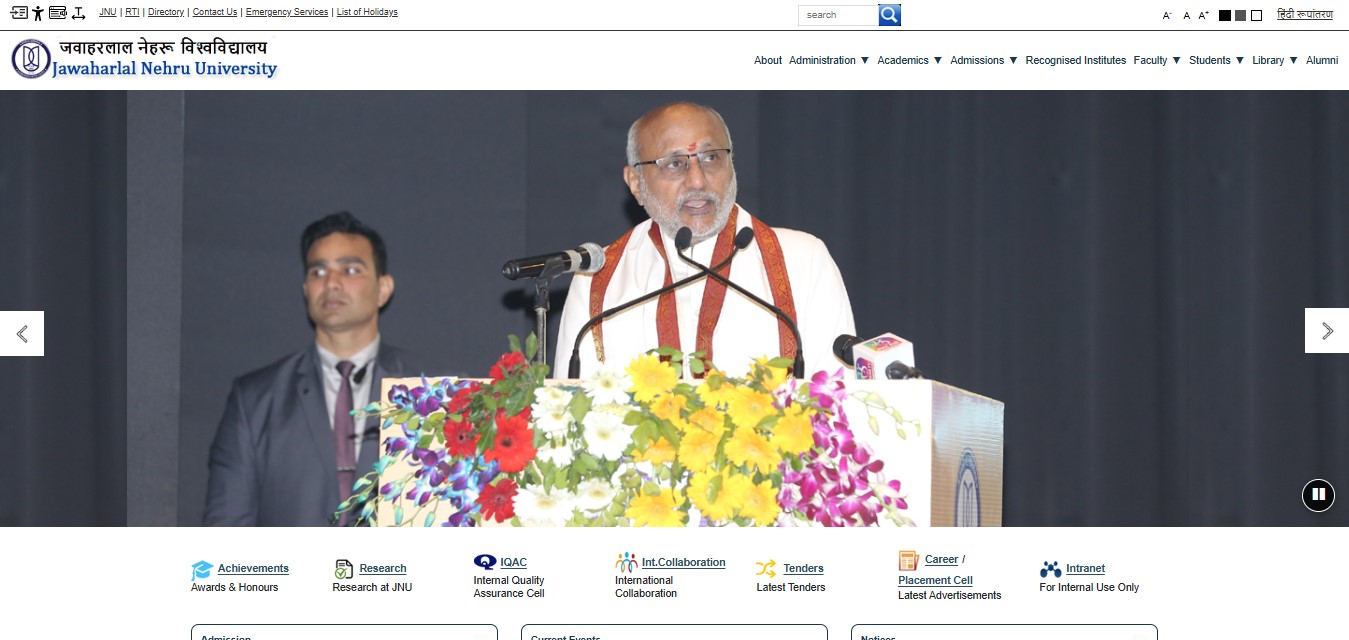
Step 2: Register using your CUET application number and required details.
Step 3: Fill out the JNU application form with personal, academic and course details.
Step 4: Upload required documents, including marksheets, photograph, signature and certificates.

Step 6: Submit the application form and download the confirmation page.
Step 8: Wait for the merit list and counselling/seat allotment process.
Step 9: Complete document verification and pay the admission fee to confirm your seat.
JNU Cutoff 2026
The cutoff for the academic year 2026–27 has not yet been released by JNU. Until the official cutoff is announced, candidates can refer to the 2025 cutoff list provided below for reference.
JNU Cutoff: Undergraduate 2025
| Course | List 1 | List 2 | List 3 | List 4 | List 5 |
| BA | Click Here | Click Here | Click Here | Click Here | N/A |
| COP | Click Here | Click Here | Click Here | Click Here | N/A |
JNU Cutoff: Postgraduate 2025
| Course | List 1 | List 2 | List 3 | List 4 | List 5 |
| MA / MSc / MCA | Click Here | Click Here | Click Here | Click Here | Click Here |
| MTech / MPH / PGD | Click Here | Click Here | N/A | Click Here | Click Here |
| ADOP | Click Here | N/A | N/A | N/A | N/A |
| MSc GATE-B | Click Here | Click Here | Click Here | Click Here | N/A |
JNU Doctoral Cutoff 2025
| Course | List 1 | List 2 | List 3 | List 4 | List 5 |
| PhD NET | Click Here | Click Here | Click Here | N/A | N/A |
| PhD JRF | Click Here | Click Here | Click Here | N/A | N/A |
| PhD GATE | Click Here | Click Here | Click Here | N/A | N/A |
| Phase-2 PhD GATE | Click Here | N/A | N/A | N/A | N/A |
| Phase-2 PhD JRF | Click Here | Click Here | N/A | N/A | N/A |
| Phase-2 PhD NET | Click Here | Click Here | N/A | N/A | N/A |
JNU Quota Cutoff 2025
| Category | Cutoff Score and Rank |
| Defence MA and MTech | Click Here |
JNU J&K Quota Cutoff 2025
| Category | Cutoff Score and Rank |
| JNU J&K Ward PG | Click Here |
| BA and COP (Defence / J&K / Covid) | Click Here |
Scholarship for JNU Admission 2026
| Scholarship / Fellowship | Eligibility Criteria |
| UGC-CSIR Junior Research Fellowship | Students who qualify in the national-level test conducted by the University Grants Commission (UGC) or CSIR for the award of a Junior Research Fellowship. |
| UGC Scholarships and Fellowships | Available for meritorious students, women candidates, category and minority students, foreign nationals, single girl child, and rank holders at UG, PG, and Ph.D. levels across Science, Humanities, Languages, and other programmes. |
| State Government Fellowship | Awarded to eligible students who devote full time to approved research at JNU. Candidates must not hold any other scholarship or receive remuneration simultaneously. |
| Merit-cum-Means Scholarship | Deserving and meritorious students whose parent’s or guardian’s income does not exceed ₹1,00,000 per annum (or as laid down from time to time). |
| Okita Memorial Fellowship | Open to meritorious Indian students in JNU registered for M.Phil./Ph.D. and M.A. 2nd year in Centres of SIS, SLL&CS, or SSS, pursuing studies or research in areas related to Japan or India’s relations with Japan.
Value: ₹5,000 per month with an annual contingency grant of ₹10,000, awarded for 2 years. |
| G. Parthasarathi Endowment Fellowship | Tailored for students from economically weaker sections, particularly Scheduled Caste (SC), Scheduled Tribe (ST), Backward Class, and Physically Challenged students.
Value: Four fellowships of ₹1,000 per month each, awarded initially for 1 year (renewable for another year based on academic performance). |
| Special Fellowship for SC/ST and PH Students | Provided to students from Scheduled Caste, Scheduled Tribe, and Physically Challenged categories to prepare them for teaching and research careers. Candidates must have completed two years of Ph.D. or be on the verge of Ph.D. completion after M.Phil.
Value: ₹12,000 per month for one or two semesters. |
| Jawahar Bhawan Trust Scholarship | 10 students who maintain a CGPA of 5.5 at the end of the 3rd semester of M.A./M.Sc. and 5th semester in the case of MCA.
Value: ₹1,000 per month for 1 year (renewable for subsequent semesters subject to maintaining the required CGPA). |
| Nippon Foundation Fellowship (Japan) | Students of the M.Phil./Ph.D. programme from the third year onwards. Exactly six students are supported by this fellowship at any given point in time.
Value: ₹15,000 per month for a period of 3 years. |
| Swamy Pranavananda Memorial Research Fellowship | Awarded annually to an M.Phil. student pursuing studies specifically for the promotion of Indian Philosophy, Culture, and Civilisation. |
JNU Admission 2026 – FAQS
What is the last date to apply for JNU Admission 2026?
The last date to submit the online application form for JNU PG, PG Diploma and ADOP programmes is June 15, 2026 till 11:50 PM. Candidates must apply through the official JNU admission portal only, as offline applications are not accepted.
Which entrance exams are accepted for JNU Admission 2026?
JNU accepts different entrance exams depending on the programme, including CUET UG for UG courses, JEE Main for B.Tech, CUET PG for PG programmes, CAT for MBA and GATE for M.Tech admissions. Ph.D. admissions are based on JRF, GATE, or university entrance tests.
What is the eligibility criteria for JNU UG and PG courses?
To be eligible for JNU undergraduate courses, candidates must have passed Class 12 with at least 45% marks from a recognised board. For postgraduate programmes, applicants must hold a Bachelor’s degree with 45% to 55% marks, depending on the selected course.
What is the fee structure for JNU programmes in 2026-27?
The fee for B.A./B.Sc. programmes are around ₹1,226 for four years, while M.A./M.Sc./MCA courses cost approximately ₹689 for two years. The MBA programme fee is around ₹35,054 for two years. Tuition fees are waived for eligible SC, ST, PwD and economically weaker students.
What scholarships are available for students at JNU?
JNU provides scholarships such as the Merit-cum-Means Scholarship, Jawahar Bhawan Trust Scholarship, Special Fellowship for SC/ST and PH students, and Nippon Foundation Fellowship. Students can also apply for government-funded schemes like the Central Sector Scholarship, Post-Matric Scholarship, and UGC-CSIR JRF.