What Does an AI Engineer Actually Do?

1. Building and fine-tuning machine learning and deep learning models
2. Developing applications using Large Language Models (LLMs) – chatbots, retrieval-augmented generation (RAG) systems, and autonomous agents
3. Deploying models into production environments and integrating them with web and mobile applications
4. Optimising systems for performance, cost, and scalability
5. Building data pipelines that feed and support these models
Two Realistic Paths Into AI Engineering

Path 1: The Formal Degree Route (B.Tech in AI / AI & Data Science)
Eligibility:
1. Class 12 pass with Physics, Chemistry, and Mathematics (PCM) as compulsory subjects
2. Minimum aggregate typically 50–75%, depending on the institute (top-tier colleges expect the higher end)
3. A 5% relaxation is commonly available for reserved categories
Entrance exams:
1. JEE Main – the primary route for NITs, IIITs, and most government/private engineering colleges

3. State and institute-specific exams – VITEEE (VIT), MET (Manipal), SRMJEEE (SRM), COMEDK (Karnataka), BITSAT (BITS)
What’s changed recently: B.Tech AI and Data Science seats across premier Indian institutes have grown by roughly 140% since 2022, directly in response to the widening talent gap. That means genuinely more seat availability than existed even a few years ago, though competition for the top-ranked programmes remains intense.
Fees: Range widely, from roughly ₹1.6 lakh to ₹12 lakh for the full four-year programme at government and mid-tier private institutes, rising to ₹8–15 lakh at premium private universities with dedicated AI infrastructure, such as NVIDIA DGX clusters at some top-ranked colleges.
Path 2: The Software Engineer Transition Route
This is genuinely the fastest path into AI engineering for those who already have, or are building, a software engineering foundation. Per multiple industry sources, many of the strongest AI engineers today came through this route rather than a dedicated AI degree.
The typical transition timeline is 6–12 months, structured around:
1. Solidifying production-grade Python skills
2. Learning core ML fundamentals (scikit-learn, PyTorch)
3. Picking one specialisation – GenAI/LLMs, computer vision, or NLP
4. Adding MLOps and deployment skills (Docker, model serving, one cloud ML platform)
5. Building demonstrable, deployed projects – not just notebook experiments
This route works particularly well for computer science graduates, existing software developers, or career switchers with some programming background, since it skips redoing an entire engineering degree and focuses directly on the incremental skills that matter.
Related Read: How to Become a Mechanical Engineer
Skills You Actually Need to Become an AI Engineer
Regardless of which path you take, these are the skills that consistently separate hireable AI engineers from candidates who only know the theory:
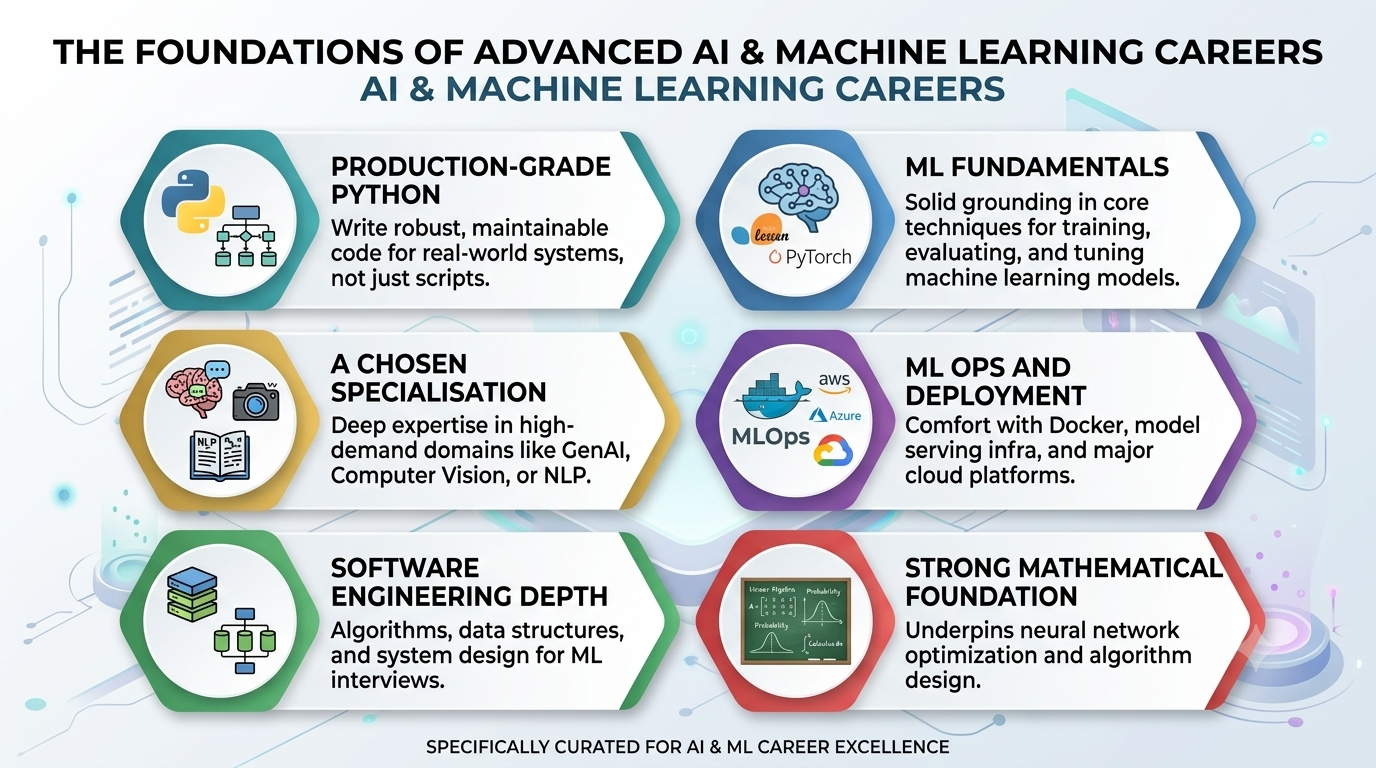
1. Production-grade Python – the ability to write robust, maintainable code that runs reliably in real-world systems, not just limited scripts
2. ML fundamentals – a solid grounding in scikit-learn and PyTorch, covering core techniques for training, evaluating, and tuning machine learning models
3. A chosen specialisation – deep expertise in a high-demand domain like GenAI/LLMs, computer vision, or NLP, instead of remaining a generalist
4. MLOps and deployment – comfort with tools like Docker, model serving infrastructure, and major cloud platforms such as AWS SageMaker, Azure ML, or Google Vertex AI
5. Software engineering depth – the data structures, algorithms, and system-design knowledge that technical interviews for ML and agentic systems actually test
6. A strong mathematical foundation – linear algebra, probability theory, and calculus, which underpin neural network optimisation and algorithm design
The Highest-Demand Specialisation Right Now: GenAI/LLM Engineering
If you can only prioritise one specialisation in 2026, industry data consistently points to GenAI/LLM engineering – building applications like RAG pipelines, fine-tuned models, and agentic workflows. Demand significantly exceeds current supply, which translates directly into the steepest pay premium across AI roles. MLOps is the second most under-supplied, high-value skill; production and deployment capability is what separates engineers who can actually ship AI systems from those who can only train models in a notebook.
A practical, high-signal project to build toward: at least one complete GenAI project – a RAG system, a fine-tuned model, or an agentic workflow – deployed on a free cloud tier or Hugging Face Spaces. This single project type carries more weight with 2026 hiring managers than a long list of theoretical coursework.
How to Build a Portfolio That Gets You Hired as an AI Engineer
In 2026, Indian AI companies evaluate three things above all else: coding ability, ML/AI understanding, and demonstrated problem-solving through real projects. A degree from a well-known institute provides assumed credibility on the first two, which somewhat lowers the portfolio bar. Candidates from less-known colleges, or those following the self-taught route, need a stronger project portfolio to compensate – practical skills increasingly matter more than credentials alone.
Practical steps:
1. Deploy real projects, not just notebook code – a GenAI project running live matters more than ten offline experiments
2. Position your resume specifically as an ML/AI Engineer, not a generic “data enthusiast” or data science profile
3. Apply through referrals where possible, targeting AI-first startups, Global Capability Centres (GCCs), product companies, and large tech firms’ dedicated AI teams
Related Read – How to Become a Civil Engineer
Common Job Roles After Becoming an AI Engineer
| Role | Focus and Overview |
| Machine Learning Engineer | Builds, trains, and deploys end-to-end machine learning models into reliable production environments |
| AI/NLP Engineer | Specialises in natural language processing systems, speech recognition, and language-based models |
| Computer Vision Engineer | Focuses on image processing, object detection, video analysis, and visual perception systems |
| MLOps Engineer | Bridges ML and DevOps to manage CI/CD pipelines, model monitoring, containerisation, and cloud deployment infrastructure |
| GenAI/LLM Engineer | Focuses on fine-tuning, embedding, prompt engineering, and building agentic workflows using LLMs |
| Data Scientist | An adjacent, analysis-focused role centred on statistical modelling, data visualisation, and extracting actionable business insights |
| AI Research Associate | An academic and R&D role focused on algorithmic innovation and novel model architectures, typically for candidates pursuing M.Tech or PhD-level specialisation |
AI Engineer Salary in India
| Experience Level | Annual Salary (₹) |
| Entry-level (0–2 years) | ₹6–15 LPA |
| Mid-level (3–6 years) | ₹15–40 LPA |
| Senior / GenAI Specialist | ₹35–70 LPA |
| ML Research Roles (top-tier colleges) | ₹25–45 LPA |
Compensation varies significantly by company type and location. Entry-level offers at Tier-1 companies commonly cluster around ₹7–12 LPA, while senior roles with genuine GenAI expertise command wide ranges (₹35–70 LPA) purely due to talent scarcity. At startups specifically, equity often matters as much as cash – a smaller cash offer with meaningful equity at a growing Series A company can outweigh a larger, equity-free offer at a services company, depending on your risk appetite and the company’s trajectory.
Is AI Engineering a Good Career Choice in 2026?
Yes, on the fundamentals – genuine demand, a strong compensation ceiling, and a widening set of entry points (formal degree or software-engineer transition) make this one of the stronger tech career bets available right now. The catch is that the field increasingly rewards depth over breadth: a strong GenAI or MLOps specialisation, backed by real deployed projects, will outperform a broad but shallow understanding of “AI in general” almost every time.
The Bottom Line
The AI engineering opportunity in India right now is genuinely large – the NASSCOM talent gap numbers aren’t hype, and companies are hiring aggressively for real technical depth. But the field has also matured past the point where a certificate course and a resume rebrand were enough to get in, the way they briefly were a few years ago. Whether you take the formal B.Tech route or the faster software-engineer transition, the actual differentiator stays the same: a genuine specialisation, real deployed projects, and production-level skills that hold up under a much more rigorous 2026 interview process.
Frequently Asked Questions
Do I need a B.Tech in AI specifically, or can I become an AI engineer with a regular Computer Science degree?
A regular CS degree works fine, and in many cases is just as viable as a dedicated AI degree. What matters more is the ML fundamentals, specialisation, and project portfolio you build on top of it, whether through electives, self-study, or a formal AI-focused programme.
Can a software engineer with no ML background realistically become an AI engineer?
Yes – this is described across multiple industry sources as the fastest path into the field. With a solid software engineering foundation already in place, adding ML fundamentals, a specialisation, and MLOps skills typically takes 6–12 months of focused effort.
Is a master’s degree or PhD necessary for AI engineering roles?
Not for most AI engineering roles, which prioritise practical, production-focused skills. A master’s or PhD becomes more relevant specifically for AI Research Associate roles or deep research-focused positions, rather than the broader AI/ML engineering track.
What’s the single most valuable project to have in my portfolio right now?
A deployed GenAI project – a RAG system, a fine-tuned model, or an agentic workflow – carries the highest signal with 2026 hiring managers, more so than a long list of completed online courses or theoretical coursework alone.
Which pays more – a core AI engineering role or a GenAI/LLM specialisation specifically?
GenAI/LLM specialisation currently commands the steepest pay premium among AI roles, given how significantly demand exceeds the available supply of genuinely skilled candidates in this specific area, compared to more generalist ML engineering roles.