

What Does a Civil Engineer Actually Do?
Civil engineering covers the design, construction, and maintenance of the physical environment we build and move through – roads, bridges, dams, buildings, airports, water supply systems, and railways. Day-to-day work typically involves:
1. Structural design and analysis of buildings, bridges, and infrastructure
2. Site surveying and geotechnical assessment
3. Project planning, scheduling, and cost estimation
4. Construction supervision and quality control

Most civil engineers eventually specialise — structural, geotechnical, transportation, water resources, or construction management being the most common tracks.
Core Skills Required to Become a Civil Engineer in India
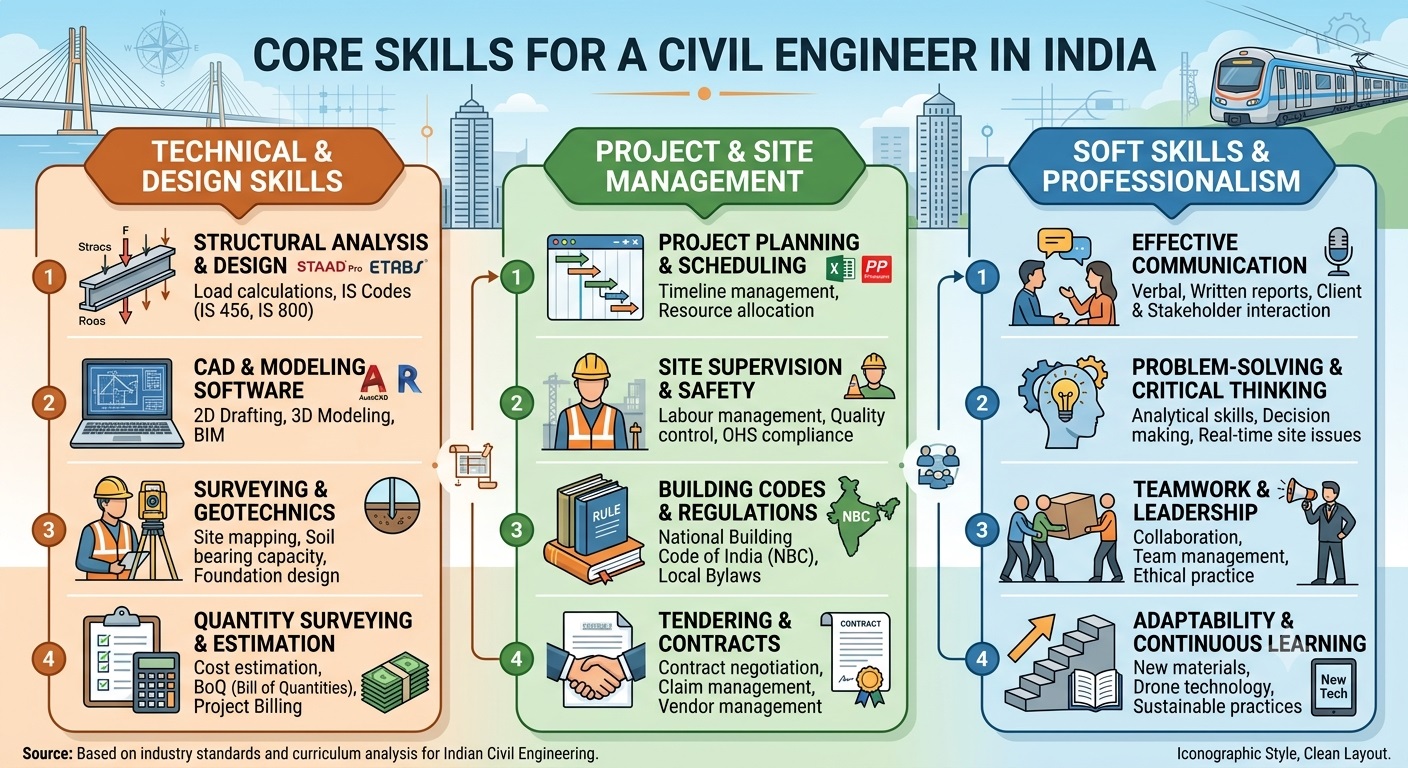
Before locking down eligibility criteria, it’s worth stepping back to see if the day-to-day realities of civil engineering fit your strengths and working style. Sitting right at the intersection of technical design, public safety, and real-world execution, civil engineering rewards a distinct blend of skills:
| Core Skill / Attribute | Description & Real-World Impact |
| Strong Mathematics & Physics Fundamentals | Calculus, classical mechanics, and structural analysis form the core technical foundation required to calculate loads, stress, and structural integrity. |
| Spatial Visualisation | Engineers must seamlessly translate 2D blueprints and CAD drawings into mental 3D models to spot physical clashes before construction begins. |
| Rigorous Attention to Detail | Precision is critical in civil design; a minor calculation mistake isn’t cosmetic – it can lead to severe structural flaws or catastrophic failure. |
| Site Resilience | The discipline extends beyond office work to active construction sites, requiring engineers to handle outdoor weather, physical demands, and on-site troubleshooting under tight deadlines. |
| Teamwork & Communication | Successful execution relies on clear coordination across diverse groups, bridging technical and non-technical gaps between architects, contractors, site workers, and clients. |
| Software Proficiency | Mastery of digital tools like AutoCAD, STAAD.Pro, Revit, and BIM (Building Information Modelling) software is an essential industry requirement for modern planning and analysis. |
If working with your hands, solving structural problems, and eventually seeing a physical building or bridge stand because of your calculations sounds appealing, the formal path below is simply about certifying and sharpening what should already feel like a natural fit.
Eligibility Criteria to Become a Civil Engineer

After Class 10 (Diploma Route)
1. Passed Class 10 from a recognised board, typically with a minimum of 35–50% marks (varies by state; reserved categories often get a 5% relaxation)
2. Science and Mathematics are usually required as core subjects
3. Diploma duration: typically 3 years, after which lateral entry into the second year of a B.Tech program is possible
After Class 12 (Degree Route — B.Tech/B.E.)
1. Passed Class 12 with Physics, Chemistry, and Mathematics (PCM) from a recognised board
2. Minimum aggregate marks generally range from 45% to 60%, though IITs/NITs/IIITs require at least 75% in Class 12 (65% for SC/ST/PwD), or a place in the top 20 percentile of your board, to be eligible for JEE Advanced counselling
3. No upper age limit for most entrance exams, though some state-level exams may specify their own limits
For Postgraduate Studies (M.Tech)
1. A B.Tech/B.E. in Civil Engineering or a closely related discipline
2. Admission typically through GATE scores for centrally funded institutions
Civil Engineering Entrance Exams in India
Admission to most reputed engineering colleges runs through competitive entrance exams rather than Class 12 marks alone:
| Exam Name | Purpose & Target Institutions |
| JEE Advanced | Required specifically for admission to the IITs (accessible only after qualifying JEE Main). |
| JEE Main | Primary examination for admission to NITs, IIITs, CFTIs, and many state or private engineering colleges. |
| State-Level CETs | State-specific entrance tests (e.g., MHT CET, KCET, AP EAMCET) for admission to state government and private colleges. |
| University-Specific Exams | Independent entrance tests conducted by various private and deemed universities such as BITS, SRM University, etc. |
| GATE | Required for postgraduate (M.Tech) admissions and widely used for recruitment in Public Sector Undertakings (PSUs). |
Course and Institute to Become a Civil Engineer
Some of the most recognised institutes for civil engineering in India include the IITs (Bombay, Delhi, Roorkee, Madras, Kanpur), NITs across states, VIT Vellore, DTU, and various state-run engineering colleges. Course fees vary enormously, from around ₹40,000 per semester at top government institutes like IIT Roorkee, up to several lakhs annually at premium private universities.
Courses for Civil Engineering
| Course Type | Duration | Best For |
| Diploma in Civil Engineering | 3 years | Early workforce entry, or lateral entry into B.Tech later |
| B.Tech/B.E. in Civil Engineering | 4 years | Standard, industry-recognised route into the profession |
| M.Tech in Civil Engineering (specialisation) | 2 years | Structural, geotechnical, or transportation specialisation; teaching/research roles |
The AMIE Route: An Alternative to Become a Civil Engineer
For working professionals and diploma holders who cannot attend a traditional four-year full-time college, Associate Membership of the Institution of Engineers (AMIE) offers a non-formal distance route to obtaining a degree-level engineering qualification.
Key aspects of the qualification:
1. Target audience: Designed primarily for polytechnic diploma holders and working professionals in technical fields seeking career advancement without stepping away from full-time employment.
2. Format & flexibility: A self-directed, exam-based pathway divided into two stages (Section A covering general engineering fundamentals and Section B focusing on specialised disciplines). Students learn independently and take examinations at designated centres.
3. Professional progression: Allows working technicians and junior engineers to upgrade their technical knowledge and qualify for internal promotions or specialised job roles.
Regulatory context worth knowing before you enrol: AMIE’s recognition as degree-equivalent has been genuinely contested for over a decade. A 2012 government order withdrew equivalence for students enrolling after 31 May 2013, and the Supreme Court has since held that such professional-body certifications aren’t automatically equivalent to a formal engineering degree without UGC or AICTE approval. That said, the matter remains under active litigation in the Delhi High Court, and outcomes have varied by case and by which specific recruitment or admission rule is being applied.
In practice: if you enrolled on or before May 31, 2013, your AMIE qualification is generally treated as degree-equivalent for government jobs and higher education. If you enrolled after that date, treat AMIE as valuable for professional development and many private-sector roles, but verify directly with AICTE, the Institution of Engineers (India), and your target employer or state recruitment body before assuming it will be accepted as degree-equivalent.
Career Paths After Civil Engineering
This is where civil engineering offers more range than people often expect the private-versus-government decision alone shapes your entire career trajectory.
Private Sector
1. Construction companies and real estate developers — site engineering, project execution
2. Consultancy and Project Management Consultancy (PMC) firms — design, structural analysis, project oversight; typically the highest private-sector earning track
3. Infrastructure and EPC (Engineering, Procurement, Construction) firms — large-scale highway, metro, and industrial projects
Government and PSU Route
This is where a large share of Indian civil engineers ultimately aim, given the job security and structured growth:
1. UPSC Engineering Services Examination (ESE) — one of the most prestigious routes, placing officers directly into central government departments like Railways, CPWD, and Border Roads Organisation
2. SSC Junior Engineer (JE) — a popular, relatively accessible entry point into central government technical posts
3. State PSC and State PWD recruitment — state-level equivalents of the above
4. PSU recruitment via GATE — companies like NTPC, ONGC, IOCL, GAIL, and Engineers India Limited (EIL) recruit Graduate Engineer Trainees largely based on GATE scores; pay varies significantly by PSU (see salary table below)
Higher Studies and Specialisation – An M.Tech, MBA (construction/infrastructure management), or PhD can open doors into specialised design roles, academia, or leadership positions in large infrastructure firms.
Entrepreneurship – Many experienced civil engineers eventually move into independent consultancy, contracting, or their own construction firms once they’ve built sufficient project experience and industry relationships.
Civil Engineer Salary in India 2026
Compensation varies significantly based on whether you go private or government, your specialisation, and your city.
| Career Stage | Private Sector (Annual) | Government/PSU (Monthly) |
| Fresher (0–2 years) | ₹2.5 – ₹4.5 LPA | ₹35,400 – ₹44,900 (basic pay, SSC JE/state level) |
| PSU Graduate Engineer Trainee (via GATE) | — | ₹6 – ₹18 LPA (CTC, including allowances; top-tier Maharatnas like IOCL, ONGC, and NTPC sit at the higher end) |
| Mid-level (5–9 years) | ₹8 – ₹14 LPA | ₹56,100+ (ESE/Pay Level 10 and above) |
| Senior/Project Manager (10+ years) | ₹20 – ₹35 LPA+ | ₹1,00,000 – ₹1,77,500 (senior pay levels) |
A few things worth noting: PSU roles recruited via GATE can offer some of the strongest fresher packages in the sector, particularly at top-tier Maharatna companies, and often outperform equivalent private-sector openings once benefits like pension, housing, and medical coverage are factored in. On the private side, consultancy and PMC firms tend to offer the highest growth ceiling, though with more volatility tied to project cycles and the broader real estate market. City also matters meaningfully — Mumbai, Delhi NCR, and Bengaluru consistently pay above the national average, while Tier-2 cities often offer a better cost-of-living-adjusted return.
Is Civil Engineering a Good Career Choice in 2026?
The honest answer: it depends on which track you choose. Generic site-execution roles are increasingly commoditised, and entry-level private salaries can feel modest relative to the years of study involved. But the macro picture remains strong — India’s sustained infrastructure investment ensures long-term demand isn’t going away, and engineers who build specialised skills (BIM, structural design software, construction management) or successfully crack the GATE/ESE government route tend to see meaningfully better outcomes than those who don’t differentiate at all.
FAQs: How to Become a Civil Engineer in India
Q1. Can I become a civil engineer with just a diploma, without a B.Tech?
Yes. A Diploma in Civil Engineering qualifies you for many private-sector site engineering roles and several government positions like SSC JE. You can also pursue lateral entry into a B.Tech program’s second year, or complete AMIE for a degree-equivalent qualification while working — though see the AMIE section above on verifying current recognition status.
Q2. Is mathematics compulsory to become a civil engineer?
Yes, for the standard B.Tech/B.E. route. Physics, Chemistry, and Mathematics (PCM) in Class 12 are mandatory prerequisites at almost every recognised engineering college in India.
Q3. What is the difference between JEE Main and JEE Advanced for civil engineering admission?
JEE Main is the qualifying exam for NITs, IIITs, and many other engineering colleges. JEE Advanced, accessible only after clearing JEE Main, is specifically required for admission to the IITs.
Q4. Which pays better — government or private civil engineering jobs?
It depends on the comparison point. PSU roles secured through GATE at top-tier Maharatnas can offer some of the strongest fresher packages in the field, while private consultancy and PMC roles typically offer higher long-term growth ceilings for those who specialise. Traditional government pay scales (SSC JE, state PWD) start more modestly but come with strong job security and benefits.
Q5. Do I need to clear GATE to get a government job to become a civil engineer?
Not necessarily. GATE is primarily the route into PSU recruitment and M.Tech admissions. Routes like SSC JE and UPSC ESE have their own separate exam processes and don’t require a GATE score.