
What is a Chartered Accountant?
A Chartered Accountant is a licensed accounting and finance professional who has cleared all levels of the ICAI examination and completed the mandatory practical training. CAs are authorised to practice across a wide range of financial domains including statutory audit, taxation (direct and indirect), corporate finance, financial reporting, forensic accounting, risk advisory, and management consulting.
Under the Companies Act 2013, only a practising CA can sign statutory audit reports of companies — making the CA designation a legal requirement rather than just a career choice for many businesses. CAs are employed across every sector of the Indian economy: from the Big 4 accounting firms (Deloitte, EY, KPMG, PwC) to MNCs like HUL and P&G, from startups and fintech companies to PSUs and government bodies.
Chartered Accountant Eligibility 2026
The eligibility criteria for the Chartered Accountancy (CA) course are broad and stream-inclusive. Students irrespective of their stream in Class 12 can apply for the Chartered Account course.
Route 1: After Class 12 (Foundation Route)
1. Minimum Qualification: Pass in Class 12 (10+2) or equivalent examination from any recognised board, in any stream.
2. Registration: Students can register for the CA Foundation course after passing Class 12. They must register at least four months before the exam date.

Route 2: After Graduation / Post-Graduation (Direct Entry)
Graduates and post-graduates can skip the CA Foundation and directly register for CA Intermediate under the Direct Entry Route, provided they meet the following marks criteria.
CA Intermediate Eligibility Criteria 2026
| Qualification | Minimum Marks for Direct Entry |
| B.Com / M.Com from a recognised university | 55% aggregate marks |
| Other graduation or post-graduation (non-Commerce) | 60% aggregate marks |
| Professional qualifications (ICSI, ICMAI members) | Eligible for Direct Entry without minimum marks requirement |
Important Note – Students in their final year of graduation may also provisionally register for CA Intermediate under Direct Entry, subject to fulfilling the marks requirement upon the result declaration.
Chartered Accountant Course Structure 2026
The CA course in India is structured in three levels: CA Foundation, CA Intermediate, and CA Final. Alongside these examinations, students must complete a 3-year Articleship (practical training) under a practising Chartered Accountant. Together, these components take a minimum of 4.5 to 5 years.
Level 1: CA Foundation
The CA Foundation is the entry-level examination conducted by ICAI twice a year — in May and November. It tests candidates on accounting, mathematics, economics, and business laws.
CA Foundation Syllabus 2026
| Subject | Marks | Exam Type |
| Paper 1: Principles and Practice of Accounting | 100 | Subjective |
| Paper 2: Business Mathematics, Logical Reasoning & Statistics | 100 | Objective (MCQ) |
| Paper 3: Business Economics | 100 | Objective (MCQ) |
| Paper 4: Business & Commercial Knowledge | 100 | Objective (MCQ) |

Level 2: CA Intermediate
CA Intermediate is the middle level, covering advanced accounting, auditing, taxation (direct and indirect), corporate law, cost management, financial management, and strategic management. It is divided into two groups of three papers each.
CA Intermediate Syllabus 2026
| Group | Paper | Subject |
| Group 1 | Paper 1 | Advanced Accounting |
| Group 1 | Paper 2 | Corporate and Other Laws |
| Group 1 | Paper 3 | Taxation (Direct & Indirect) |
| Group 2 | Paper 4 | Cost and Management Accounting |
| Group 2 | Paper 5 | Auditing and Code of Ethics |
| Group 2 | Paper 6 | Financial Management & Strategic Management |
Articleship Eligibility: Students can register for the 3-year Articleship after passing either one or both groups of CA Intermediate.
Level 3: CA Final
CA Final is the most advanced level, covering financial reporting (Ind AS / IFRS), strategic financial management, advanced auditing, direct and indirect taxation, risk management, and more. There are six papers across two groups.
CA Final Syllabus 2026
| Group | Paper | Subject |
| Group 1 | Paper 1 | Financial Reporting |
| Group 1 | Paper 2 | Advanced Financial Management |
| Group 1 | Paper 3 | Advanced Auditing, Assurance & Professional Ethics |
| Group 2 | Paper 4 | Direct Tax Laws & International Taxation |
| Group 2 | Paper 5 | Indirect Tax Laws (GST & Customs) |
| Group 2 | Paper 6 | Integrated Business Solutions (Multi-disciplinary case study) |
When to Appear: CA Final exams can be attempted after completing the 3-year Articleship (or within the last 6 months of Articleship under specific conditions).
Articleship: The Heart of CA Training
The 3-year Articleship under a practising Chartered Accountant is what sets the CA qualification apart. During Articleship, students work on real-world assignments — auditing company accounts, filing income tax returns, handling GST compliance, advising clients, and assisting in financial due diligence. The quality of your Articleship firm significantly shapes your practical knowledge, network, and career trajectory. Articleship at a Big 4 firm, a mid-tier CA firm, or an industry finance department each offers a distinct but
Articleship Stipend: Generally ₹7,000–15,000 per month, depending on the city and the size of the firm. Some Big 4-affiliated firms pay ₹18,000–25,000 per month.
Step-by-Step: How to Become a Chartered Accountant?
| Step | Action | Timeline |
| 1 | Pass Class 12 in any stream | – |
| 2 | Register for CA Foundation with ICAI at icai.org | After Class 12 result |
| 3 | Appear and clear CA Foundation (May or November exam) | 6 months after registration |
| 4 | Register for CA Intermediate; enrol in the Integrated Course on IT & Soft Skills (ICITSS) | After Foundation clearance |
| 5 | Complete ICITSS (mandatory IT and orientation programme) | 4 weeks, before Articleship |
| 6 | Register for Articleship (3 years) under a practising CA | After clearing 1 group of Intermediate |
| 7 | Clear both groups of CA Intermediate | Within first 1–2 years of Articleship |
| 8 | Enrol in Advanced Integrated Course on IT & Soft Skills (AICITSS) | During last 2 years of Articleship |
| 9 | Complete AICITSS and appear in CA Final | After completing Articleship (or in last 6 months) |
| 10 | Clear both groups of CA Final | Minimum 4.5 years after Class 12 |
| 11 | Apply for ICAI membership; become a qualified CA | After clearing CA Final + Articleship |
Important Note: From the date you register for CA Foundation to the day you receive your ICAI membership, the minimum time is approximately 4.5 years. Most students complete the journey in 5–6 years. Starting early, choosing a strong Articleship firm, and aiming for first-attempt clears at each level can significantly accelerate this timeline.
Also Read – Aptitude Test for Students
Chartered Accountant Salary in India 2026
One of the biggest motivations to pursue the CA qualification is its exceptional earning potential. The Chartered Accountant salary in India is among the highest for any professional qualification in the country, and it grows substantially with experience, specialisation, and the right career choices.
CA Fresher Salary (0–2 Years Experience)
| Employer Type | Fresher CA Salary (2026) | Notes |
| Big 4 (Deloitte, EY, KPMG, PwC) – Audit / Tax | ₹8.5–12 LPA | Advisory / Deals roles can reach ₹15 LPA |
| Indian & Global MNCs (Finance, FP&A) | ₹12–20 LPA | Higher for ranked candidates (AIR Top 50) |
| Startups (PE-backed) | ₹10–16 LPA | Performance-linked upside |
| PSUs (e.g., PFC, ONGC, BHEL) | ₹10–18 LPA | Job security + perks |
| CA Firms (Mid-tier / Independent) | ₹3–8 LPA | Strong practical learning exposure |
| ICAI Campus Placement Average (2025) | ₹12.88 LPA | Highest: ₹26.60 LPA (PFC) |
The ICAI 62nd Campus Placement Programme (August–September 2025) placed newly qualified CAs, with an average package of ₹12.88 LPA; the highest domestic offer was ₹26.60 LPA from Power Finance Corporation (PFC). In the open market, most CA freshers earn between ₹6–14 LPA depending on the firm type, city, and whether they cleared exams in the first attempt.
CA Salary based on Experience Level
| Experience Level | Salary Range | Typical Roles |
| Fresher (0–2 years) | ₹6–14 LPA | Junior Auditor, Tax Associate, Finance Analyst |
| Mid-level (3–5 years) | ₹15–25 LPA | Senior Auditor, Tax Manager, Financial Controller |
| Senior (6–10 years) | ₹25–50 LPA | Finance Director, VP Finance, Transfer Pricing Head |
| Leadership (10+ years / CFO / Partner) | ₹50 LPA – ₹1 Crore+ | CFO, Big 4 Partner, Independent Practice |
CA Salary Range: based on Working Sector
| Sector / Industry | Typical CA Salary Range (2026) |
| Investment Banking & Private Equity | ₹18–45 LPA (freshers to mid-level) |
| Fintech & Technology | ₹10–45 LPA (high growth, equity upside possible) |
| FMCG & Consumer Goods (HUL, P&G, Marico) | ₹18–25 LPA (freshers with AIR Top 50) |
| Big 4 (Audit, Tax, Advisory) | ₹8.5–55 LPA (fresher to Director level) |
| Banking & Financial Services | ₹10–35 LPA |
| Manufacturing & Real Estate | ₹8–90 LPA (range across roles) |
| PSU / Government | ₹7–20 LPA (structured + perks) |
| Independent CA Practice | Highly variable – ₹5 LPA to ₹1 Crore+ (depends on client base) |
Career Paths After Becoming a Chartered Accountant (CA)
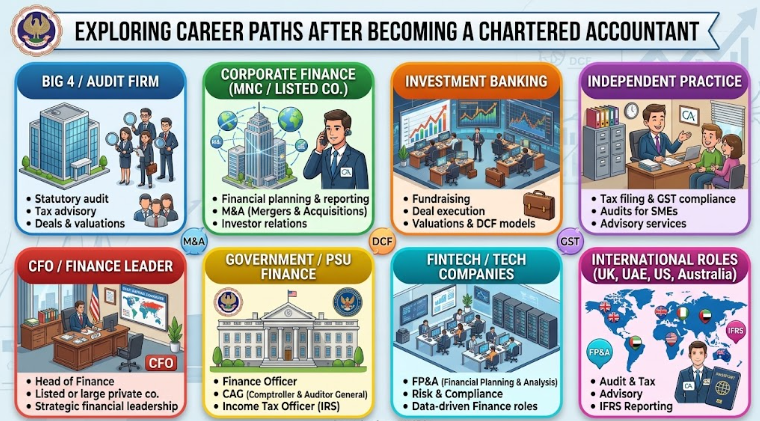
One of the most underrated aspects of the CA qualification is the sheer breadth of career options it unlocks. Here are the most popular and high-growth paths:
List of Careers after becoming a Chartered Accountant
| Career Path | What You Do | Salary Potential |
| Big 4 / Audit Firm | Statutory audit, tax advisory, deals & valuations | ₹8–55 LPA |
| Corporate Finance (MNC / Listed Company) | Financial planning, reporting, M&A, investor relations | ₹12–60 LPA |
| Investment Banking | Fundraising, deal execution, valuations, DCF models | ₹20–80 LPA |
| Independent Practice | Tax filing, GST compliance, audits, advisory for SMEs | ₹5 LPA – ₹1 Crore+ |
| CFO / Finance Leader | Head of Finance at a listed or large private company | ₹50 LPA – ₹1 Crore+ |
| Government / PSU Finance | Finance Officer, CAG, Income Tax Officer (through IRS) | ₹7–20 LPA + perks |
| Fintech / Tech Companies | FP&A, Risk, Compliance, Data-driven Finance roles | ₹12–45 LPA |
| International Roles (UK, UAE, US, Australia) | Audit, Tax, Advisory, IFRS Reporting | ₹26–76 LPA equivalent |
Why Pursue the CA Course?
The CA qualification stands apart from other finance credentials for several reasons. First, it is India’s only legally mandated professional qualification for statutory audit, creating a structural floor of demand that no other degree can access. Second, the ICAI rigour, widely regarded as one of the toughest professional exams in the world, with pass rates sometimes below 10% at the Final level, means that qualified CAs carry an enormous signal of capability.
Third, the breadth of the curriculum means you emerge genuinely multi-skilled: taxation, accounting, audit, law, financial management, and ethics are all part of the core syllabus. Add to this the three-year Articleship, and you have a professional who has both theoretical depth and practical experience from Day 1 of their career.
The ICAI Career Catalyst Programme 2026 (launched in March 2026 as a virtual preparation platform for campus placements) and the expanding ICAI mutual recognition agreements with international bodies further reinforce that the CA qualification is not just India-bound. It is a globally portable credential that continues to evolve.
Also Read – Buddy4Study Career Assessment Test
Final Thoughts: Is CA the Right Career for You?
Becoming a Chartered Accountant in India is not an easy path, but it is a deeply rewarding one. The combination of a structured qualification framework, a legally protected professional designation, and an earnings trajectory that ranges from ₹8–12 LPA as a fresher to ₹1 Crore+ as a senior professional or partner, makes it one of the most powerful career investments a student can make.
The key is starting early, choosing the right Articleship firm, targeting first-attempt clears, and deliberately building a specialisation (GST, M&A, IFRS, FP&A) that commands a premium in the market. If you enjoy working with numbers, problem-solving under complexity, and building businesses from the financial ground up, the CA course is built for you.
How to Become a Chartered Accountant in India 2026 – FAQs
Q1. What is the minimum qualification to become a CA?
An individual is required to pass Class 12 in any stream to register for CA Foundation. Graduates with 55–60% marks can directly join CA Intermediate, skipping Foundation entirely.
Q2. How many years does it take to become a CA?
Becoming a Chartered Accountant takes at least 4.5 years after Class 12. It includes a 6-month Foundation, 1–1.5 years Intermediate, a 3-year Articleship, and the Final exam. Most students complete the entire qualification within 5 to 6 years.
Q3. What is the salary of a CA fresher in India?
A Chartered Accountant fresher earns ₹6–14 LPA depending on the firm and city. The average for the ICAI 62nd Campus Placement was ₹12.88 LPA, with the highest offer reaching ₹26.60 LPA.
Q4. Can a Science or Arts student become a CA?
Absolutely, CA eligibility has no stream restriction — Science, Commerce, and Arts students are all equally eligible to register for CA Foundation after Class 12.