
Who is a General Physician?

Key Skills Needed to Become a General Physician
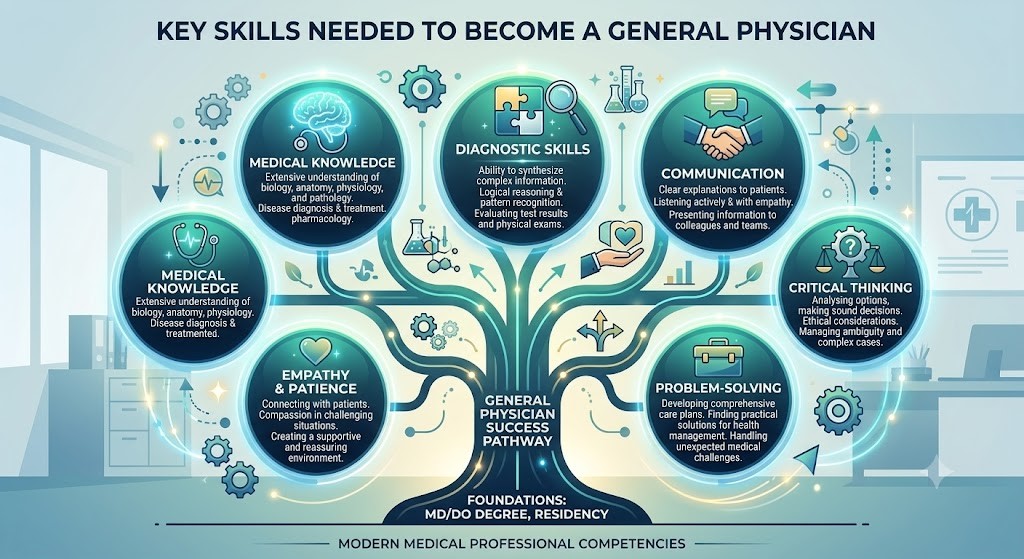
Clearing the MBBS and qualifying exams gets you the qualification, but these are the skills that actually determine how good a physician you become in practice. The infographic and list below cover the six areas that matter most, from clinical grounding to the judgement to know your limits.
1. Sound clinical knowledge across common illnesses and chronic disease management
2. Careful diagnostic reasoning and attention to detail
3. Clear communication to explain diagnoses and treatment plans to patients
4. Empathy and patience when supporting patients over long-term care

6. Commitment to continuous learning as medical knowledge and treatment guidelines evolve
Eligibility Criteria to Become a General Physician
Eligibility for this path falls into two distinct stages: what you need before you can even start MBBS, and what you need to complete afterward before you can actually practise. The lists below cover each separately.
Admission Eligibility for General Physician Before MBBS
1. Educational Qualification: Class 12 passed with Physics, Chemistry, and Biology (PCB) from a recognised board

3. Age Limit: Minimum 17 years at the time of admission (no upper age limit for NEET as per current norms)
4. Entrance Exam: Must qualify NEET-UG for MBBS admission
Post-MBBS Requirements for General Physician to Practise
Once you clear MBBS, a few more requirements stand between you and practising independently as a doctor.
1. Degree Requirement: MBBS degree from a college recognised by the National Medical Commission (NMC)
2. Internship: Completion of 1-year mandatory rotatory internship post-MBBS
3. Registration: Valid registration with State Medical Council or NMC to practice
4. Postgraduate Qualification (optional): MD in General Medicine for specialisation, requiring NEET-PG qualification
How to Become a General Physician
Becoming a General Physician in India follows a clearly defined academic and clinical path that runs through an MBBS degree, a mandatory internship, and registration with the medical regulator.
Step 1: Complete Class 12 from a recognised board in the science stream with Physics, Chemistry and Biology (PCB), along with English as a core subject.
Step 2: Appear for NEET UG (National Eligibility cum Entrance Test, Undergraduate), conducted by the National Testing Agency, and secure a seat through the relevant counselling process.
Step 3: Complete the MBBS degree at a college recognised by the National Medical Commission, combining academic study with clinical training.
Step 4: Undertake the Compulsory Rotatory Residential Internship (CRRI), a mandatory one-year internship required to practise as a doctor in India.
Step 5: Register with the National Medical Commission or the relevant State Medical Council to obtain a licence to practise.
Step 6: Begin practising as a General Physician in a hospital, clinic or Primary Health Centre, or pursue further postgraduate study.
Step 7: Consider an MD in General Medicine, via NEET PG, to deepen clinical expertise and pursue senior hospital or teaching positions.
Step 8: Continue medical education and clinical experience to progress into senior consultant or specialist roles.
Career Paths After General Physician Course
Once registered and practising, a General Physician’s career can branch in several directions depending on the setting, ambition, and whether further specialisation is pursued. The table below outlines the main paths available.
| Career Path | What You Do |
| General Physician (Primary Care) | Diagnose and treat common illnesses, manage chronic conditions, and refer patients to specialists when needed |
| Hospital Medical Officer | Provide clinical care within a hospital setting, often across multiple departments |
| Government Health Service Doctor | Work within Primary Health Centres and district hospitals under state or central health services |
| Consultant Physician (after MD) | Provide specialised internal medicine consultations in a hospital or private practice setting |
| Medical Researcher or Academic | Pursue research or teaching roles at a medical college or research institution |
| Independent Clinic Owner | Run a private practice, building an independent patient base over time |
Also Read: How to Become a Chef in India
General Physician Salary in India
Earnings for a General Physician vary considerably by sector, city, and experience, with private practice and specialisation typically offering the highest long-term potential. The table below breaks this down by practice type.
Salary for General Physician in India
| Practice Type | Salary / Earning Potential |
| Government Hospitals/Clinics | Structured pay scale with job security and allowances, accessed through state or central recruitment processes |
| Private Hospitals | Salary varies by hospital and experience; potential for higher earnings compared to government roles |
| Independent Clinic/Private Practice | Earning potential grows over time as the physician builds an independent patient base |
| Senior Consultant Roles | Higher earning potential, typically achieved with experience and specialization |
| Average General Physician Salary (India) | Approximately ₹48,500 |
Also Read: How to Become an Aerospace Engineer in India
Top Institutes for General Physicians in India
Government medical colleges generally offer the lowest fees and, at the most reputed institutes, some of the strongest clinical exposure in the country, though seats are highly competitive and NEET UG cutoffs run high.
Top Government General Physician Institutes, Courses and Eligibility Criteria
| Institute | Courses Offered | Entrance Exam | Eligibility Criteria |
| All India Institute of Medical Sciences (AIIMS), New Delhi | MBBS, MD General Medicine | NEET UG (UG), NEET PG (PG) | Class 12 with PCB; qualifying NEET UG score. MD: MBBS degree;
qualifying NEET PG score |
| Armed Forces Medical College (AFMC), Pune | MBBS, MD General Medicine | NEET UG (UG), NEET PG (PG) | Class 12 with PCB; qualifying NEET UG score, subject to additional service eligibility criteria |
| Lady Hardinge Medical College, New Delhi | MBBS, MD General Medicine | NEET UG (UG), NEET PG (PG) | Class 12 with PCB; qualifying NEET UG score |
| Postgraduate Institute of Medical Education and Research (PGIMER), Chandigarh | MD General Medicine | NEET PG | MBBS degree with minimum aggregate marks specified by the college; qualifying NEET PG score |
| Jawaharlal Institute of Postgraduate Medical Education and Research (JIPMER), Puducherry | MBBS, MD General Medicine | NEET UG (UG), NEET PG (PG) | Class 12 with PCB; qualifying NEET UG score |
| Maulana Azad Medical College, New Delhi | MBBS, MD General Medicine | NEET UG (UG), NEET PG (PG) | Class 12 with PCB; qualifying NEET UG score |
| King George’s Medical University (KGMU), Lucknow | MBBS, MD General Medicine | NEET UG (UG), NEET PG (PG) | Class 12 with PCB; qualifying NEET UG score |
| Madras Medical College, Chennai | MBBS, MD General Medicine | NEET UG (UG), NEET PG (PG) | Class 12 with PCB; qualifying NEET UG score |
| Grant Medical College, Mumbai | MBBS, MD General Medicine | NEET UG (UG), NEET PG (PG) | Class 12 with PCB; qualifying NEET UG score |
| Government Medical College, Chandigarh | MBBS, MD General Medicine | NEET UG (UG), NEET PG (PG) | Class 12 with PCB; qualifying NEET UG score |
Top Private General Physician Institutes, Courses and Eligibility Criteria
Private medical colleges typically charge significantly higher fees but often offer more predictable admission chances and modern infrastructure – a trade-off worth weighing against the government route above.
| Institute | Courses Offered | Entrance Exam | Eligibility Criteria |
| Christian Medical College (CMC), Vellore | MBBS, MD General Medicine | NEET UG (UG), NEET PG (PG) | Class 12 with PCB; qualifying NEET UG score |
| Kasturba Medical College (KMC), Manipal/Mangalore | MBBS, MD General Medicine | NEET UG (UG), NEET PG (PG) | Class 12 with PCB; qualifying NEET UG score |
| St. John’s Medical College, Bengaluru | MBBS, MD General Medicine | NEET UG (UG), NEET PG (PG) | Class 12 with PCB; qualifying NEET UG score |
| JSS Medical College, Mysuru | MBBS, MD General Medicine | NEET UG (UG), NEET PG (PG) | Class 12 with PCB; qualifying NEET UG score |
| Sri Ramachandra Medical College, Chennai | MBBS, MD General Medicine | NEET UG (UG), NEET PG (PG) | Class 12 with PCB; qualifying NEET UG score |
| M S Ramaiah Medical College, Bengaluru | MBBS, MD General Medicine | NEET UG (UG), NEET PG (PG) | Class 12 with PCB; qualifying NEET UG score |
| D Y Patil Medical College, Pune | MBBS, MD General Medicine | NEET UG (UG), NEET PG (PG) | Class 12 with PCB; qualifying NEET UG score |
| Bharati Vidyapeeth Medical College, Pune | MBBS, MD General Medicine | NEET UG (UG), NEET PG (PG) | Class 12 with PCB; qualifying NEET UG score |
| Amrita School of Medicine, Kochi | MBBS, MD General Medicine | NEET UG (UG), NEET PG (PG) | Class 12 with PCB; qualifying NEET UG score |
| SRM Medical College Hospital and Research Centre, Chennai | MBBS, MD General Medicine | NEET UG (UG), NEET PG (PG) | Class 12 with PCB; qualifying NEET UG score |
Also Read: How to Become an Interior Designer in India
Why Choose General Medicine as a Career?
General Medicine is one of the few medical paths where you don’t have to decide everything upfront. An MBBS alone is enough to begin practising and building a career, specialising further with an MD remains a genuine later option, not a prerequisite, which makes this route more accessible than surgical or super-specialist tracks that demand years of additional training before you can practise independently. The field also offers real flexibility in how you build a career: work within government health services for stability and structured growth, join private hospitals or corporate healthcare chains for higher earning potential, or build an independent clinical practice at your own pace, without being tied to a single, rigid career ladder.
How to Become a General Physician: FAQs
What is the minimum qualification needed to become a General Physician in India?
An MBBS degree from a college recognised by the National Medical Commission is the standard entry qualification. This requires completing Class 12 in the science stream with Physics, Chemistry and Biology (PCB), along with English, generally with a minimum aggregate of around 50 per cent marks.
Do I need to clear an entrance exam to study MBBS?
Yes. NEET UG, conducted by the National Testing Agency, is the sole entrance exam for MBBS admission across all government and private medical colleges in India.
How long does it take to become a General Physician?
The MBBS degree, including the mandatory one year Compulsory Rotatory Residential Internship, takes 5.5 years after Class 12. Practitioners who pursue an MD in General Medicine for further specialisation add a further three years.
Is General Medicine a good career option in India?
Yes, particularly if you value stability and flexibility over the higher but narrower earning ceiling of a super-specialisation. It offers a lower barrier to independent practice than surgical or super-specialist fields, since an MBBS alone lets you begin working, and demand remains especially strong in Tier 2/3 cities and rural Primary Health Centres, where qualified doctors are harder to recruit and retain than in metro hospitals.