
Who is a Dietician?

Dieticians work across hospitals, nursing homes, wellness centres, sports organisations, the food and pharmaceutical industry, and private practice.
Key Skills Needed to Become a Dietician
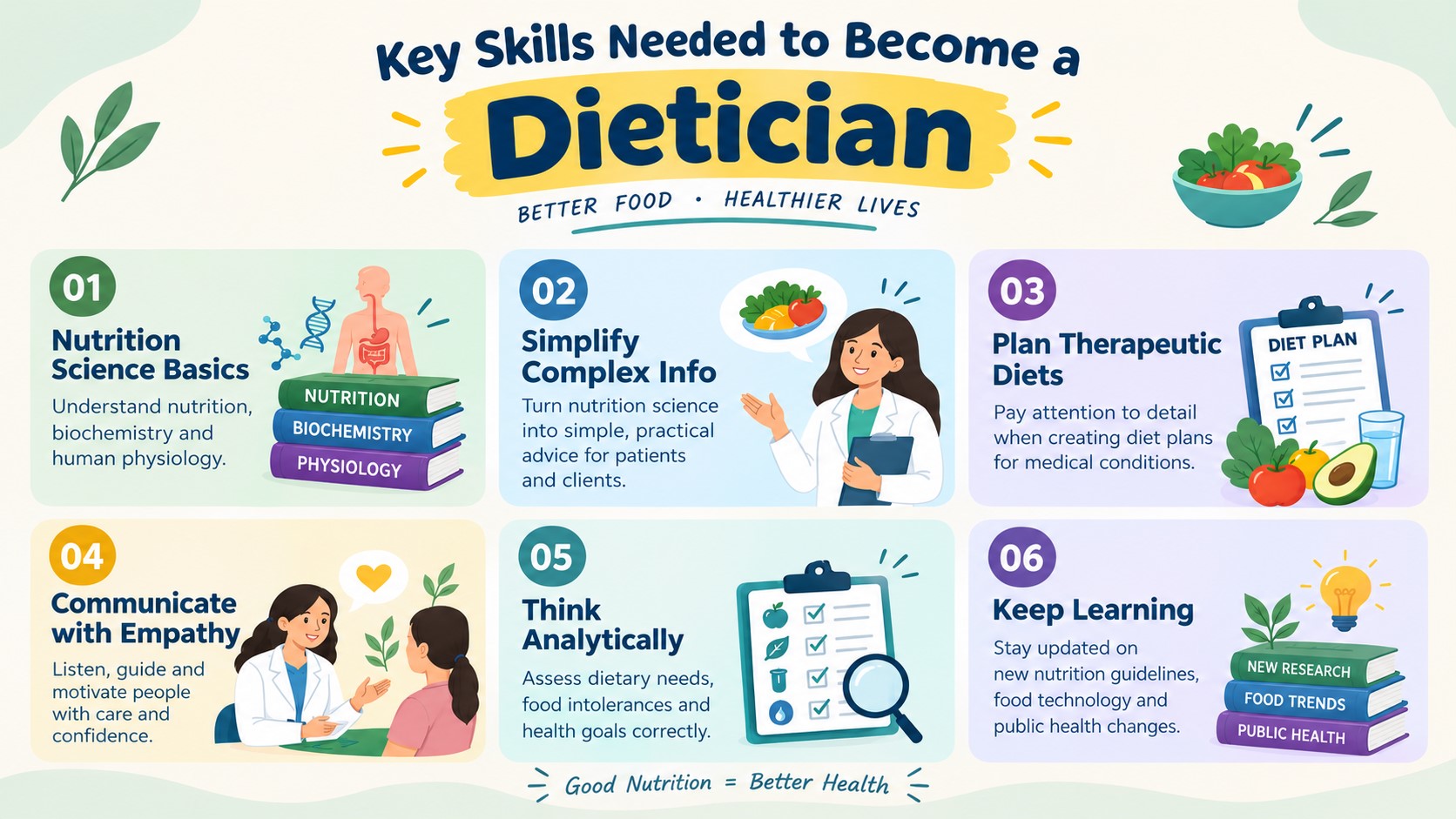
Becoming a successful dietician calls for a mix of scientific knowledge and people skills. Here are the key skills you’ll need to build:
1. A strong grounding in nutrition science, biochemistry and human physiology.
2. The ability to translate complex nutrition science into simple, practical advice for patients and clients.
3. Attention to detail while designing therapeutic diet plans for people with specific medical conditions.

5. Analytical thinking to assess dietary needs, food intolerances and health goals accurately.
6. A willingness to keep learning as nutrition guidelines, food technology and public health priorities evolve.
Also Read: How to Become a Biomedical Engineer
Eligibility Criteria to Become a Dietician in India
| Stage | Requirement |
| Class 12 (10+2) | Science stream, generally with Physics, Chemistry and Biology, from a recognised board. Some institutes also admit students from a Home Science background. |
| Bachelor’s degree | A graduate degree in Food, Nutrition & Dietetics, or a B.Sc. in Home Science with Food and Nutrition as a specialisation covering at least four nutrition-related subjects (Nutritional Biochemistry, Food Microbiology, Basic Nutrition, Clinical and Therapeutic Nutrition), from a UGC-recognised university. |
| IDA Life Membership | Candidates must hold a Life Membership of the Indian Dietetic Association before starting their internship. |
| Postgraduate qualification | A Postgraduate Diploma in Food, Nutrition & Dietetics, or an M.Sc. in Foods & Nutrition, Clinical Nutrition, or Dietetics. |
| Internship | Six months of continuous internship at a hospital recognised by the IDA for RD training, completed under an eligible Registered Dietician. |
| Alternative to internship | Five years of full-time clinical experience as a Dietician in a multispecialty hospital recognised by the IDA (a recommendation letter from the IDA Chapter Convenor is needed if the hospital is not on the IDA’s recognised list). |
| Registration | Passing the Registered Dietician (RD) board examination conducted by the IDA. |
How to Become a Dietician in India: Step-by-Step Process

Step 1: Complete Class 12 in the science stream, ideally with Physics, Chemistry and Biology, from a recognised board.
Step 2: Enrol for a Bachelor’s degree in Food, Nutrition & Dietetics, or a B.Sc. in Home Science with a Nutrition specialisation, at a UGC-recognised university.
Step 3: Take up Life Membership of the Indian Dietetic Association before beginning the internship stage.
Step 4: Complete a postgraduate qualification, either a PG Diploma in Food, Nutrition & Dietetics or an M.Sc. in Foods & Nutrition, Clinical Nutrition, or Dietetics.
Step 5: Undertake a six-month continuous internship at a hospital recognised by the IDA for RD training (or complete five years of full-time clinical Dietician experience at a recognised multispecialty hospital as an alternative route).
Step 6: Register for and appear in the Registered Dietician (RD) board examination conducted annually by the IDA.
Step 7: Clear both papers of the RD exam, with a minimum of 50 per cent overall and at least 45 per cent in each paper, to be allotted an RD number by the Association.
Step 8: Build practical experience and consider specialising further, in areas such as clinical nutrition, sports nutrition, paediatric nutrition, or public health nutrition.
Also Read: How to Become an HR Manager in India
Career Paths After a Dietician Qualification
| Career Path | What You Do |
| Clinical Dietician | Design and monitor therapeutic diet plans for patients in hospitals and clinics |
| Public Health Nutritionist | Work on community nutrition programmes and public health campaigns |
| Paediatric Nutritionist | Plan nutrition and dietary care specifically for infants, children and adolescents |
| Sports Nutritionist | Advise athletes and fitness clients on performance and recovery nutrition |
| Food Safety Officer or Quality Analyst | Evaluate the nutritional and safety standards of food products for manufacturers |
| Research Dietician | Work in clinical or academic research on nutrition and dietary interventions |
| Corporate Wellness Consultant | Design workplace nutrition and wellness programmes for organisations |
Dietician Salary in India
| Job Profile | Starting Salary Range | Salary With Experience |
| Clinical Dietician | ₹3,00,000 to ₹4,00,000 per annum | ₹6,00,000 to ₹10,00,000 per annum |
| Nutritionist | ₹2,50,000 to ₹4,00,000 per annum | ₹6,00,000 to ₹8,00,000 per annum |
| Paediatric Nutritionist | ₹3,00,000 to ₹4,00,000 per annum | ₹6,00,000 to ₹9,00,000 per annum |
| Public Health Nutritionist | ₹3,50,000 to ₹5,00,000 per annum | ₹7,00,000 to ₹10,00,000 per annum |
| Sports Nutritionist | ₹3,50,000 to ₹5,00,000 per annum | ₹6,00,000 to ₹12,00,000 per annum |
The Registered Dietician (RD) Examination
Source: Indian Dietetic Association, R.D. Examination Pattern
The RD exam is the qualifying step that separates a nutrition graduate from a professionally recognised dietician in India, so understanding its format is essential before applying.
1. The exam is conducted once a year, typically in February, with the exact 2026-27 cycle dates to be announced by the IDA on its website at least six months in advance.
2. Paper I (two hours): Physiology, Microbiology and Biochemistry.
3. Paper II (two and a half hours): Nutrition, Dietetics and Food Service Management.
4. Each paper has three sections: objective questions, multiple-choice questions, and clinical-oriented questions.
5. Candidates need a minimum of 50 per cent overall, with at least 45 per cent in each paper, to qualify.
6. Successful candidates are issued an RD number and are listed as a Registered Dietician by the IDA.
Top Colleges for Nutrition and Dietician Courses in India
India has more than 200 colleges offering Nutrition and Dietician programmes at the undergraduate and postgraduate level. The table below lists some of the widely referenced government and private institutions for this stream.
Top Government and Public Institutions for Nutrition and Dietician Courses in India
| Institute | Location | Courses Offered |
| Lady Irwin College, Delhi University | New Delhi | B.Sc. and M.Sc. in Food and Nutrition |
| Queen Mary’s College | Chennai, Tamil Nadu | B.Sc. Nutrition and Dietetics |
| Women’s Christian College | Chennai, Tamil Nadu | B.Sc. Nutrition and Dietetics |
| SNDT Women’s University | Mumbai, Maharashtra | B.Sc. and M.Sc. in Food, Nutrition and Dietetics |
Top Private Institutions for Nutrition and Dietician Courses in India
| Institute | Location | Courses Offered |
| Sri Ramachandra Medical College and Research Institute | Chennai, Tamil Nadu | B.Sc. and M.Sc. in Clinical Nutrition and Dietetics |
| Mount Carmel College | Bengaluru, Karnataka | B.Sc. Nutrition and Dietetics |
| J.D. Birla Institute | Kolkata, West Bengal | B.Sc. Home Science with Food and Nutrition |
| Lovely Professional University | Punjab | B.Sc. and M.Sc. Food and Nutrition |
Also Read: How to Become a Criminal Lawyer in India
Why Choose Dietetics as a Career in India?
Rising awareness of lifestyle diseases, obesity, and preventive healthcare has widened the scope for qualified dietitians well beyond hospitals, extending into corporate wellness, sports teams, the food industry, and private practice. According to a recent National Statistical Office survey, over 50% of India’s population now lives with lifestyle diseases like diabetes, hypertension, and heart disease – up from just 31% a decade ago, driving fast-rising demand for trained dietetic professionals. The career also offers flexibility: a Registered Dietitian can build a clinical career, move into public health and research, or work independently as a consultant, without being confined to one type of employer.
How to Become a Dietician in India: FAQs
Do I need to become a member of the Indian Dietetic Association before my internship?
Yes. The IDA’s eligibility rules require candidates to hold Life Membership of the Association before starting the six-month internship, alongside the required graduate and postgraduate qualifications, before they can apply for the Registered Dietician examination.
Can I appear for the RD exam without a postgraduate degree?
No. The Indian Dietetic Association requires either a Postgraduate Diploma in Food, Nutrition & Dietetics or an M.Sc. in Foods & Nutrition, Clinical Nutrition, or Dietetics, in addition to a relevant graduate degree, before a candidate can write the exam.
Is work experience an alternative to the six-month internship?
Yes. Candidates with five years of full-time clinical experience as a Dietician in a multispecialty hospital recognised by the IDA can apply for the RD exam without completing the standard internship route.
What subjects are tested in the RD examination?
Paper I covers Physiology, Microbiology and Biochemistry, while Paper II covers Nutrition, Dietetics and Food Service Management. Candidates need 50 per cent overall and at least 45 per cent in each paper to pass.
Do I need to clear NEET to become a dietician?
No, NEET is not required to become a dietician. NEET is only for medical courses like MBBS and BDS. To become a dietician, you need a bachelor’s degree in Nutrition, Dietetics, Food Science or Home Science, followed by a postgraduate diploma or master’s degree for specialisation.