What Does an HR Manager Actually Do?

1. Talent acquisition and recruitment strategy
2. Employee relations, performance management, and conflict resolution
3. Compensation and benefits structuring
4. Learning and development (L&D) programme design
5. Compliance with labour law and organisational policy

At senior levels, particularly in the HR Business Partner (HRBP) model common at larger companies, the role shifts from administrative execution toward strategic input on business decisions involving people.
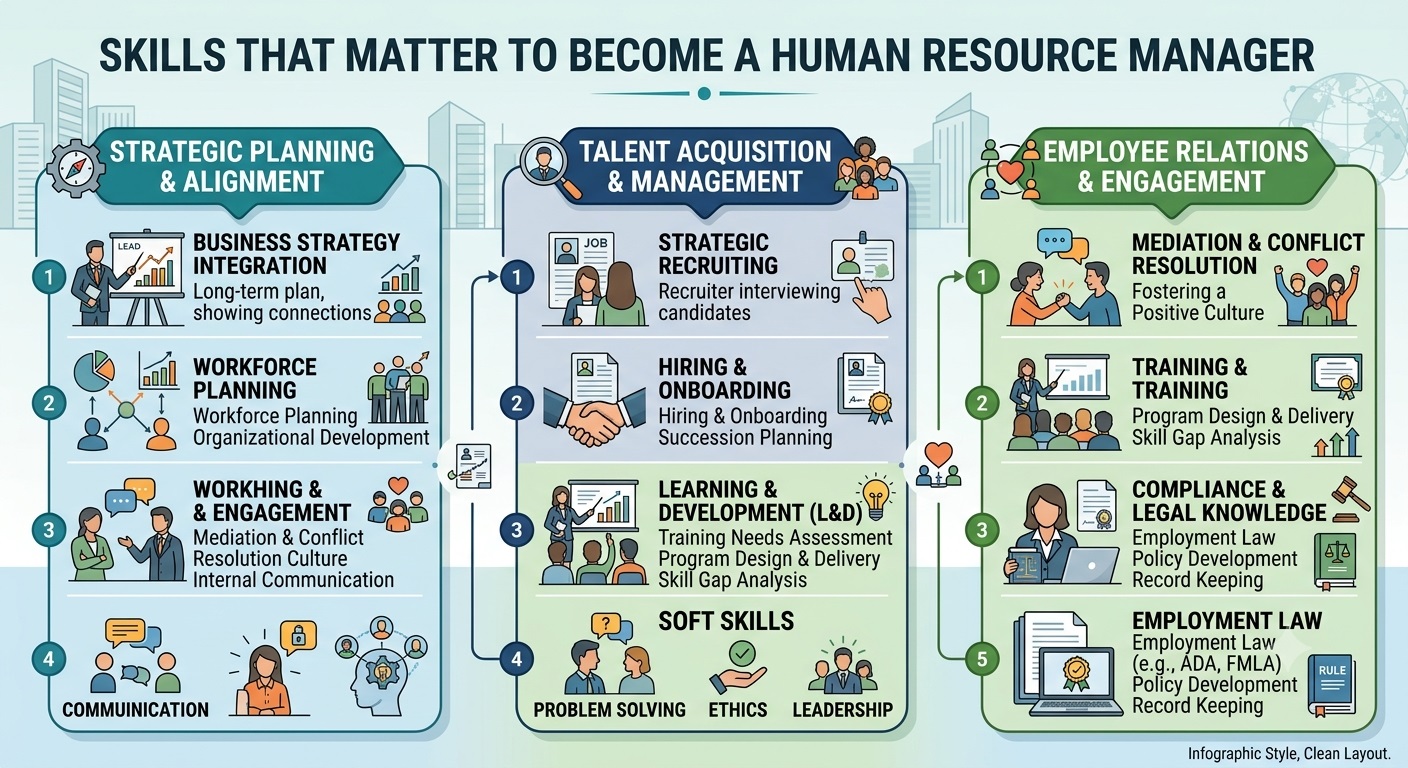
Skills That Matter to Become a Human Resource Manager
1. Communication and conflict resolution — you’re the point of contact for disputes no one else wants to handle
2. Discretion and ethical judgment — HR routinely handles sensitive, confidential information
3. Data literacy — increasingly non-negotiable, as workforce analytics becomes central to HR decision-making rather than a specialised add-on

5. Strategic thinking — especially for HRBP-track roles, where you’re expected to connect people decisions to business outcomes
6. Adaptability to new tools — HR software and AI-assisted workflows are now standard at most mid-size and large employers
Two Real Paths Into HR Management
This is the part most competitor content gets wrong by assuming only one route exists.
Path 1: The MBA-HR Route
1. Complete a bachelor’s degree in any discipline (Science, Arts, or Commerce), typically with a minimum of 45-50% aggregate.
2. Clear an MBA entrance exam — CAT, XAT, CMAT, MAT, GMAT, or CUET PG, depending on your target institute.
3. Complete a 2-year MBA with HR specialisation at an institute such as XLRI Jamshedpur, TISS Mumbai, SCMHRD, an IIM, MDI Gurgaon, NMIMS, or KJ Somaiya.
4. Enter through campus placement into a Management Trainee or HR Executive role, typically at an MNC, large IT services firm, FMCG company, or BFSI organisation.
5. Rotate through HR specialisations — Talent Acquisition, L&D, Compensation & Benefits, HRBP — over the following 2-3 years before reaching a Manager-level title.
Path 2: The Non-MBA Route
1. Complete a bachelor’s degree in any related field (BBA, B.Com, or even an unrelated discipline).
2. Build a certification stack from early on — modular HR courses, payroll certification, and eventually SHRM-CP, HRCI aPHR, or CHRMP.
3. Enter the workforce through an SMB, mid-market company, factory, retail chain, or startup HR role, since these employers hire non-MBA HR talent far more readily than large MNCs do at entry level.
4. Build demonstrable specialisation — deep expertise in one function (recruitment, payroll, compliance) rather than broad generalist exposure — since this is what compensates for the missing MBA credential in employers’ eyes.
5. Move toward SHRM-SCP eligibility and HR Manager titles as your specialisation and track record deepen.
The honest trade-off between the two paths: Non-MBA HR Managers typically earn 10-15% less than their MBA counterparts by Year 5, but tend to break even by Year 7-8, since they’re effectively 2 years ahead in real work experience, having skipped the MBA’s 2-year classroom hiatus entirely.
Certifications Worth Pursuing to Become an HR Manager
Certifications matter more in the non-MBA path, but they add value regardless of which route you take:
| Certification | Level | Value |
|---|---|---|
| SHRM-CP / SHRM-SCP | Mid to Senior | Globally recognised, strong signal for HRBP-track roles |
| HRCI aPHR | Entry-level | Good foundational credential for early-career professionals |
| CHRMP | Modular, flexible | India-relevant, practical HR skill certification |
| NPTEL – Principles of HRM | Foundational | Free/low-cost, useful for building core theory |
| CIPD | International | Valuable if targeting global or UK-linked employers |
None of these are mandatory, but employers increasingly weigh certifications for mid-level and senior HR hiring, particularly for candidates without an MBA-HR credential to lean on.
Realistic Year-by-Year Roadmap to Become an HR Manager
Here’s the timeline most content won’t tell you plainly: the default trajectory from fresher to HR Manager in India is 8-10 years, not the fast-track many courses imply. Compressing this to roughly 5 years is possible, but requires deliberate moves, aggressive certification stacking from day one, strategic job switches around Year 1 and Year 3, and at least one move to an MNC or large firm by year 4.
| Year | Non-MBA Path (Indicative) |
|---|---|
| Year 1 | ₹2.5-4 LPA — entry-level HR role, foundational certification |
| Year 2 | ₹3.5-5 LPA — advanced certification, first specialisation focus |
| Year 3 | ₹5-8 LPA — People Analytics/HRM theory, deepening specialisation |
| Year 4 | ₹7-12 LPA — SHRM-CP or equivalent, move to larger firm |
| Year 5 | ₹10-18 LPA — SHRM-SCP eligible, HR Manager title achievable |
Location adds a further premium – Bangalore, Mumbai, and Gurgaon typically pay 15-25% above other Indian cities for equivalent HR roles, reflecting both cost of living and concentration of large employers.
Specialisations Within HR Field
1. Talent Acquisition — recruitment strategy and hiring pipeline management
2. Learning & Development (L&D) — training programme design and employee upskilling
3. Compensation & Benefits (Comp & Ben) — salary structuring, incentive design, benefits administration
4. HR Business Partner (HRBP) — the most strategic track, embedding HR expertise directly into business unit decisions
5. HR/People Analytics — the fastest-growing specialisation in 2026, combining HR expertise with data and workforce intelligence
People Analytics specifically deserves attention: as organisations shift from intuition-based to data-driven workforce planning, professionals who can build dashboards, run predictive attrition models, and translate workforce data into strategy are increasingly the ones commanding premium pay within HR, not the broad generalists.
Top Recruiters for HR Roles in India
HR talent in India is absorbed across a genuinely wide employer base: large IT services firms (TCS, Wipro, Infosys), consulting firms (Deloitte, EY), FMCG and consumer companies (Samsung and similar), BFSI institutions, and an expanding pool of startups and GCCs (Global Capability Centres) that increasingly hire non-MBA HR talent directly into specialised roles rather than only through campus MBA placement.
FAQs: How to Become an HR Manager in India
Q1. Do I really need an MBA to become an HR Manager, or is that outdated advice?
It’s genuinely outdated as an absolute requirement. While an MBA-HR remains a strong, faster-recognised route, particularly for MNC roles, a non-MBA path with a strong certification stack and demonstrated specialisation is a real, increasingly common route to the same title, especially at SMBs, factories, retail chains, and startups.
Q2. How long does it actually take to become an HR Manager in India?
The honest default is 8-10 years. A 5-year compressed timeline is achievable, but requires deliberate certification stacking from year one and strategic job switches at specific points, not passive tenure alone.
Q3. Is AI actually going to replace HR jobs?
Not in the way that headline suggests. Agentic AI is absorbing tactical, transactional HR tasks (leave processing, basic screening, routine documentation), which reduces the value of purely administrative HR skills over time, but it isn’t eliminating the strategic, judgment-based, and culture-building work that defines senior HR roles.
Q4. Which HR specialisation offers the best long-term career value right now?
People/HR Analytics is currently the fastest-growing specialisation, driven by organisations shifting toward data-driven workforce decisions. Professionals who combine core HR expertise with analytics and business intelligence skills are increasingly commanding a premium over generalist HR profiles.
Q5. Are HR certifications actually worth pursuing if I already have a related degree?
Yes, particularly for non-MBA professionals or those targeting mid-to-senior roles. Certifications like SHRM-CP, HRCI aPHR, or CHRMP signal specific, verifiable expertise that many employers now weigh alongside or, in some cases, ahead of the underlying degree itself.
Final Word
Becoming an HR Manager in India no longer runs through a single, MBA-shaped door; both paths are genuinely viable, and the right one depends on how much time and money you can front-load versus build gradually through certifications and specialisation. What’s changed more than the entry path, though, is what the job itself increasingly rewards: as agentic AI absorbs the tactical layer of HR work, the professionals who invest early in analytics fluency and strategic capability rather than administrative depth alone are the ones positioning themselves for where this field is actually heading, not where it used to be.