
Who is a Criminal Lawyer?
A criminal lawyer handles cases involving offences under India’s criminal statutes, primarily the Bharatiya Nyaya Sanhita (BNS), the Bharatiya Nagarik Suraksha Sanhita (BNSS), and the Bharatiya Sakshya Adhiniyam (BSA). Defence lawyers represent the accused, working to secure an acquittal, bail, or a reduced sentence, while public prosecutors represent the state, presenting evidence to establish the accused’s guilt beyond reasonable doubt. Both roles draw on the same core legal skills but sit on opposite sides of the courtroom.
Skills Required for a Criminal Lawyer
| Skill | Why It Matters |
| Analytical and research skills | Needed to study case facts, precedents, and evidence in detail |
| Communication and advocacy | Essential for arguing cases before a judge and cross-examining witnesses |
| Attention to detail | Errors in documentation or procedure can affect the outcome of a case |
| Negotiation skills | Used in plea bargaining and settlement discussions |
| Knowledge of criminal procedure and evidence law | Forms the procedural backbone of every criminal case |
| Ethical judgement | Criminal lawyers must balance client representation with professional conduct rules |
Criminal Lawyer Eligibility Criteria 2026
| Course Level | Minimum Eligibility |
| 5-Year Integrated LLB (BA LLB / BBA LLB, after Class 12) | Class 12 pass in any stream, generally with 45% aggregate marks (40% for SC/ST candidates, varying by institute) |
| 3-Year LLB (after graduation) | Bachelor’s degree in any discipline from a recognised university, generally with 45–50% aggregate marks |
| LLM in Criminal Law (2 years, optional specialisation) | LLB degree from a BCI-recognised university |
Age, Stream & Other Conditions
1. Stream: There is no restriction on stream at Class 12 or graduation level. Science, Commerce, and Arts students are all equally eligible.
2. Category relaxation: Candidates from SC, ST and other reserved categories typically receive a marked relaxation, generally around 5%, depending on the institute’s own policy.
Step-by-Step Process to Become a Criminal Lawyer in India
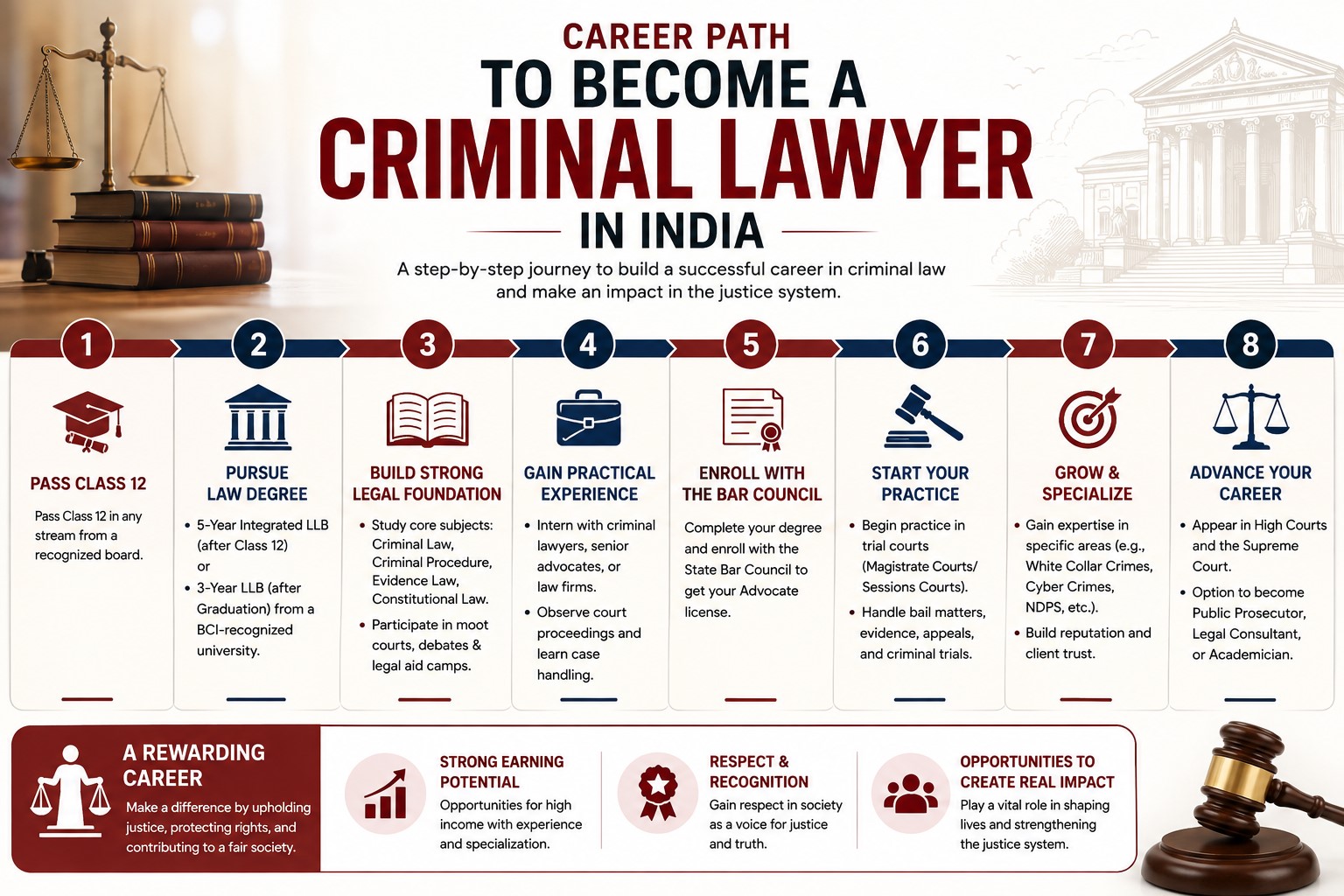
1. Pass Class 12 in any stream, ideally with 45% or higher marks.
2. Choose a criminal lawyer course route, either the 5-year integrated BA LLB/BBA LLB after Class 12, or the 3-year LLB after graduation.

4. Enrol in the LLB programme and study core subjects including criminal law, criminal procedure, evidence law, and constitutional law, alongside moot courts.
5. Complete internships with criminal lawyers, law firms, or public prosecutors’ offices during the course; most law schools include this as part of the curriculum.
6. Register with a State Bar Council after completing the LLB degree.
7. Appear for and clear the All India Bar Examination (AIBE), conducted by the Bar Council of India.

9. Gain practical experience by working as a junior with a senior criminal lawyer or joining a law firm’s litigation team.
10. Optionally, pursue an LLM in Criminal Law to specialise further in areas such as criminal procedure, evidence law, or cyber law.
Career Paths After a Criminal Lawyer Course
An LLB with a focus on criminal law leads to several career paths, including:
1. Defence Lawyer: Represents individuals or entities accused of a crime in court.
2. Public Prosecutor: Represents the state in criminal proceedings, typically after clearing a state judicial or prosecutorial service exam.
3. Legal Associate at a Law Firm: Works within a litigation team handling criminal matters alongside other practice areas.
4. Judicial Service (Judge/Magistrate): Requires clearing a state Judicial Services Examination after the LLB.
5. Legal Researcher / Academic: Works in legal research, policy, or teaching, often after an LLM.
6. Independent Practice: Practises independently before magistrate courts, sessions courts, High Courts, or the Supreme Court, building a client base over time.
Also Read – how to become a Judge
Criminal Lawyer Salary in India 2026
The criminal lawyer salary in India ranges from approximately ₹0.4 lakh to ₹9.5 lakh a year, with an average annual salary of around ₹5 lakh. Entry-level criminal lawyers earn between roughly ₹0.2 lakh and ₹4 lakh a year, with an average of about ₹2.5 lakh. Salary estimates for criminal lawyers vary considerably across sources depending on experience mix, city, and whether the lawyer works independently, in a firm, or in government service.
Criminal Lawyer Salary in India 2026 by Experience
| Experience Level | Approximate Annual Salary |
| Entry-level (0–2 years) | ₹0.2 – 4 Lakh |
| Senior Criminal Lawyer | ₹0.4 – 9.5 Lakh, higher for established independent practice |
Important Note: A criminal lawyer salary in India varies significantly by employer type and location. Lawyers employed by law firms or corporate legal departments generally have a fixed salary structure, while independent practitioners earn through client fees, which can range widely depending on case complexity, court level, and professional standing built over years of practice.
Also Read – How to Become a Chartered Accountant
Entrance Exams to Become a Criminal Lawyer
Admission to most law schools in India, including those offering a criminal law specialisation, is through a national or university-level entrance exam rather than academic marks alone. The main exams are:
1. CLAT (Common Law Admission Test): The entrance exam accepted by the Consortium of National Law Universities for admission to 26 National Law Universities (NLUs) and several other institutes, for both the 5-year integrated and postgraduate LLM programmes. General category candidates typically need a minimum of 45% marks in Class 12 (40% for SC/ST) to apply.
2. AILET (All India Law Entrance Test): Conducted separately by National Law University, Delhi, which does not accept CLAT scores. General category candidates typically need a minimum of 45–50% marks in Class 12.
3. LSAT-India: Accepted by a number of private law schools for admission to undergraduate law programmes.
4. SLAT (Symbiosis Law Admission Test): The entrance exam for admission to Symbiosis Law School campuses.
5. State-level law entrance exams: Including the DU LLB Entrance Exam for the University of Delhi and MH CET Law for law colleges in Maharashtra.
After completing the LLB, all law graduates, regardless of which entrance exam or institute they attended, must clear the All India Bar Examination (AIBE) and enrol with a State Bar Council to receive a licence to practise.
Also Read – How to Become a Mechanical Engineer
Top Universities Offering Criminal Law Course and Eligibility Criteria
| University | Courses Offered | Eligibility Criteria | Entrance Exam |
| National Law School of India University (NLSIU), Bangalore | BA LLB (Hons), LLM, PhD | Class 12 pass with min. 45% marks (40% for SC/ST) | CLAT |
| NALSAR University of Law, Hyderabad | BA LLB (Hons), LLM, PhD | Class 12 pass with min. 45% marks | CLAT |
| National Law University (NLU), Delhi | BA LLB (Hons), LLM, PhD | Class 12 passes with min. 45–50% marks | AILET (does not accept CLAT) |
| West Bengal National University of Juridical Sciences (WBNUJS), Kolkata | BA LLB (Hons), LLM | Class 12 pass with min. 45% marks | CLAT |
| Gujarat National Law University (GNLU), Gandhinagar | BA LLB (Hons), BBA LLB (Hons), LLM | Class 12 pass with min. 45% marks | CLAT |
| National Law University, Jodhpur (NLUJ) | BA LLB (Hons), BBA LLB (Hons), LLM | Class 12 passes with min. 45% marks | CLAT |
| Rajiv Gandhi National University of Law (RGNUL), Punjab | BA LLB (Hons), LLM | Class 12 pass with min. 45% marks | CLAT |
| Hidayatullah National Law University (HNLU), Raipur | BA LLB (Hons), BBA LLB (Hons), LLM | Class 12 pass with min. 45% marks | CLAT |
| Dr. Ram Manohar Lohiya National Law University (RMLNLU), Lucknow | BA LLB (Hons), LLM | Class 12 pass with min. 45% marks | CLAT |
| Symbiosis Law School (SLS), Pune | BA LLB, BBA LLB, LLM | Class 12 pass with min. 45–50% marks (varies by programme) | SLAT |
How to Become a Criminal Lawyer in India – FAQs
Q1. What is the minimum qualification to become a criminal lawyer in India?
You need to pass Class 12 in any stream, generally with a minimum of 45% marks, to register for a 5-year integrated LLB. Graduates from any discipline can alternatively pursue a 3-year LLB. After the LLB, passing the AIBE is compulsory before practising.
Q2. Which entrance exam is required to become a criminal lawyer?
Most law schools, including the National Law Universities, admit students through CLAT. National Law University, Delhi conducts its own exam, AILET, and does not accept CLAT scores. Some private law schools use LSAT-India or SLAT instead.
Q3. What is the criminal lawyer salary in India for freshers?
Criminal lawyer salaries in India defer from position to position, entry-level criminal lawyers in India earn between roughly ₹0.2 lakh and ₹4 lakh a year, averaging around ₹2.5 lakh. Earnings vary by city, employer type, and whether the lawyer works independently or within a firm.
Q4. Is an LLM in Criminal Law necessary to practise criminal law?
No, an LLM is not compulsory. An LLB degree from a BCI-recognised university, followed by AIBE clearance and Bar Council enrolment, is sufficient to practise as a criminal lawyer. An LLM in Criminal Law is an optional route for those who want deeper specialisation.
Q5. Can a Science or Commerce student become a criminal lawyer?
Yes. Law courses in India are stream-agnostic, so Science, Commerce, and Arts students are equally eligible to register for a 5-year integrated LLB after Class 12, or a 3-year LLB after graduation in any discipline.