

Ramanujan Fellowship – Key Highlights
The table below provides a quick overview of Ramanujan Fellowship –
| Particulars | Details |
| Application Deadline | December 31, 2026 |
| Eligible Applicants | Ph.D./MD holders under 40 years of age |
| Duration | 5 Years (Non-extendable) |
| Official Portal | Click Here |
Ramanujan Fellowship – Eligibility Criteria
The eligibility criteria for the Ramanujan Fellowship is listed below. Applicants are advised to carefully review all the requirements before applying.
1. The fellowship is open to brilliant Indian or Indian-origin scientists and engineers working abroad, who are below 40 years of age.
2. Applicants must hold a higher degree such as a Ph.D. in Science/Engineering, Master’s in Engineering/Technology or MD in Medicine, along with relevant professional experience.
3. Candidates should have an outstanding track record, supported by quality research publications and recognitions.

5. If a selected fellow secures any such position in India, they will become ineligible and must relinquish the fellowship along with all associated benefits.
6. The nominee must be working abroad at the time of application/nomination.
Ramanujan Fellowship – Application Process
The application process for the Ramanujan Fellowship is provided below. Applicants are advised to follow each step carefully to ensure successful submission of their application –
Step 1 – Visit the official ANRF online portal at www.anrfonline.in and complete the registration process.

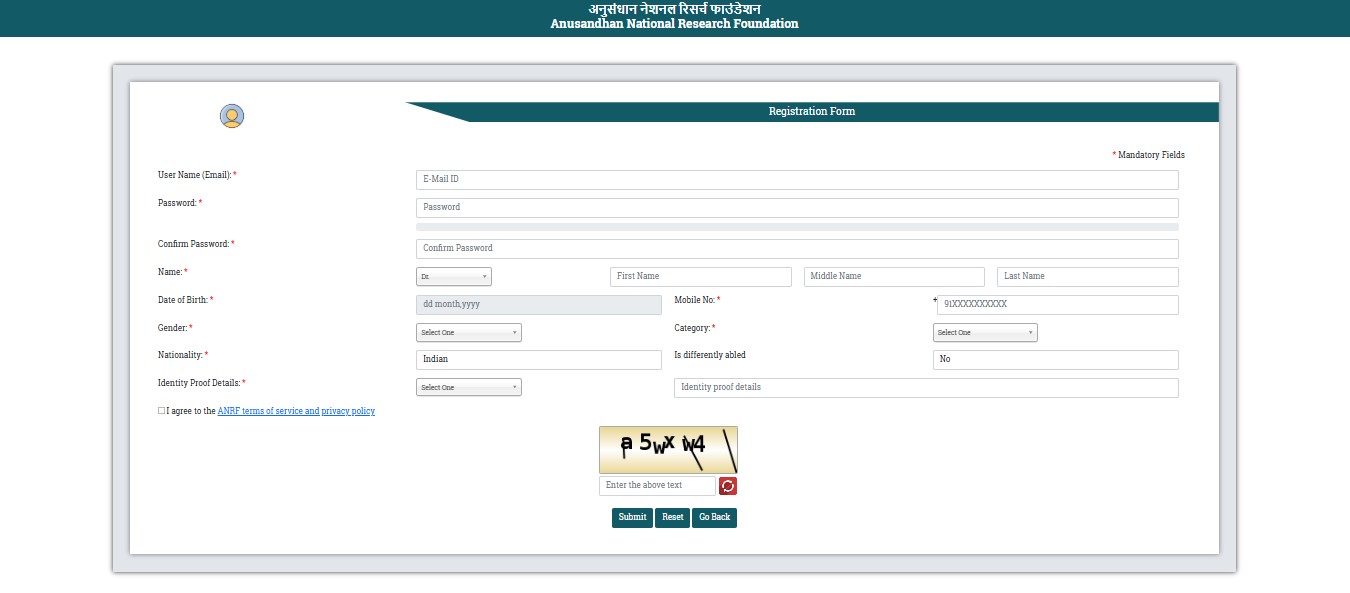
Step 2 – Log in to your account and fill in all mandatory details under the ‘user profile’ section, including photo, institution, and address.
Step 3 – Under the ‘form submission’ section, select the scheme ‘Ramanujan Fellowship’ and fill in the nomination form with details such as nominee information, qualifications and nominator details.
Step 4 – Upload the proposed area of research along with a brief research proposal in a single PDF file (not exceeding 5 pages).
Step 5 – After completing all details, click on ‘send to nominator’ to forward the application for review.
Step 6 – The nominator will receive an email notification with a link to access the ANRF portal and review the submitted nomination form.
Step 7 – The nominator can either submit the application to ANRF or return it to the nominee for corrections or revisions, if required.
Step 8 – Once the nomination is successfully submitted, both the nominee and the nominator will receive a confirmation notification.
Ramanujan Fellowship – Financial Support & Benefits Overview
The table below presents a detailed breakdown of the financial support and benefits offered under the Ramanujan Fellowship 2026. It highlights the key components of funding available to selected fellows for their research and academic work.
Ramanujan Fellowship: Benefits 2026
| Particulars | Amount |
| Monthly Fellowship | ₹1,35,000 per month (including HRA) |
| Annual Research Grant | ₹7,00,000 per annum |
| Overhead Charges | ₹60,000 per annum |
Ramanujan Fellowship – Methodology for Nomination & Selection
The nomination and selection process for the Ramanujan Fellowship is detailed below. Applicants are required to adhere strictly to the prescribed guidelines and ensure that all conditions are fulfilled for successful consideration.
1. Eligible scientists can carry out their research at any recognized Science & Technology institution in India, including universities, academic institutions, or national laboratories, provided the host institute agrees to offer necessary administrative and research infrastructure support.
2. The fellowship encourages researchers to work in new institutions and emerging research areas, preferably different from the institute where they completed their Ph.D., to broaden their research exposure.
3. Nominations submitted by a candidate’s Ph.D. supervisor or from the same institution where the doctoral degree was obtained will not be accepted.
4. Applicants are required to independently approach their preferred institutions for hosting support and ensure that their nominations are forwarded to ANRF through the host organization.
5. The selection of Ramanujan Fellows is carried out at regular intervals by a specially constituted empowered Selection Committee.
Documents Required for Ramanujan Fellowship
The following documents are essential for submission under the Ramanujan Fellowship. Applicants are advised to keep these documents ready in advance to ensure a smooth and error-free application process.
1. Nomination Letter (On letter head, duly signed and stamped) – Download Template
2. CV of Nominee
3. Plagiarism undertaking – Download Template
Frequently Asked Questions (FAQs)
What is the deadline to apply for the Ramanujan Fellowship 2026?
The final date for submission of online applications for the Ramanujan Fellowship is December 31, 2026. However, as the selection process is conducted at regular intervals by a duly constituted empowered committee, applicants are advised to submit their applications at the earliest upon securing a host institution in India.
Can I apply for the Ramanujan Fellowship if I am already working in India?
No, candidates who are currently working in India are not eligible to apply for the Ramanujan Fellowship. The scheme is intended for Indian or Indian-origin researchers who are employed abroad at the time of application.
Can I choose my PhD-granting institute as my host institution?
No, candidates are not allowed to choose their Ph.D.-granting institute as the host institution.
The fellowship requires research to be conducted at a different institution to broaden exposure. Additionally, nominations from the candidate’s Ph.D. supervisor are not accepted.
What happens to the fellowship if I get a permanent job in India?
If a Ramanujan fellow secures a permanent, tenure-track, or contractual position in any Indian institution during the five-year tenure, they become ineligible to continue the fellowship. In such cases, the fellow must relinquish the monthly stipend, research grant, and overhead charges immediately.
Is the monthly stipend of ₹1,35,000 taxable?
Yes. The financial support received under the Ramanujan Fellowship is considered income and is taxable as per the prevailing Indian Income Tax (I.T.) rules.