
Who Is a Cabin Crew Member?

1. Conducting pre-flight safety checks and demonstrations
2. Assisting passengers with boarding, seating, and baggage
3. Managing in-flight service, food, and beverages
4. Handling emergencies, medical situations, and security protocols
5. Ensuring passenger comfort throughout the flight

Cabin Crew Eligibility Criteria in India
Every airline has its own specific requirements, but most Indian carriers, including IndiGo, Air India, Akasa Air, SpiceJet, and Vistara, follow a broadly similar eligibility framework.
1. Educational Qualification: The minimum qualification to become cabin crew in India is Class 12 (10+2) pass from a recognised board, in any stream – Science, Commerce, or Arts. A degree isn’t mandatory for domestic airlines, though international carriers like Emirates, Qatar Airways, and Singapore Airlines often prefer graduates.
2. Age Limit: Most airlines hire freshers between 18 and 27 years of age. Some carriers extend this to 35 years for experienced candidates, and government norms typically offer age relaxation for SC/ST (5 years) and OBC (3 years) candidates.
3. Height and Physical Fitness: Female candidates must have a minimum height of 155 cm, while male candidates must be at least 170 cm. BMI should fall within the standard range (18–22 for females, 18–25 for males), with weight proportional to height. Candidates must also have normal eyesight (6/6 vision) and no visible tattoos when wearing the uniform.

5. Other Requirements:
- Applicants must hold Indian nationality and possess a valid passport, PAN card, and Aadhaar card.
- Additionally, candidates must have a clear medical history and demonstrate basic swimming ability, which is required by many airlines for mandatory water-survival safety training.
Core Skills That Matter Beyond the Checklist
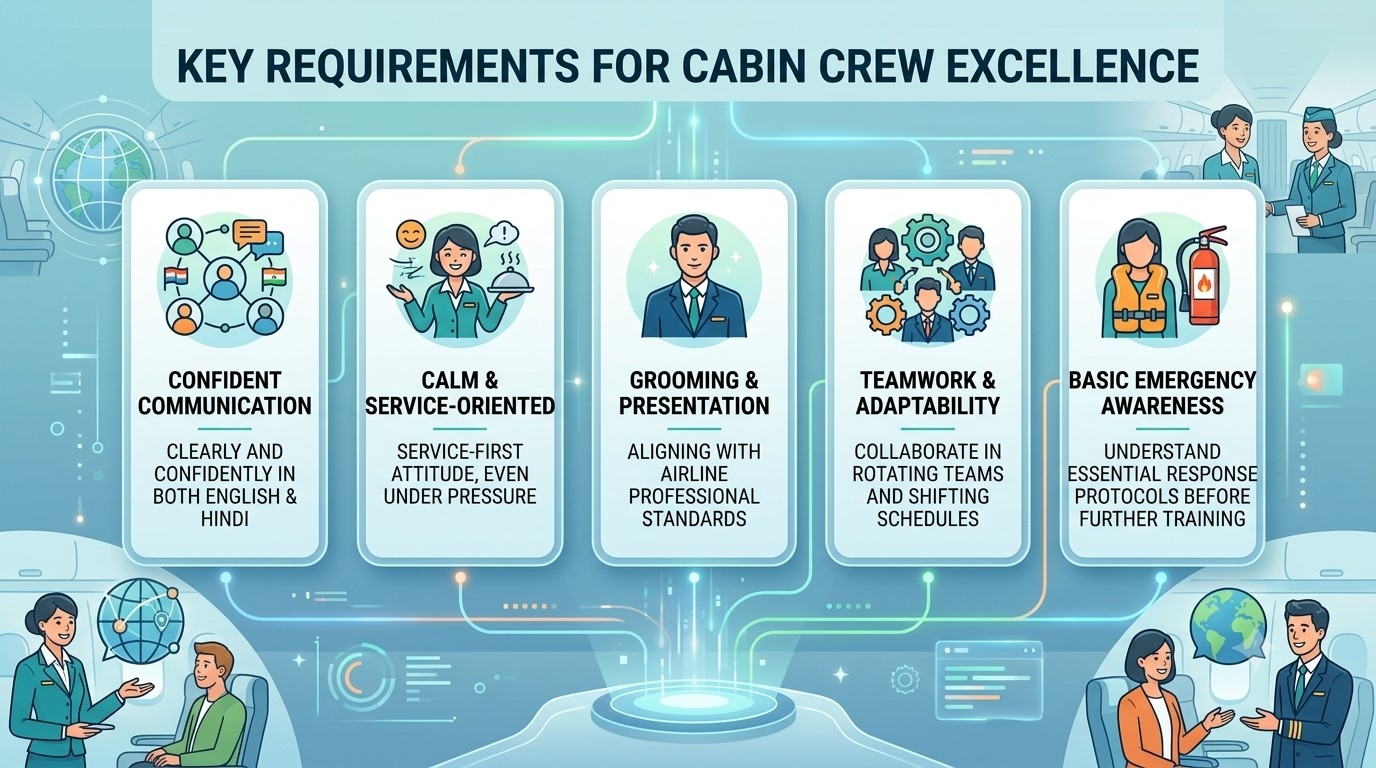
Meeting the eligibility criteria only gets you in the room – airlines select candidates who demonstrate:
1. Candidates must communicate confidently and clearly in both English and Hindi.
2. They should maintain a calm, service-first attitude, even under pressure.
3. Their grooming and presentation must align with airline standards.
4. They need strong teamwork and adaptability, since cabin crew work in rotating teams and shifting schedules.
5. They should have basic emergency response awareness, which is refined further during airline-specific training.
How to Become Cabin Crew in India – Step-by-Step Process
Step 1: Complete Your Class 12 Education – This is your non-negotiable starting point. Focus on strengthening your English communication alongside your regular studies – most interview rounds test comfort and clarity in the language, not just grammar.
Step 2: Enrol in a Cabin Crew or Air Hostess Training Course – While not always mandatory, a certified cabin crew training course significantly boosts your selection chances. These programmes, typically lasting 3 to 12 months, cover:
A. Aviation and airport operations
B. In-flight service standards
C. Safety, security, and emergency procedures
D. Grooming, personality development, and communication
E. Mock interviews and group discussion practice
Look for institutes offering IATA-recognised certification, which airlines actively prioritise during shortlisting. Some well-known cabin crew training institutes in India include:
A. Frankfinn Institute of Air Hostess Training (multiple cities)
B. Air Hostess Academy, Bangalore
C. Universal Aviation Academy, Chennai
D. The Bombay Flying Club’s College of Aviation, Mumbai
E. Various IATA Classic Authorised Training Centres across states
Step 3: Build Your Documentation – Keep your passport, Aadhaar, PAN card, Class 12 marksheet, and passport-size photographs ready and updated; airlines request these at multiple stages of recruitment.
Step 4: Apply to Airlines – Once trained, start applying through official airline career portals. IndiGo, Air India, Akasa Air, SpiceJet, and Vistara regularly post cabin crew vacancies, especially as India adds new airports and expands fleet capacity.
Step 5: Clear the Selection Process – Generally, the cabin crew selection process includes:
A. Screening and Grooming: Candidates undergo an initial screening and grooming round to evaluate height, overall physical appearance, and professional presentation.
B. Group Discussion: A group discussion is conducted to assess communication skills, team collaboration, and interpersonal dynamics.
C. Personal Interview: Candidates participate in a personal interview designed to evaluate personality, self-confidence, and situational judgment.
D. Medical Examination: Shortlisted applicants must pass a mandatory pre-employment medical examination to confirm physical fitness.
E. Final Offer: Upon successful completion of all stages, candidates complete final documentation and receive their official job offer.
Step 6: Undergo Airline-Specific Training – Once selected, airlines put you through an intensive in-house training programme covering safety procedures, service standards, and aircraft-specific protocols before you’re certified to fly.
Cabin Crew Salary in India 2026
Cabin Crew Compensation varies significantly by airline, experience, and whether you’re flying domestic or international routes.
| Airline | Fresher Salary (Monthly) | Experienced Crew |
| IndiGo | ₹28,000 – ₹50,000 | ₹60,000 – ₹1,00,000+ |
| Air India | ₹40,000 – ₹60,000 | ₹80,000 – ₹1,20,000+ |
| Akasa Air | ₹35,000 – ₹45,000 | ₹50,000 – ₹70,000 |
| SpiceJet | ₹30,000 – ₹45,000 | ₹45,000 – ₹65,000 |
| Vistara | ₹35,000 – ₹45,000 | ₹50,000 – ₹70,000 |
International airlines offer significantly higher compensation. Cabin crew at Emirates and Qatar Airways can earn anywhere between ₹1,10,000 and ₹2,50,000 per month, often tax-free, along with free accommodation, transport, and health insurance, making these roles a major draw for Indian candidates willing to relocate.
Beyond the base pay, a cabin crew package includes hourly flying allowances, layover allowances, and additional perks such as flight discounts and medical coverage. Over time, crew members can progress into senior roles like Senior Cabin Crew, Cabin Supervisor, or In-Flight Manager, where earnings can exceed ₹1,20,000 per month within 7 to 10 years.
Cabin Crew Course Syllabus 2026
Cabin crew members, including air hostesses and flight stewards, play an important role in the aviation industry. They ensure passenger comfort, safety, and well-being while managing onboard operations and emergency procedures. Most comprehensive cabin crew diploma courses run for 11 months and equip candidates with both the theoretical knowledge and practical skills required by leading global airlines.
Cabin Crew Course Curriculum
The curriculum is designed to cover every aspect of in-flight management, safety, and hospitality.
1. In-Flight Safety & Emergency Protocols: Comprehensive training on safety equipment, fire response, emergency evacuations, and survival techniques.
2. First Aid & CPR: Essential medical training to respond effectively to health emergencies onboard.
3. Aircraft & Airport Familiarisation: Operational understanding of aviation terminology, aircraft cabin layouts, and core technical functions.
4. Customer Service & Passenger Handling: Mastering passenger relations, conflict resolution, and food and beverage service management.
5. Communication Skills & Language Proficiency: Focus on spoken English fluency, clear public announcements (PAs), and effective team coordination.
6. Grooming & Professional Image: Guidance on personal hygiene, uniform etiquette, and representing the airline’s brand image.
7. Personality Development & Leadership: Building situational confidence, stress management, and teamwork skills.
Common Mistakes Aspiring Cabin Crew Should Avoid
1. Skipping communication practice: Airlines reject far more candidates for a lack of confidence and English fluency than for their physical appearance.
2. Choosing an uncertified institute: Always verify an institute’s IATA recognition and placement track record before enrolling.
3. Ignoring fitness and grooming standards: These criteria are assessed from the very first screening round.
4. Underestimating the physical demands: Irregular hours, shift work, and frequent travel are regular parts of the job, not exceptions.
Final Thoughts
A cabin crew career in India rewards preparation far more than luck. If you meet the eligibility criteria, invest in quality training, sharpen your communication skills, and approach the selection process with genuine confidence, the opportunities – ranging from India’s fast-growing domestic carriers to leading global airlines are wide open. Start with thorough research, choose a credible training institute, and give yourself a real shot at a career that quite literally takes off.
How to Become Cabin Crew in India
Q1. Can I become cabin crew directly after Class 12?
Yes. A degree is not mandatory for most domestic airlines. Completing Class 12, followed by a certified cabin crew course, is often enough to apply.
Q2. Is there an entrance exam for cabin crew courses?
Some private aviation institutes conduct their own entrance tests or interviews, but there’s no single national entrance exam required specifically for cabin crew training.
Q3. What is the age limit for cabin crew jobs in India?
Generally 18 to 27 years for freshers, with some airlines extending this up to 35 years for experienced candidates.
Q4. Do male candidates get hired as cabin crew?
Yes. Airlines hire both male and female cabin crew, with slightly different height and BMI benchmarks.
Q5. Which Indian airline pays the highest cabin crew salary?
Among domestic carriers, Air India, especially on international routes and IndiGo tend to offer the most competitive packages. International airlines like Emirates and Qatar Airways pay significantly higher.