
Who is a Robotics Engineer?
A Robotics Engineer designs, builds and maintains robots and robotic systems that can perform tasks humans are unable to, or prefer not to, do themselves. The role draws on mechanical engineering, electrical engineering and computer science together, covering the construction, operation and control of robots, along with the sensory feedback and information-processing systems that drive them. Robotics Engineers work across manufacturing, healthcare, space research, agriculture, defence and automobile industries.
Skills Required to Become a Robotics Engineer
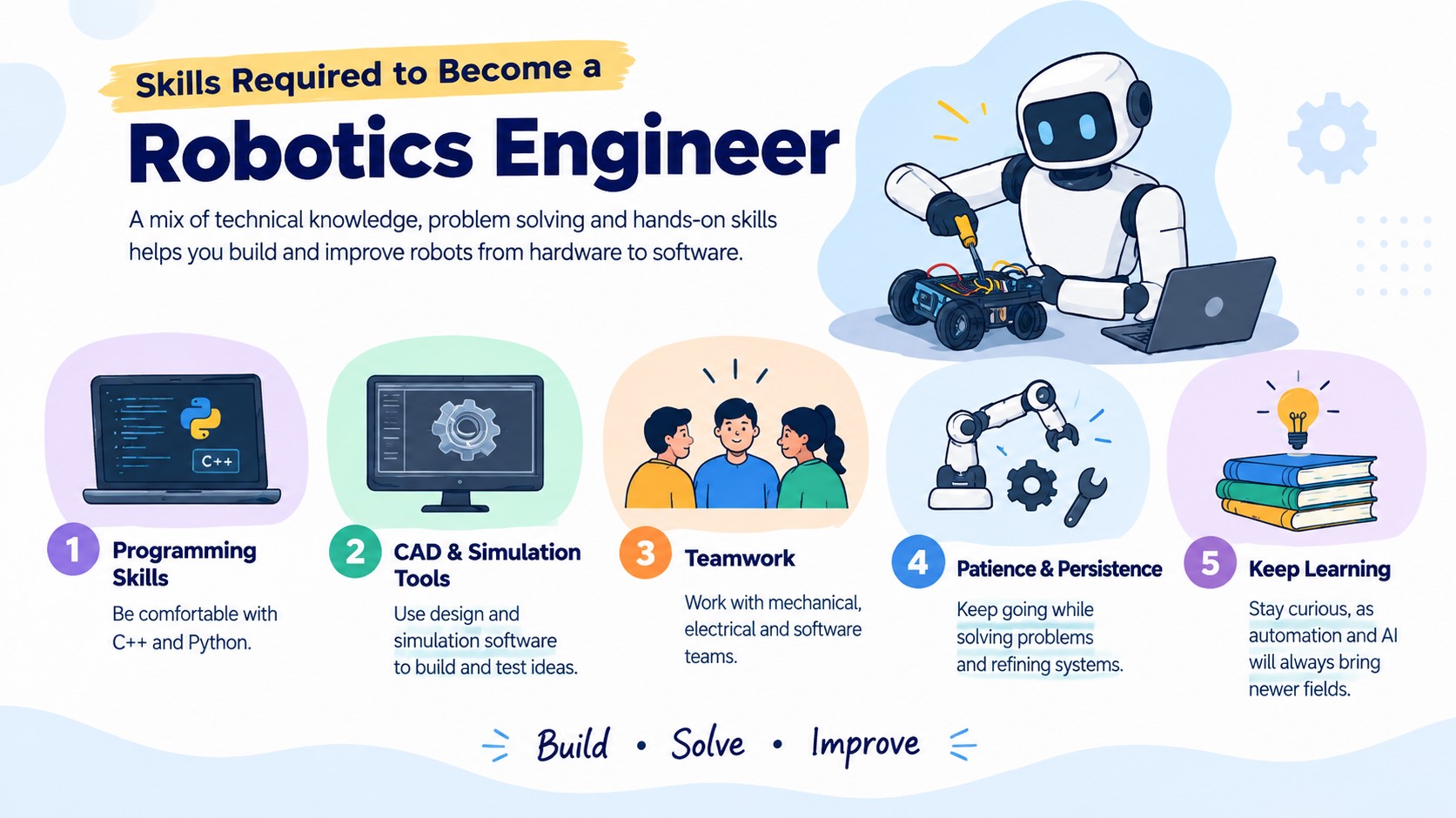
A strong foundation in mechanics, electronics and programming helps a Robotics Engineer move between the physical and software sides of a robotic system. Analytical thinking and a genuine enjoyment of hands-on problem-solving matter just as much, since much of the role involves testing, troubleshooting and refining designs. Other useful qualities include:
1. Proficiency in programming languages such as C++ and Python
2. Familiarity with computer-aided design (CAD) and simulation tools
3. Strong teamwork skills, since robotics projects usually span mechanical, electrical and software teams

5. A willingness to keep learning, given how quickly automation and AI-linked robotics evolve
Robotics Engineer Eligibility Criteria
Robotics Engineer eligibility in India depends on the stage of the career a candidate is pursuing: entry into an undergraduate engineering course, or entry into a postgraduate specialisation after a first engineering degree. Most students enter the profession straight after Class 12, though a related engineering degree followed by an M.Tech is also a common route.
Route 1: After Class 12 (Undergraduate Entry)
1. Minimum Qualification: Pass in Class 12 with Physics, Chemistry and Mathematics (Science stream), with a minimum of around 50% aggregate marks.

3. Entrance Exam: Admission is through engineering entrance exams such as JEE Main, JEE Advanced, MHT CET, KEAM, GUJCET, COMEDK UGET or state-level CETs, depending on the institute.
Route 2: After Graduation (Postgraduate Entry)
1. Graduate Degree: Open to candidates who hold a B.Tech/B.E in Mechanical, Electrical, Electronics, Computer Science or a related engineering discipline.
2. Postgraduate Course: Pursue an M.Tech or M.E in Robotics Engineering, Automation and Robotics, or Mechatronics from a recognised university.
3. Entrance Exam: Postgraduate admission is generally through GATE, and in some institutes through a university-specific entrance test or interview.
Also Read: How to Become a Mechanical Engineer
Career Options After Becoming a Robotics Engineer
| Job Profile | What They Do |
| Robotics Engineer | Designs, builds and tests robots and robotic subsystems |
| Automation Engineer | Develops automated systems for manufacturing and industrial processes |
| Robotics Programmer | Writes and maintains the software that controls robot behaviour |
| Mechatronics Engineer | Integrates mechanical, electronic and control systems in a single design |
| Research Engineer | Works on new robotics technologies in academic or industrial research labs |
| Robotics Consultant | Advises companies on adopting or upgrading robotic and automation systems |
Robotics Engineer Salary in India
| Career Stage | Annual Salary Range | Average Annual Salary |
| Entry-level/Fresher Robotics Engineer | ₹3 lakh to ₹12 lakh | ₹4.3 lakh (as reported by AmbitionBox, cited by Careers360) |
| Experienced Robotics Engineer | Rises with specialisation, employer and years of experience | Varies too widely across employers to state as a single figure |
Salaries tend to be significantly higher for graduates of premier institutes such as the IITs, and for candidates who move into research, robot learning, or leadership roles within automation teams.
Robotics Engineer Course
| Course | Level | Academic Eligibility |
| Diploma in Robotics/Mechatronics Engineering | Diploma | 10th pass, or 10+2 with Science, depending on the institute |
| B.Tech Robotics Engineering | Undergraduate | 10+2 with Physics, Chemistry and Mathematics, minimum 50% aggregate |
| B.Tech Mechatronics Engineering | Undergraduate | 10+2 with Physics, Chemistry and Mathematics, minimum 50% aggregate |
| B.Tech Mechanical/Electrical/Electronics Engineering (Robotics specialisation) | Undergraduate | 10+2 with Physics, Chemistry and Mathematics, minimum 50% aggregate |
| MTech/ME in Robotics Engineering or Automation and Robotics | Postgraduate | B.Tech/B.E in a related engineering discipline |
Important note: While there’s no single national entrance exam reserved exclusively for Robotics Engineering at the undergraduate level, admission runs through the standard engineering entrance exams this is changing at the postgraduate level. IIT Madras, the organising institute for GATE 2027, has introduced a dedicated Robotics and Automation (RA) paper for the first time. Registration is open now and closes on 21 September 2026 (with a late fee till 30 September), so if you’re eyeing an M.Tech in Robotics, this is time-sensitive; don’t miss the window.
How to Become a Robotics Engineer: Step-by-Step Process
Step 1: Pass Class 12 with Physics, Chemistry and Mathematics, meeting the aggregate percentage required by your chosen university.
Step 2: Appear for an engineering entrance exam such as JEE Main, JEE Advanced, MHT CET, KEAM, GUJCET or COMEDK UGET, depending on the institutes you are targeting.
Step 3: Complete a four-year B.Tech in Robotics Engineering, Mechatronics Engineering, or a related engineering branch with a robotics specialisation.
Step 4: Build practical experience through internships, robotics competitions and hands-on projects, since employers place significant weight on demonstrated project work in this field.
Step 5: Consider an M.Tech or M.E in Robotics Engineering or Automation and Robotics, generally through GATE, if you want to move into research, design leadership or specialised roles.
Step 6: Apply for entry-level roles such as Robotics Engineer, Automation Engineer, or Robotics Programmer, and build your resume around your academic projects and internship experience.
Also Read: Scholarships for Engineering Students
Top Colleges and Courses for Robotics Engineering in India
| College | Course |
| Indian Institute of Technology (IIT), Kanpur | M.Tech Automation and Robotics |
| SRM Institute of Science and Technology, Chennai | B.Tech Automation and Robotics |
| VIT, Vellore | M.Tech Mechatronics Engineering |
| Manipal Institute of Technology (MIT), Manipal | B.Tech Mechatronics/Robotics Engineering |
| Chandigarh University, Mohali | B.Tech Robotics and Automation |
Also Read: How to Become an Artificial Intelligence Engineer
How to Become a Robotics Engineer: FAQs
Q1. Is JEE Advanced compulsory to become a Robotics Engineer in India?
No. JEE Advanced is only required for admission to the IITs. Robotics Engineering courses are also offered by NITs, state universities and private institutes accepting JEE Main, MHT CET, KEAM or COMEDK UGET, so JEE Advanced is one route, not a compulsory step.
Q2. Can a Mechanical or Electronics Engineering graduate switch to robotics later?
Yes. Graduates with a B.Tech in Mechanical, Electrical, Electronics or Computer Science can move into robotics through an M.Tech in Robotics Engineering or Automation and Robotics, typically admitted through GATE, or by building robotics-specific project experience and internships during their degree.
Q3. What is the difference between Robotics Engineering and Mechatronics Engineering?
Mechatronics Engineering combines mechanical, electronic and control systems more broadly, covering automation beyond robots alone. Robotics Engineering focuses specifically on designing, programming and operating robots. Many colleges in India treat the two as closely related, overlapping specialisations with shared core subjects.
Q4. Do Robotics Engineers need to know how to code?
Yes. Programming is central to the role, since robots are controlled through software that governs movement, sensing and decision-making. Languages such as C++ and Python are commonly used, alongside robotics-specific frameworks, so coding skills are expected throughout the course, not optional extras.
Q5. Is there a dedicated GATE paper for Robotics Engineering?
Yes. Starting with GATE 2027, IIT Madras has introduced a dedicated Robotics and Automation (RA) paper for the first time, aimed at candidates pursuing an M.Tech or research career in robotics.