

Who Is a Product Manager?
A Product Manager is responsible for developing the vision of a product and the strategy needed to achieve an organisation’s goals. The role focuses on understanding user needs, guiding the product through development, and monitoring its performance once launched. Product Managers typically work closely with engineering, design, marketing and sales teams to ensure a product meets both customer expectations and business objectives, and the role has grown to include working with newer tools such as generative AI to support decision-making and innovation.
Key Skills Needed to Become a Product Manager
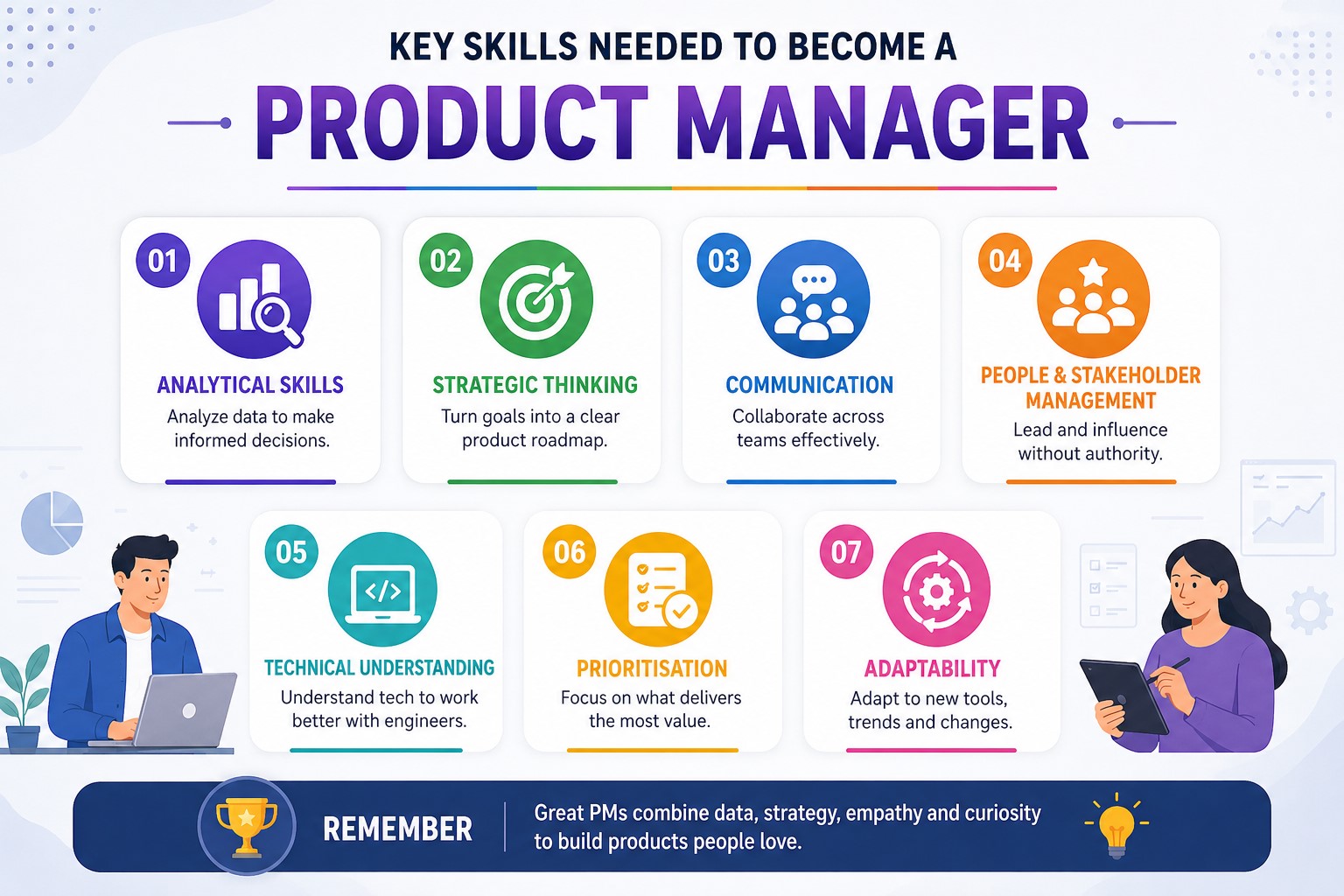
1. Strong analytical skills to interpret market research and user data
2. Strategic thinking to translate business goals into a clear product roadmap
3. Cross-functional communication skills to work with engineering, design and marketing teams

5. Basic technical understanding to communicate effectively with engineering teams
6. Prioritisation skills to decide which features or improvements matter most
7. Adaptability, given how quickly product tools and technologies such as AI are evolving
Eligibility Criteria to Become a Product Manager
| Stage | Eligibility Requirement |
| Undergraduate degree | A bachelor’s degree in engineering, computer science, marketing, management, or business administration is the minimum requirement for most Product Manager roles |
| Postgraduate degree (optional) | An MBA, particularly with a focus on product management, provides advanced expertise and is commonly sought for senior-level positions |
| Certifications (optional) | Specialised certifications such as the Certified Scrum Product Owner or Pragmatic Institute’s product management courses can strengthen a candidate’s profile |
| Executive/mid-career route | Some executive MBA programmes in product leadership require a minimum of 3 years of work experience alongside a bachelor’s degree in any discipline |
Also Read – how to become a Chartered Accountant
How to Become a Product Manager: Step-by-Step

1. Complete a bachelor’s degree in engineering, computer science, business administration, marketing, or a related field.
2. Build a foundational understanding of market research, product roadmapping and product strategy alongside the degree.
3. Gain early experience through internships or entry-level roles such as Product Analyst or Junior Analyst.
4. Consider a specialised certification, such as Certified Scrum Product Owner or a Pragmatic Institute product management course, to strengthen practical skills.
5. Build a portfolio that documents specific projects, showing how you identified user needs and contributed to product decisions.
6. Apply for entry-level Product Manager or Associate Product Manager roles, using the portfolio to demonstrate applied skills.
7. Pursue an MBA, ideally with a product management focus, if aiming for senior or leadership-track roles.
8. Continue building expertise and experience to progress into Senior Product Manager, Director, or Chief Product Officer roles.
Also Read – how to become a Mechanical Engineer
Courses and Institutes for Product Management
| Institute | Course | Eligibility Criteria |
| Institute of Product Leadership, Bangalore | Executive MBA in Product Management and Leadership | Minimum 3 years of work experience with a bachelor’s degree in any discipline; admission via an assessment, group discussion and interview |
| Various providers | Certified Scrum Product Owner | Open to graduates and working professionals seeking a recognised, targeted product management certification |
| Pragmatic Institute | Product Management courses | Open to a broad range of professionals from diverse educational backgrounds seeking practical product management skills |
| General route via bachelor’s degree | B.Tech/BE, BBA, or B.Com/B.Sc with a business or technology focus | Class 12 completion in the relevant stream, followed by admission to the respective undergraduate programme, as per each institute’s own entrance criteria |
Also Read – how to become a Psychologists
Career Paths After Becoming a Product Manager
| Career Path | What You Do |
| Product Analyst/Junior Analyst | Supports product decisions through market research and data analysis, typically as an entry point into the field |
| Associate Product Manager | Assists a Product Manager with smaller product features or components under supervision |
| Product Manager | Owns the strategy, roadmap and execution for a specific product or product line |
| Senior Product Manager | Leads larger or more complex products and mentors junior product team members |
| Director of Product Management | Oversees multiple product lines and sets overall product strategy across teams |
| Chief Product Officer | Sets the organisation-wide product vision and represents product strategy at the leadership level |
Product Manager Salary in India
| Level | Experience | Salary Range (LPA) |
| Associate PM (APM) | 0–2 yrs | ₹8–22 LPA |
| Product Manager (PM) | 2–5 yrs | ₹20–42 LPA |
| Senior PM | 5–8 yrs | ₹35–70 LPA |
| Group/Principal PM | 8+ yrs | ₹65 LPA–1.2 Cr |
| Director/VP of Product | Leadership | ₹60 LPA–3 Cr+ (incl. equity) |
Why Choose Product Management as a Career?
Product Management sits at the intersection of technology, business and user experience, which keeps the role in demand across India’s IT, finance and manufacturing sectors. The career also rewards continuous learning: professionals who stay current with tools such as generative AI are better positioned to support innovation and decision-making. It offers a clear progression path too, running from analyst-level roles through to senior leadership positions such as Chief Product Officer.
Frequently Asked Questions
Is an engineering background compulsory to become a Product Manager?
No, an engineering background isn’t compulsory. A non-technical candidate can still be eligible for Product Manager roles, and many professionals enter the field from design or marketing backgrounds. A basic technical understanding helps, but it isn’t a strict requirement.
Is an MBA necessary to become a Product Manager?
An MBA isn’t necessary for entry-level roles but is commonly sought for senior positions such as Director of Product Management or Chief Product Officer. A bachelor’s degree in engineering, business, or a related field, combined with experience and certifications, is often sufficient to begin.
What is the difference between a Product Manager and a Project Manager?
A Product Manager defines what should be built and why, focusing on strategy, user needs and market fit. A Project Manager focuses on how and when a project is delivered, managing timelines and resources. The two roles often work closely but serve distinct functions.
Which certifications are most useful for someone starting out in product management?
Certifications such as the Certified Scrum Product Owner and Pragmatic Institute’s product management courses are commonly used to build practical, recognised skills. These are most valuable when paired with a relevant degree and hands-on project or internship experience.
Do Product Managers need experience before applying for their first role?
Many Product Managers begin in adjacent roles such as Product Analyst or Junior Analyst before progressing, since these positions build the market research and cross-functional experience employers look for. A strong portfolio of relevant projects can also support a direct application.