
Who Is a Cinematographer?

Cinematographer Eligibility Criteria
Cinematographer eligibility in India depends on which route a candidate follows: an undergraduate degree or diploma straight after Class 12, or a postgraduate diploma or MFA after completing a first degree in any discipline.
Route 1: After Class 12 (Undergraduate Entry)
1. Minimum qualification: Pass in Class 12 (10+2) in any stream from a recognised board.
2. Course: Enrol in a B.Sc or BFA in Cinema with a Cinematography specialisation, or a diploma in cinematography, generally a one- to three-year programme.
3. Admission: Most institutes admit students through their own entrance test and a personal interview; there is no single national-level exam for this route.
Route 2: After Graduation (Postgraduate Entry)
1. Minimum qualification: A bachelor’s degree in any discipline from a recognised university.

3. Admission: FTII and SRFTI select candidates through the Joint Entrance Test (JET), followed by orientation and an interview. Whistling Woods International instead uses its own Media and Entertainment Common Aptitude Test (MECAT) along with a Creative Ability Test (CAT).
Cinematographer Course Options in India
| Course | Level | Academic Eligibility |
| Certificate/Diploma in Cinematography | Certificate/Diploma | 10+2 in any stream; duration ranges from a few months to one year |
| B.Sc/BFA in Cinema (Cinematography specialisation) | Undergraduate | 10+2 in any stream; generally a three-year programme |
| MFA in Cinema with Cinematography specialisation (FTII) | Postgraduate | Bachelor’s degree in any discipline; three years (six semesters) |
| MFA in Cinema with Cinematography specialisation (SRFTI) | Postgraduate | Bachelor’s degree in any discipline; one-year bridge programme plus a two-year MFA |
| MFA in Filmmaking with Cinematography specialisation (Whistling Woods International) | Postgraduate | Graduation from any recognised university; two years |
| M.Sc in Cinema (Cinematography specialisation), AAFT | Postgraduate | Bachelor’s degree in any discipline; two years |
Note: Course structures and nomenclature (PG Diploma versus MFA) have changed at some institutes in recent years, so it’s worth checking the current prospectus on the institute’s own website before applying.
Also Read – how to become a Actor
How to Become a Cinematographer: Step-by-Step Process
1. Complete Class 12 in any stream from a recognised board. A background in the arts, media, or photography can help but isn’t compulsory.

3. Apply to a recognised film institute for a postgraduate diploma or MFA in Cinematography, sitting the relevant entrance test, such as the FTII/SRFTI Joint Entrance Test or an institute-specific test.
4. Build practical skills through student film projects, short films, and assistantships, since hands-on camera and lighting experience matters as much as formal qualifications in this field.
5. Begin working as a camera assistant or associate cinematographer to gain on-set experience before taking on independent cinematography assignments.
6. Build a portfolio or showreel of completed work, and pursue further certifications or specialisations, such as drone cinematography or colour grading, to stay competitive.
Also Read – how to become an Interior Designer
Cinematographer Salary in India
Cinematography doesn’t have a fixed, standardised pay scale in India. Cinematographers commonly work long, irregular hours on project-based assignments, so pay depends heavily on the individual production’s budget, the cinematographer’s experience and reputation, and whether the work is salaried or freelance.
| Career Stage | General Pattern |
| Entry-level (camera assistant/associate) | Lower, often variable pay while building experience and a portfolio |
| Experienced/established cinematographer | Pay rises significantly with reputation, project scale, and whether work is on a retainer or per-project basis |
Because so much cinematography work in India is freelance and project-based, published salary figures vary widely across sources. A candidate’s actual earnings depend far more on their body of work and industry connections than on any fixed scale.
Also Read – how to become a Film Director
Skills Required to Become a Cinematographer
Cinematography combines a strong visual and artistic sense with technical mastery of cameras, lenses and lighting. Critical thinking, decision-making, problem-solving and attention to detail are core soft skills for the role, alongside its physical demands. Other useful qualities include:
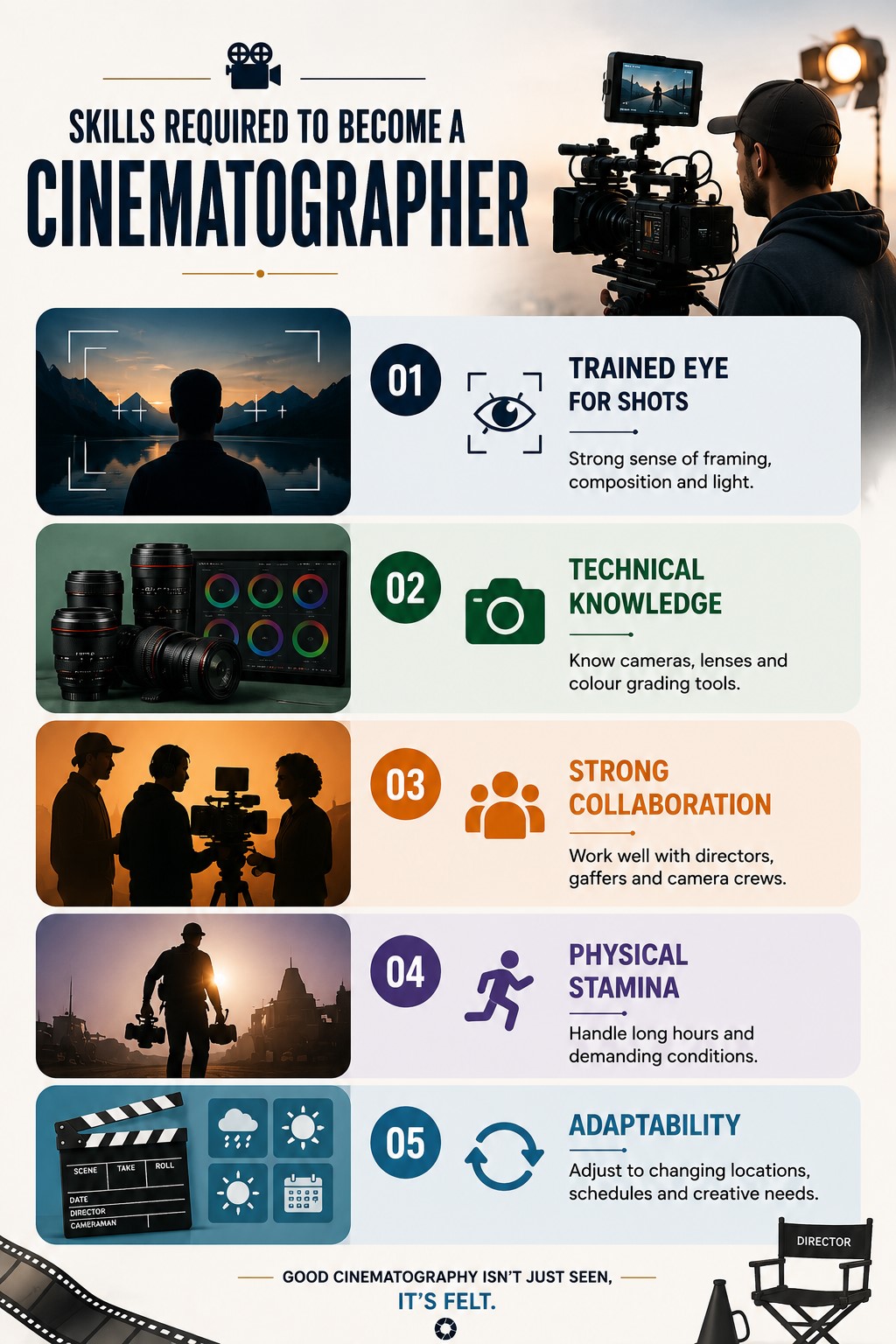
1. A trained eye for framing, composition and light
2. Familiarity with different camera systems, lenses and digital colour grading tools
3. Strong collaboration skills, since cinematographers work closely with directors, gaffers and camera crews
4. Physical stamina, given long, irregular hours often spent outdoors or on location
5. Adaptability to changing shoot conditions, schedules and creative briefs
Career Options After Becoming a Cinematographer
| Job Profile | What They Do |
| Director of Photography (DOP) | Leads the camera and lighting departments on a film or TV production |
| Camera Operator | Physically operates the camera under the cinematographer’s direction |
| Assistant Cameraperson | Supports the camera department with equipment, focus pulling and setup |
| Commercial/Ad Film Cinematographer | Shoots advertisements, corporate films and branded content |
| Documentary Cinematographer | Specialises in non-fiction and observational filmmaking |
| Cinematography Educator | Teaches camera and lighting technique at a film institute |
Top Colleges and Courses for Cinematography
| College | Course |
| Film and Television Institute of India (FTII), Pune | MFA in Cinema with specialisation in Cinematography |
| Satyajit Ray Film and Television Institute (SRFTI), Kolkata | MFA in Cinema with specialisation in Cinematography |
| Whistling Woods International, Mumbai | MFA in Filmmaking with specialisation in Cinematography |
| Asian Academy of Film & Television (AAFT), Noida | M.Sc in Cinema with specialisation in Cinematography |
| L V Prasad Film & TV Academy, Chennai | PG Diploma in Cinematography |
A quick note on accuracy: fees, seat intake and admission tests can change year to year, so it’s worth confirming current details against each institute’s own admissions page before applying.
How to Become a Cinematographer in India – FAQs
Is a specific degree compulsory to become a cinematographer in India?
No. There is no single mandatory degree. Many cinematographers hold a diploma, B.Sc, or MFA from a film institute, but the profession isn’t formally licensed, so some enter through hands-on experience as camera assistants, though formal training is the more common route.
Can a graduate from any discipline apply for a postgraduate cinematography course?
Yes. Institutes such as FTII, SRFTI, Whistling Woods International and AAFT accept graduates from any discipline for their postgraduate cinematography programmes, provided the candidate holds a recognised bachelor’s degree and clears the relevant entrance test and interview round.
What is the difference between a cinematographer and a camera operator?
A cinematographer, or Director of Photography, makes the creative and technical decisions about lighting, framing and camera movement for a production. A camera operator physically operates the camera, carrying out the cinematographer’s instructions rather than setting the overall visual approach.
Which entrance exam is required for FTII and SRFTI cinematography courses?
Both institutes admit students to their postgraduate cinematography programmes through the Joint Entrance Test (JET), followed by orientation and an interview round. Whistling Woods International instead uses its own MECAT and Creative Ability Test for admission to its equivalent programme.
Is cinematography a stable, salaried career in India?
Not always. A significant share of cinematography work in India is project-based and freelance, particularly early in a career, so income can vary considerably between assignments. Building a strong portfolio and industry network matters as much as formal qualifications for steady work.