
What Does a Wedding Planner Actually Do?

1. Budget planning and tracking across dozens of vendor categories simultaneously
2. Vendor sourcing and negotiation – caterers, decorators, photographers, venues, entertainment
3. Floor planning, lighting design, and overall event layout
4. Managing multi-day, multi-ceremony logistics, which are the norm rather than the exception in Indian weddings
5. Client consultation, expectation management, and crisis handling on the day itself

Skills That Matter More Than a Certificate to Become a Wedding Planner
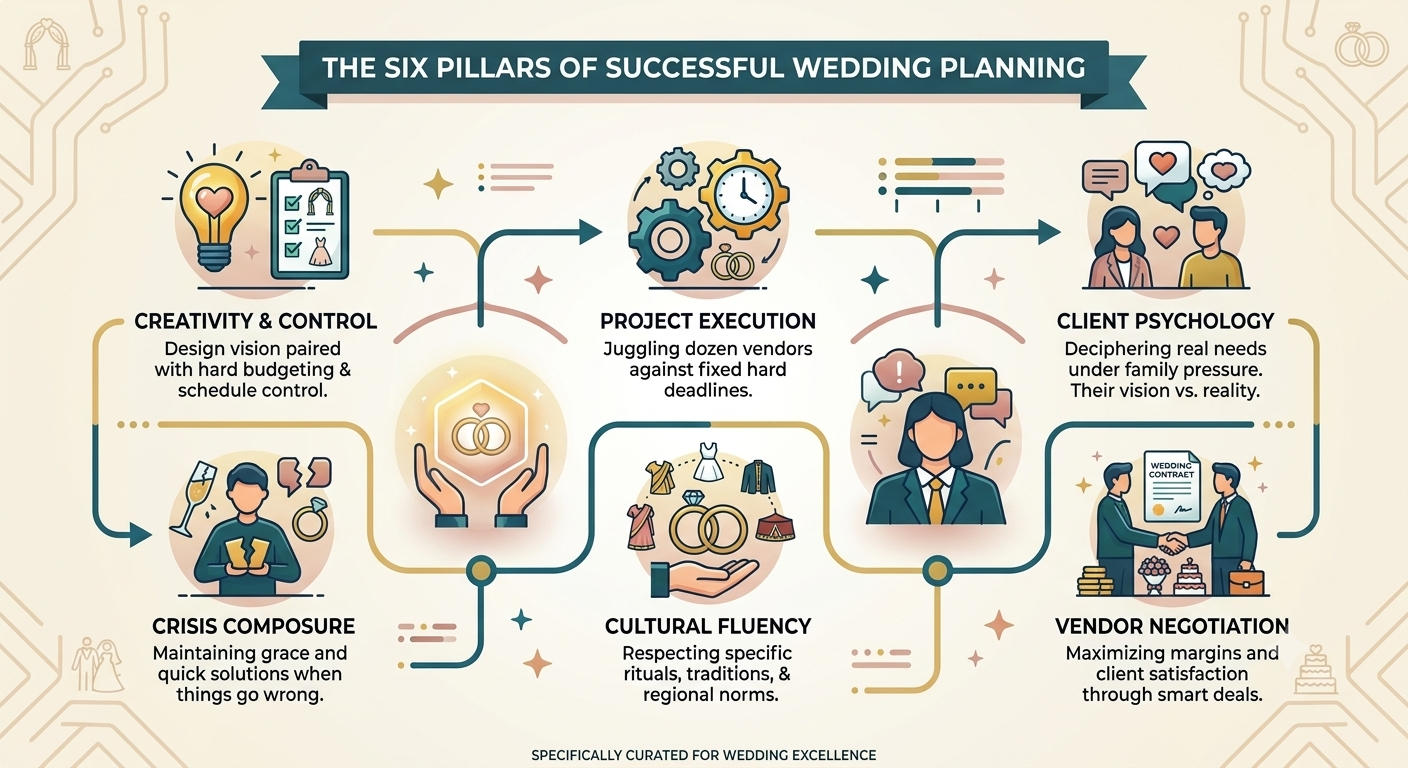
Becoming a successful wedding planner, it requires a balance of artistic vision, operational discipline, and psychological insight.
1. Maintain genuine creativity paired with discipline: The fun, design-forward side of the job is real, but it sits on top of budgeting and scheduling work that is far less glamorous.
2. Master time and project management: You must be skilled at juggling a dozen vendors against a hard, unmovable date.
3. Develop strong communication and client psychology: Success relies on understanding what a couple actually wants versus what they are saying, especially under family pressure.

5. Build deep cultural fluency: You need to know the specific rituals, sensitivities, and expectations across different communities and regions.
6. Execute strategic vendor negotiation: Your profit margins and your client’s satisfaction both depend on this skill more than almost anything else.
Related Read – How to Become a Makeup Artist
Do You Need a Formal Degree to Become a Wedding Planner?
Honestly, NO, and this is one of the few creative-adjacent careers in India where that’s stated plainly across nearly every credible source. A degree isn’t compulsory. That said, a certificate or diploma genuinely helps, both for building foundational skills quickly and for signalling credibility to early clients who have no other way to assess you.
Popular course types include:
| Course Type | Focus |
| Wedding Event Management Course | Wedding-specific training – design, logistics, vendor management |
| General Event Management Course | Broader training covering corporate events and parties alongside weddings |
| Event Decoration Course | Specialised, design-focused training for those leaning toward décor specifically |
A degree in an unrelated but transferable field – business administration, communications, or public relations – can also work as a strong foundation, especially when paired with a short wedding-specific certification and real on-the-job training. These fields build the negotiation, budgeting, and client-management skills the role actually depends on.
Real Institutes Worth Knowing to Become a Wedding Planner
Two names come up repeatedly with genuinely wedding-specific curricula, rather than generic event management repackaged:
1. The Wedding School (TWS), founded by industry veteran Mareesha Parikh, offers live online and hybrid courses covering hospitality, logistics, décor aesthetics, and client servicing specifically for weddings.
2. IEM’s Certificate Program in Wedding Planning (CPWP) runs a six-month structure – three months of core theory (floor planning, lighting, vendor negotiation, client psychology) followed by three months of live, on-ground internship during actual peak wedding season, across multiple centres.
Course fees for wedding-planning-specific certifications typically stay under ₹2 lakh, and most programmes run for under a year – genuinely fast compared to most professional qualifications, which is part of why the field attracts so many career-switchers.
Related Reads – How to Become an Interior Designer
How to Build Real Experience to Become a Wedding Planner
Certificates open doors; portfolios walk through them. The realistic sequence most working planners describe looks like this:
1. Intern with an established wedding planner – this is where you learn how events are actually executed, not just how they’re designed on paper.
2. Work at an event management company, even a general one, to understand vendor logistics and coordination at scale.
3. Freelance on small projects first – birthdays, anniversaries, engagements – before attempting a full wedding solo.
4. Offer free or heavily discounted services initially, for a friend or family member’s event specifically, to build a portfolio and generate word-of-mouth referrals.
5. Attend wedding expos and industry meetups consistently – this is where vendor relationships and future referrals actually form, not from a website alone.
Most sources converge on a realistic timeline here: with focused training and internship experience, 1–2 years is a reasonable runway before you’re ready to independently lead a full wedding.
Building Your Vendor Network to Become a Wedding Planner
A wedding planner without a strong vendor network isn’t really a wedding planner yet – vendors are the actual supply chain behind everything you promise a client. This network takes deliberate, ongoing effort:
1. Build direct relationships with caterers, decorators, photographers, and venues rather than working only through intermediaries
2. Negotiate rates and reliability upfront, before you’re under deadline pressure with a client watching
3. Maintain a tiered vendor list across different budget levels, since not every client can afford your top-tier recommendations
4. Treat every wedding as a networking event – the planners, vendors, and venue managers you meet on one project often become referral sources for the next
Career Progression and Earning Potential
| Stage | Typical Role |
| 0–1 years | Intern / Assistant Coordinator |
| 1–3 years | Junior Planner (small events, assisting on larger ones) |
| 3–6 years | Independent Planner (leading full weddings solo) |
| 6+ years | Agency Owner / Senior Planner (team-based, high-budget events) |
Earnings of a wedding planner vary enormously by scale and client tier. Freelance planners commonly earn ₹50,000 to ₹2 lakh per wedding, depending on event size and service scope, with professionals seeing roughly 5–12% income growth over time as experience and client networks expand. Planners handling luxury or destination weddings, where average budgets run significantly higher, can earn substantially more per event than this baseline suggests – though this tier takes years of reputation-building to reach.
Destination Weddings: The Fastest-Growing Specialisation
If you’re choosing a niche within wedding planning, this is the one with the clearest growth trajectory right now. Destination weddings now make up roughly 25% of Indian weddings, with an average budget of ₹58 lakh – notably higher than home weddings – and the segment is expanding at roughly 22% annually. Popular destinations include Udaipur, Jaipur, Goa, Jaisalmer, Dehradun, and Rishikesh. Notably, around 89–90% of India’s destination weddings are actually hosted within India rather than abroad, which matters for planners deciding where to build local vendor relationships.
The Honest Market Reality: Boom, But Not Immune to Slowdown
This is the nuance most career guides skip entirely. India’s wedding industry genuinely is enormous – commonly cited at $130 billion (₹10.79 lakh crore), making it India’s fourth-largest industry and the country’s second-largest retail sector after food and groceries, injecting an estimated ₹6–6.5 lakh crore into the economy during the roughly 45-day peak wedding season alone.
But 2026 has brought a real, reported slowdown. Broader economic pressure – growth at a six-year low, rising costs – has visibly pushed many Indian families to trim wedding budgets, even at the cost of social expectations. One widely cited independent estimate, from research firm KPMG, puts the industry closer to $40–50 billion once the more generously projected figures are set aside. Both things are true simultaneously: this remains a very large, structurally durable industry, and it is not immune to the same economic pressures affecting every other consumer spending category in India right now.
The practical implication for anyone entering the field: the mid-market, budget-conscious wedding segment is where real belt-tightening is happening, while ultra-high-budget and destination weddings appear comparatively insulated. Positioning yourself with some flexibility across both ends of that spectrum is a more resilient strategy than assuming the “recession-proof” framing applies uniformly.
Common Mistakes New Wedding Planners Make
1. Underpricing early to win clients. It’s tempting to undercut established planners when you’re starting out, but pricing too low makes it genuinely difficult to raise rates later, and it signals inexperience to the exact high-value clients you eventually want to attract.
2. Skipping written contracts, even for small events. Verbal agreements with vendors and clients are a common early mistake – a clear, written scope of work protects you when a client’s expectations shift midway, which they often do.
3. Overpromising on vendor availability. New planners sometimes commit a client to a specific vendor or date before actually confirming availability, which can unravel an entire event plan close to the wedding date.
4. Underestimating the emotional labour of the job. Family dynamics, last-minute changes, and high-stress clients are a bigger part of the job than most course marketing admits – planners who go in expecting only the creative, design-forward side burn out faster.
5. Not building a financial buffer for the off-season. Indian weddings cluster heavily around specific auspicious dates and seasons, so planners who don’t plan their finances around this seasonality often struggle during quieter months.
Tools of the Trade for a Wedding Planner
Beyond people skills and vendor relationships, most working planners rely on a practical toolkit to stay organised across multiple simultaneous events:
1. Budgeting spreadsheets or dedicated event-budgeting software to track spend across dozens of vendor line items in real time
2. Shared digital timelines and checklists (Google Sheets, Trello, or dedicated event-planning apps) that both the planner and client can access
3. A well-organised vendor contact database, ideally tiered by budget level and service quality
4. Mood board and design tools (Pinterest, Canva, or similar) for communicating décor concepts clearly to clients and decorators alike
None of these tools replaces experience or judgment, but they’re what separates a planner who can scale to handling multiple weddings per season from one who can only manage one event at a time.
The Bottom Line
Wedding planning in India rewards a fairly rare combination: genuine creative instinct, disciplined project management, and the patience to build a vendor network and portfolio the slow way, one small event at a time. The industry’s scale is real, but so is the current economic nuance within it. The planners who do well over the next few years are likely to be the ones who understand where client budgets are actually tightening – not just the ones repeating the “$130 billion, recession-proof” line from a course brochure.
Frequently Asked Questions
Can I become a wedding planner without any formal certification at all?
Yes, technically – there’s no legal or licensing requirement. But without a certification or a strong portfolio, building initial client trust is considerably harder, which is why most successful planners have at least one of the two.
How much does wedding planning training actually cost in India?
Wedding-specific certificate programmes typically cost under ₹2 lakh, with many falling well below that, and most run for a few months to under a year – considerably shorter and cheaper than most professional qualifications.
Is destination wedding planning a realistic specialisation for someone just starting out?
It’s a strong long-term direction given its 22% annual growth, but it’s not usually where beginners start, since destination weddings involve more complex logistics, travel coordination, and higher client expectations. Building experience with local weddings first, then transitioning into destination work, is the more common path.
Is the Indian wedding industry really “recession-proof,” as most marketing claims say?
Not entirely, based on current 2026 reporting. While the industry remains structurally large, real belt-tightening is visibly happening at the mid-market level amid a broader economic slowdown. The ultra-luxury and destination segments appear more insulated than the budget-conscious middle, which is where the “recession-proof” claim breaks down.
What’s a realistic first-year income for a new wedding planner in India?
Highly variable, since most beginners start with a mix of internship stipends, small freelance events (birthdays, engagements), and possibly one or two smaller weddings. Meaningful, sustained income usually builds over the first 1–3 years rather than arriving immediately.
Do I need to specialise in décor, or can I be a general wedding planner?
Both paths work. Many planners start as generalists handling full-event coordination, then develop a specific specialisation – décor, destination weddings, or luxury events – once they’ve built enough experience to understand where their strongest interest and market demand overlap.